Loading...
Done
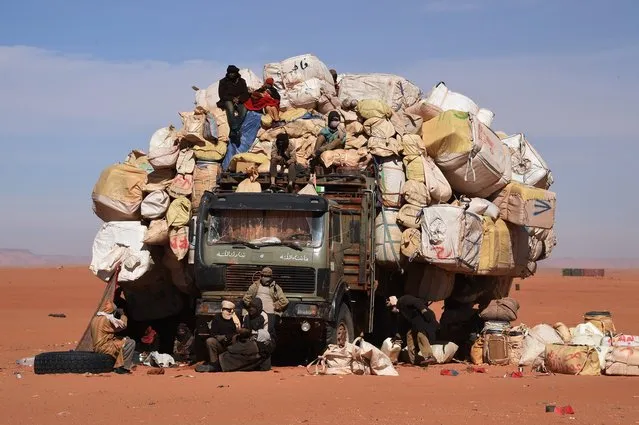
People sit near a fully loaded in Madama near the border with Lybia on January 1, 2015. French Defence Minister Jean-Yves Le Drian paid a surprise visit to northern Niger on January 1, to visit a base being built to combat the growing flow of weapons and jihadists from neighbouring Libya. Le Drian travelled from Chad to Madama, a desert outpost about 100 kilometres from Libya, where he saw in the New Year with troops at a French base. (Photo by Dominique Faget/AFP Photo)

People sit near a fully loaded in Madama near the border with Lybia on January 1, 2015. French Defence Minister Jean-Yves Le Drian paid a surprise visit to northern Niger on January 1, to visit a base being built to combat the growing flow of weapons and jihadists from neighbouring Libya. Le Drian travelled from Chad to Madama, a desert outpost about 100 kilometres from Libya, where he saw in the New Year with troops at a French base. Madama is situated on the route used by jihadists and arms smugglers in southern Libya to reach northern Mali and Niger. (Photo by Dominique Faget/AFP Photo)
Details
03 Jan 2015 13:27:00
Corona del Mar High School students Kim Robertson, Pat Auvenshine and Pam Pepin wear “hippie” fashions, 1969. (Photo by Arthur Schatz/Time & Life Pictures/Getty Images)

“By 1969, the fashion choices of tens of millions of young American men and women were as variegated and ever-evolving as the world around them. Cultural transformation was an irresistible force during the Sixties, and across America and around the globe civil rights, women’s and gay liberation, the sexual revolution and, of course, the explosive soundtrack of R&B, soul and rock and roll informed everything from politics to fashion”. – LIFE. Photo: Corona del Mar High School students Kim Robertson, Pat Auvenshine and Pam Pepin wear “hippie” fashions, 1969. (Photo by Arthur Schatz/Time & Life Pictures)
Details
11 Aug 2013 12:43:00
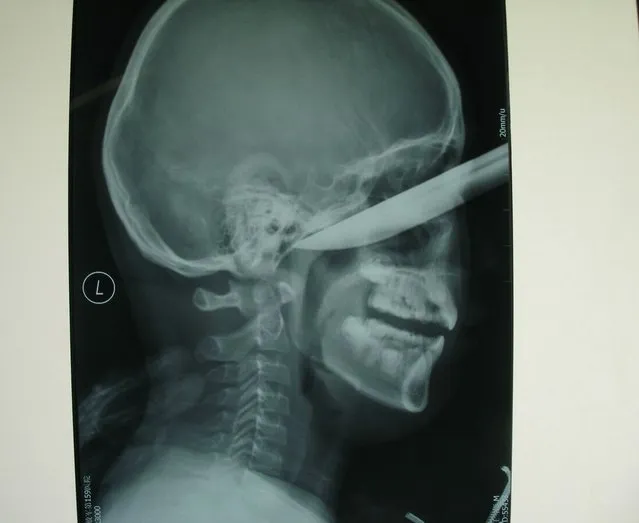
Keep your eyes peeled: A Chinese teenager slipped and stabbed himself in the face with a 7cm knife while peeling an apple. Ren Hanzhi's father recalled: “He was walking to the sofa while peeling the apple. Suddenly he slipped down and his face hit onto the sharp knife. I dared not pull out the knife as my son was screaming”. (Photo by Rex Features)

Keep your eyes peeled: A Chinese teenager slipped and stabbed himself in the face with a 7cm knife while peeling an apple. Ren Hanzhi's father recalled: “He was walking to the sofa while peeling the apple. Suddenly he slipped down and his face hit onto the sharp knife. I dared not pull out the knife as my son was screaming”. The nearest hospital referred the 13-year-old to a larger unit. Chief surgeon Peng Liwei, who operated to remove the knife, commented: “It's shocking. The knife, which is more than 20cm long, penetrated 7cm into his face. The surgery was successful and the patient could recover fully in around a month”. (Photo by Rex Features)
Details
27 Jun 2014 10:43:00
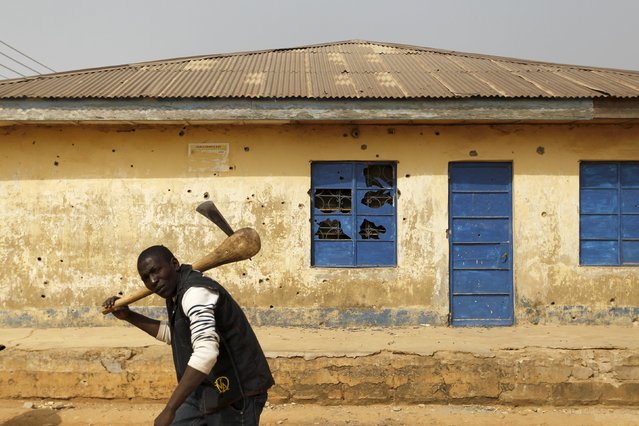
A man carrying an axe walks past a house marked with bullet holes in Gyallesu district after recent clashes between Shi'ites and the army in Zaria, Kaduna state, Nigeria, February 3, 2016. (Photo by Afolabi Sotunde/Reuters)

A man carrying an axe walks past a house marked with bullet holes in Gyallesu district after recent clashes between Shi'ites and the army in Zaria, Kaduna state, Nigeria, February 3, 2016. Sectarian tensions are rising in Nigeria's Muslim north, where hundreds of Shi'ites were killed in clashes with the army in the town of Zaria in December, according to Shi'ites and rights groups. Following the clashes, bulldozers sent by the state levelled Shi'ite shrines, a cemetery and offices in the deeply divided town. The region is already grappling with an insurgency waged by the jihadist Boko Haram group. (Photo by Afolabi Sotunde/Reuters)
Details
12 Feb 2016 12:52:00
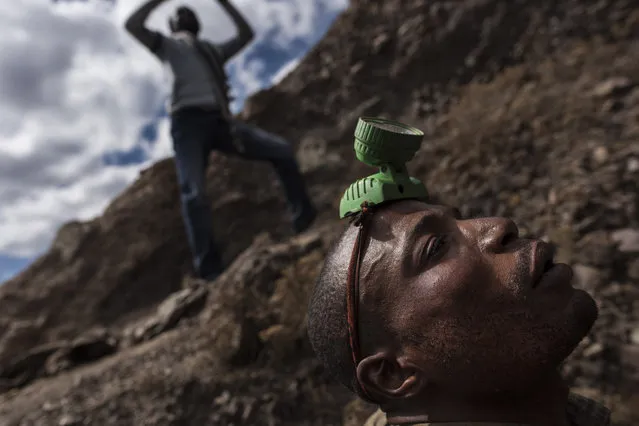
A “creuseur”, or digger, a plastic lantern on his head, readies to enter a copper and cobalt mine in Kawama, Democratic Republic of Congo on June 8, 2016. Cobalt is used in the batteries for electric cars and mobile phones. Working conditions are dangerous, often with no safety equipment or structural support for the tunnels. The diggers say they are paid on average US$2-3/day. (Photo by Michael Robinson Chavez/The Washington Post)

A “creuseur”, or digger, a plastic lantern on his head, readies to enter a copper and cobalt mine in Kawama, Democratic Republic of Congo on June 8, 2016. Cobalt is used in the batteries for electric cars and mobile phones. Working conditions are dangerous, often with no safety equipment or structural support for the tunnels. The diggers say they are paid on average US$2-3/day. (Photo by Michael Robinson Chavez/The Washington Post)
Details
30 Dec 2016 10:29:00
A protestor confronts police and National Guard troops near the Wauwatosa City Hal on October 09, 2020 in Wauwatosa, Wisconsin. The city has faced three days of demonstrations, prompting a 7 PM curfew, after District Attorney John Chisholm refused to press charges against Wauwatosa Police Officer Joseph Mensah for the Feb. 2 fatal shooting of 17-year-old Alvin Cole.  (Photo by Scott Olson/Getty Images)

A protestor confronts police and National Guard troops near the Wauwatosa City Hal on October 09, 2020 in Wauwatosa, Wisconsin. The city has faced three days of demonstrations, prompting a 7 PM curfew, after District Attorney John Chisholm refused to press charges against Wauwatosa Police Officer Joseph Mensah for the Feb. 2 fatal shooting of 17-year-old Alvin Cole. (Photo by Scott Olson/Getty Images)
Details
19 Oct 2020 00:05:00
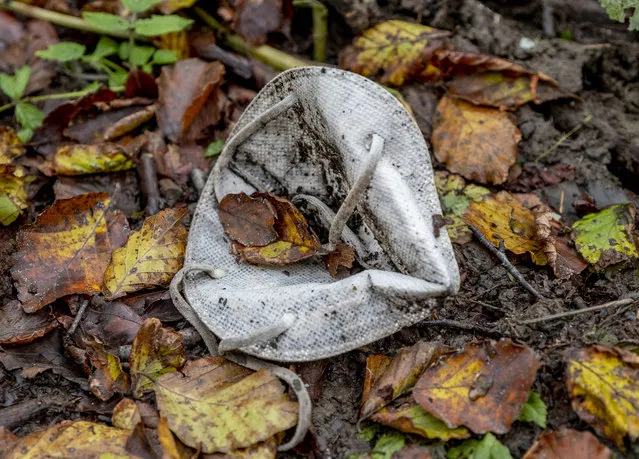
A face mask discarded in a forest in the Taunus region near Frankfurt, Germany, Sunday, October 18, 2020. (Photo by Michael Probst/AP Photo)

A face mask discarded in a forest in the Taunus region near Frankfurt, Germany, Sunday, October 18, 2020. (Photo by Michael Probst/AP Photo)
Details
20 Oct 2020 00:07:00
A couple wearing masks as a precaution against the spread of the new coronavirus walk on the Malecon seawall at sunset in Havana, Cuba, Monday, August 31, 2020. Cuban authorities will introduce new measures starting tomorrow Tuesday aimed at containing the spread of the coronavirus in Havana among others a curfew from 7 pm until 5 am and no one without special permission will be able to enter or leave the province. The new measures will last at least 15 days. (Photo by Ramon Espinosa/AP Photo)

A couple wearing masks as a precaution against the spread of the new coronavirus walk on the Malecon seawall at sunset in Havana, Cuba, Monday, August 31, 2020. Cuban authorities will introduce new measures starting tomorrow Tuesday aimed at containing the spread of the coronavirus in Havana among others a curfew from 7 pm until 5 am and no one without special permission will be able to enter or leave the province. The new measures will last at least 15 days. (Photo by Ramon Espinosa/AP Photo)
Details
22 Oct 2020 00:05:00