Loading...
Done
Clash of the storms, New Mexico, US by Camelia Czuchnicki. “A clash between two storm cells in New Mexico, US, each with its own rotating updraft. The curved striations of the oldest noticeable against the new bubbling convection of the newer. It was a fantastic sight to watch and it’s the rarity of such scenes that keep drawing me back to the US Plains each year”. (Photo by Camelia Czuchnicki/Weather Photographer of the Year 2016)

Clash of the storms, New Mexico, US by Camelia Czuchnicki. “A clash between two storm cells in New Mexico, US, each with its own rotating updraft. The curved striations of the oldest noticeable against the new bubbling convection of the newer. It was a fantastic sight to watch and it’s the rarity of such scenes that keep drawing me back to the US Plains each year”. (Photo by Camelia Czuchnicki/Weather Photographer of the Year 2016)
Details
16 Sep 2016 11:11:00
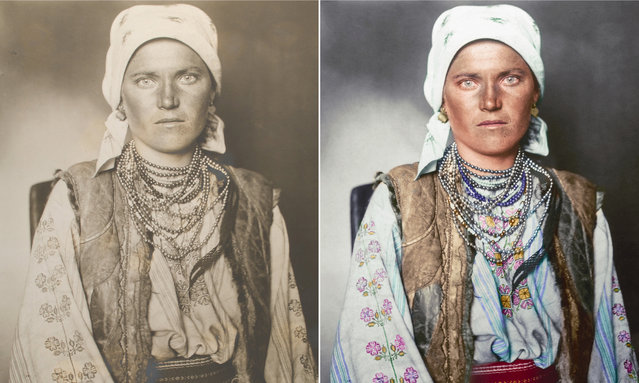
A Ruthenian woman circa 1906 from the region historically inhabiting the kingdom of the Rus, incorporating parts of modern-day Slavic speaking countries. Her outfit consists of a shirt and underskirt made from linen embroidered with traditional floral-based patterns. (Photo by Augustus Francis Sherman/New York Public Library/The Guardian)

Many of the 12 million people who entered the US through New York’s Ellis Island wore traditional dress from their homelands. Here: A Ruthenian woman circa 1906 from the region historically inhabiting the kingdom of the Rus, incorporating parts of modern-day Slavic speaking countries. Her outfit consists of a shirt and underskirt made from linen embroidered with traditional floral-based patterns. (Photo by Augustus Francis Sherman/New York Public Library/The Guardian)
Details
03 Oct 2016 09:15:00
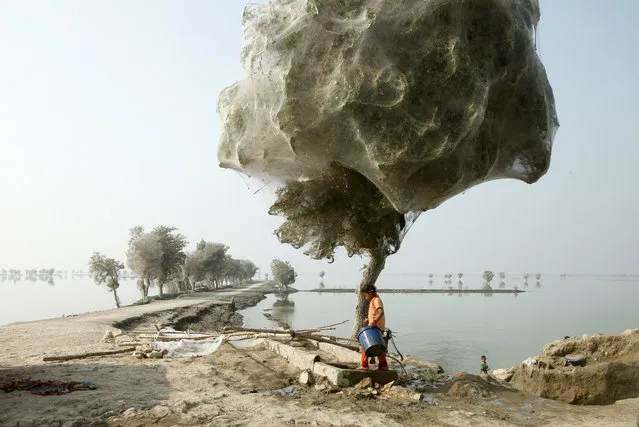
Spiderweb Cocooned Trees In Pakistan

An unexpected side-effect of the flooding in parts of Pakistan has been that millions of spiders climbed up into the trees to escape the rising flood waters. Because of the scale of the flooding and the fact that the water has taken so long to recede, many trees have become cocooned in spiders’ webs.
Details
15 May 2014 11:22:00
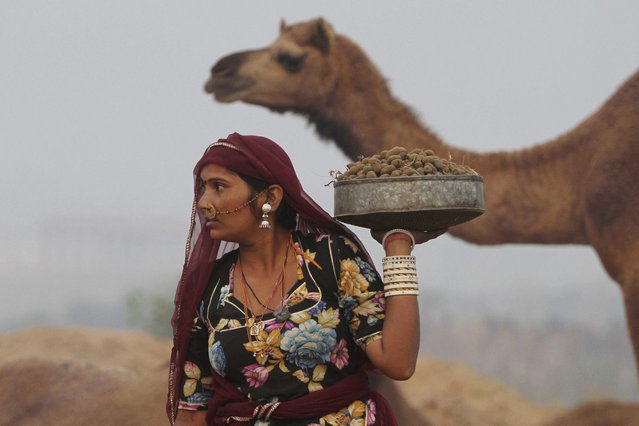
An Indian woman collects camel dung during the annual cattle fair in Pushkar, in the western Indian state of Rajasthan, Sunday, November 10, 2013. Pushkar, located on the banks of Pushkar Lake, is a popular Hindu pilgrimage spot that is also frequented by foreign tourists who come to the town for the annual cattle fair and camel races. (Photo by Ajit Solanki/AP Photo)

An Indian woman collects camel dung during the annual cattle fair in Pushkar, in the western Indian state of Rajasthan, Sunday, November 10, 2013. Pushkar, located on the banks of Pushkar Lake, is a popular Hindu pilgrimage spot that is also frequented by foreign tourists who come to the town for the annual cattle fair and camel races. (Photo by Ajit Solanki/AP Photo)
Details
11 Nov 2013 10:59:00
People take pictures of the sunset in Berlin October 27, 2014. (Photo by Hannibal Hanschke/Reuters)

People take pictures of the sunset in Berlin October 27, 2014. (Photo by Hannibal Hanschke/Reuters)
Details
04 Nov 2014 12:06:00
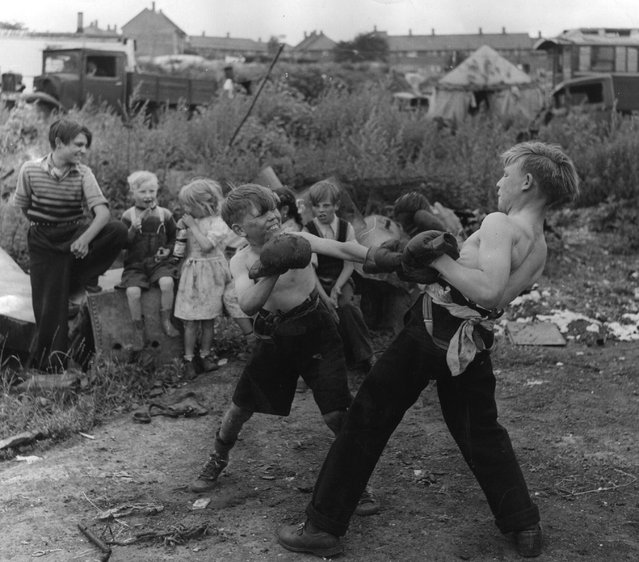
The unromantic gypsies. Children boxing in a gypsy camp in Kent, England on July 1, 1951. Like all boys these gypsy lads like to try their hand at boxing. Encouraged by their friends they fight it out on Corke's Meadow. Few Romanies now live a life of wandering romance. Most are like the three hundred squatters of Corke's Meadow, Kent, which is part of a “gypsy problem” that involves about 100,000 today. Of those about 25,000 can be rightly called gypsies, the rest are Mumpers and Posh-rats and Hobos. Corke's Meadow has both kinds. “Picture Post” cameraman Bert Hardy photographs the Corke's Meadow gypsies in their encampment. (Photo by Hulton-Deutsch Collection/Corbis via Getty Images)

The unromantic gypsies. Children boxing in a gypsy camp in Kent, England on July 1, 1951. Like all boys these gypsy lads like to try their hand at boxing. Encouraged by their friends they fight it out on Corke's Meadow. Few Romanies now live a life of wandering romance. Most are like the three hundred squatters of Corke's Meadow, Kent, which is part of a “gypsy problem” that involves about 100,000 today. Of those about 25,000 can be rightly called gypsies, the rest are Mumpers and Posh-rats and Hobos. Corke's Meadow has both kinds. “Picture Post” cameraman Bert Hardy photographs the Corke's Meadow gypsies in their encampment. (Photo by Hulton-Deutsch Collection/Corbis via Getty Images)
Details
12 Mar 2017 00:01:00
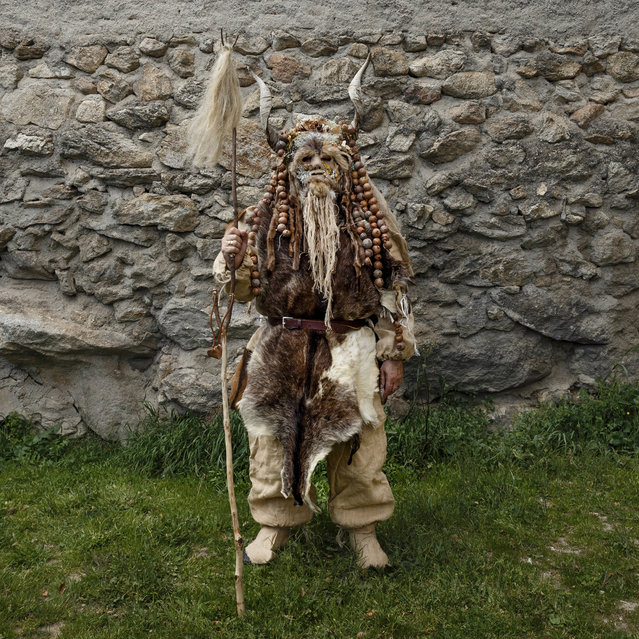
In this April 1, 2017 picture a man dressed as a “Harramacho” a traditional character from the Navalacruz carnival poses for a picture before a traditional Spanish mask gathering in the small village of Casavieja, Spain. (Photo by Daniel Ochoa de Olza/AP Photo)

In this April 1, 2017 picture a man dressed as a “Harramacho” a traditional character from the Navalacruz carnival poses for a picture before a traditional Spanish mask gathering in the small village of Casavieja, Spain. Every spring they come from towns across central and northwestern Spain, clad in elaborate costumes – some as trees, others as bears, still others as monsters who could have emerged from some sort of fever dream. (Photo by Daniel Ochoa de Olza/AP Photo)
Details
10 Apr 2017 08:50:00
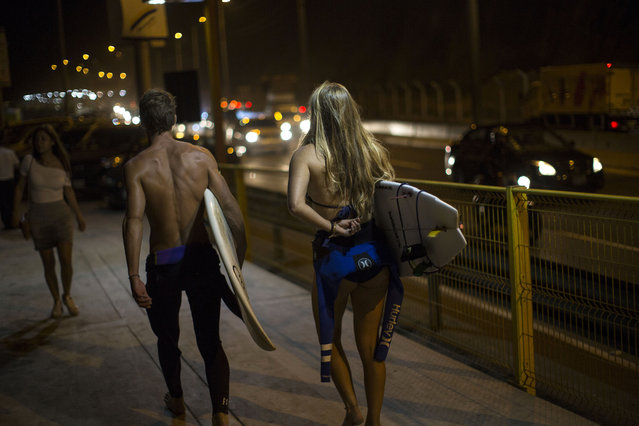
In this Feb. 17, 2017 photo, surfers walk to La Pampilla beach in Lima, Peru. Night surfing apparently came about in Lima because of a dispute with the capital municipality that in 2015 increased the width of a road that runs along the coast. The surfers protested the construction for months by camping on the asphalted beach area, but in the end the municipality prevailed, with support from the police. At the end of 2016, perhaps to win over the surfers, Lima's mayor set up beach lights that allows for night surfing. (Photo by Rodrigo Abd/AP Photo)

In this Feb. 17, 2017 photo, surfers walk to La Pampilla beach in Lima, Peru. Night surfing apparently came about in Lima because of a dispute with the capital municipality that in 2015 increased the width of a road that runs along the coast. The surfers protested the construction for months by camping on the asphalted beach area, but in the end the municipality prevailed, with support from the police. At the end of 2016, perhaps to win over the surfers, Lima's mayor set up beach lights that allows for night surfing. (Photo by Rodrigo Abd/AP Photo)
Details
04 May 2017 09:23:00