Loading...
Done
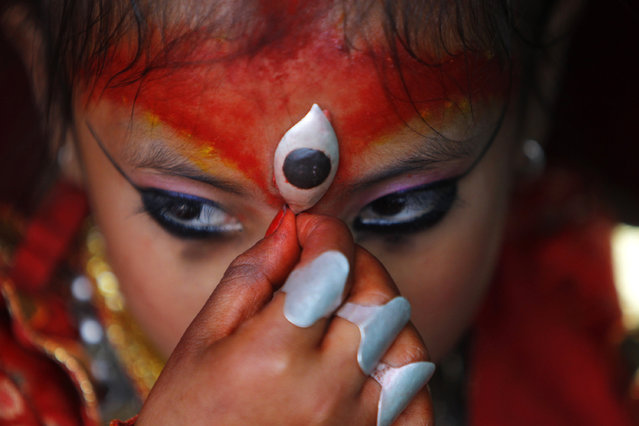
Nepal's Kumari, or living goddess, adjusts her ornament as she watches the Rato Machindranath chariot Festival in Lalitpur, Nepal, Friday, April 24, 2015. Nepal's living goddesses are young pre-pubescent girls considered by devotees to be incarnations of a Hindu goddess. Selected as toddlers, living goddesses usually keep their positions until they reach puberty. (Photo by Niranjan Shrestha/AP Photo)

Nepal's Kumari, or living goddess, adjusts her ornament as she watches the Rato Machindranath chariot Festival in Lalitpur, Nepal, Friday, April 24, 2015. Nepal's living goddesses are young pre-pubescent girls considered by devotees to be incarnations of a Hindu goddess. Selected as toddlers, living goddesses usually keep their positions until they reach puberty. (Photo by Niranjan Shrestha/AP Photo)
Details
25 Apr 2015 10:05:00
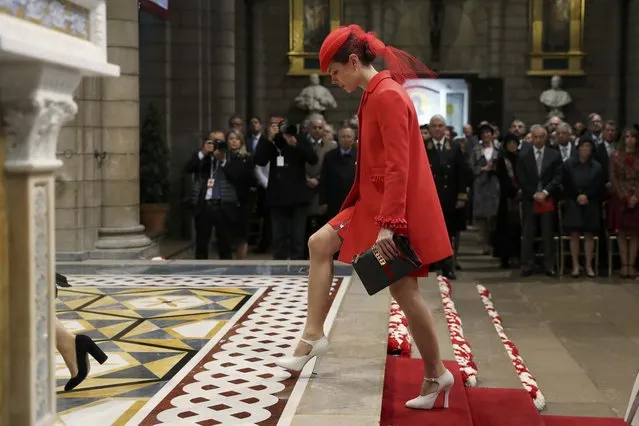
Monaco's Princess Charlotte Casiraghi arrives to attend a mass at the Saint Nicholas Cathedral during the celebrations marking Monaco's National Day, on November 19, 2016 in Monaco. (Photo by Valery Hache/Reuters)

Monaco's Princess Charlotte Casiraghi arrives to attend a mass at the Saint Nicholas Cathedral during the celebrations marking Monaco's National Day, on November 19, 2016 in Monaco. (Photo by Valery Hache/Reuters)
Details
20 Nov 2016 11:24:00
People eat sushi off the body of a model at an opening event of a bar in Taiyuan, Shanxi province, August 22, 2015. (Photo by Reuters/Stringer)

People eat sushi off the body of a model at an opening event of a bar in Taiyuan, Shanxi province, August 22, 2015. (Photo by Reuters/Stringer)
Details
25 Aug 2015 11:20:00
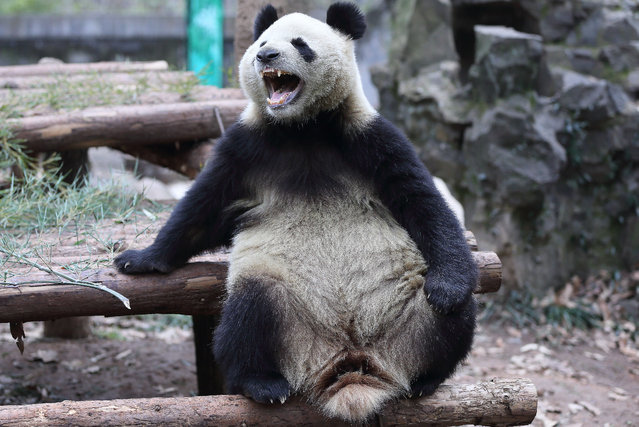
A panda bear sits on a logs in a zoo on January 15, 2015 in Hangzhou, China. (Photo by Feature China/Barcroft Media)

A panda bear sits on a logs in a zoo on January 15, 2015 in Hangzhou, China. (Photo by Feature China/Barcroft Media)
Details
17 Jan 2015 12:56:00
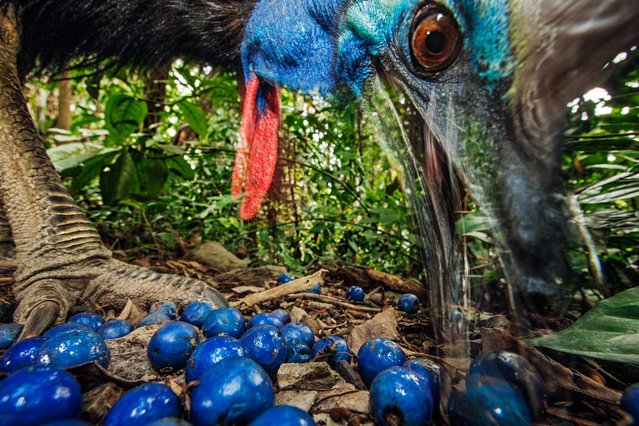
“Cassowaries are large, flightless birds related to emus and (more distantly) to ostriches, rheas, and kiwis”, writes Olivia Judson in the September issue of National Geographic magazine. (Photo by Christian Ziegler/National Geographic)

“Cassowaries are large, flightless birds related to emus and (more distantly) to ostriches, rheas, and kiwis”, writes Olivia Judson in the September issue of National Geographic magazine. How large? People-size: Adult males stand well over five foot five and top 110 pounds. Females are even taller, and can weigh more than 160 pounds. Dangerous when roused, they’re shy and peaceable when left alone. But even birds this big and tough are prey to habitat loss. The dense New Guinea and Australia rain forests where they live have dwindled. Today cassowaries might number 1,500 to 2,000. And because they help shape those same forests – by moving seeds from one place to another – “if they vanish”, Judson writes, “the structure of the forest would gradually change” too. (Photo by Christian Ziegler/National Geographic)
Details
06 Jan 2014 12:21:00
Israeli illusionist and endurance artist Hezi Dean performs a purported levitation trick in Tel Aviv March 22, 2015. Dean on Sunday began what he calls a “24-hour levitation” on the outside of a Tel Aviv building. (Photo by Baz Ratner/Reuters)

Israeli illusionist and endurance artist Hezi Dean performs a purported levitation trick in Tel Aviv March 22, 2015. Dean on Sunday began what he calls a “24-hour levitation” on the outside of a Tel Aviv building. (Photo by Baz Ratner/Reuters)
Details
23 Mar 2015 10:45:00
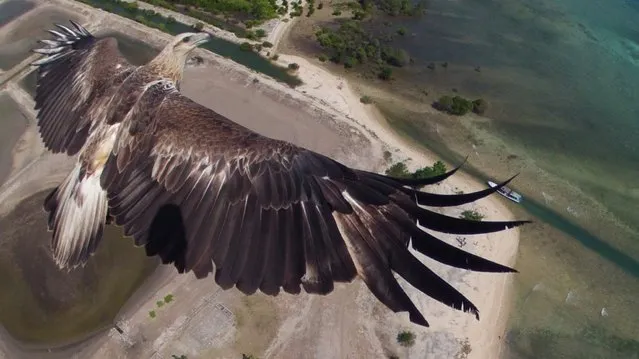
First prize. Taken over Bali Barat National Park, Denpasar, Bali. Made with a GoPro Hero 2 camera. (Photo by Capungaero)

First prize. Taken over Bali Barat National Park, Denpasar, Bali. Made with a GoPro Hero 2 camera. (Photo by Capungaero)
Details
18 Jul 2014 11:47:00
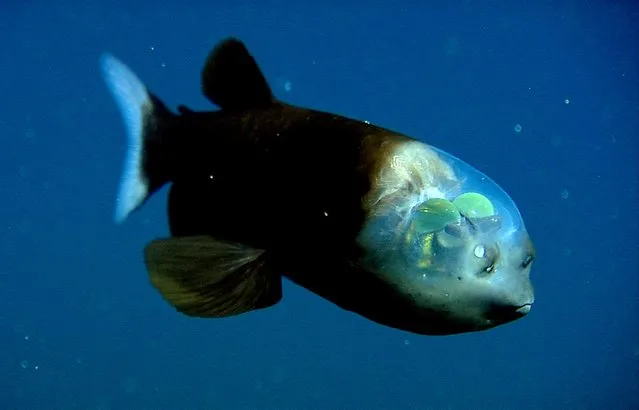
Macropinna Microstoma

Macropinna microstoma is the only species of fish in the genus Macropinna, belonging to Opisthoproctidae, the barreleye family. It is recognized for a highly unusual transparent, fluid-filled dome on its head, through which the lenses of its eyes can be seen. The eyes have a barrel shape and can be rotated to point either forward or straight up, looking through the fish's transparent dome. M. microstoma has a tiny mouth and most of its body is covered with large scales.
Details
08 Jan 2013 17:42:00