Loading...
Done
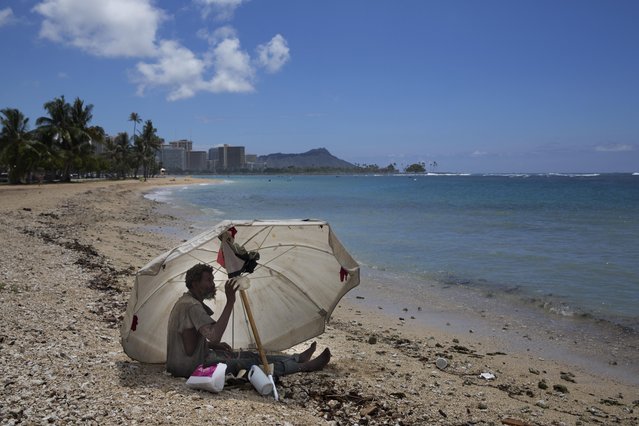
In this Thursday, August 27, 2015 photo, a homeless man drinks water while sitting on the beach at Ala Moana Beach Park located near Waikiki in Honolulu. Homelessness in Hawaii has grown steadily in recent years, leaving the state with the nation's highest rate of homeless people per capita. (Photo by Jae C. Hong/AP Photo)

Hawaii has long been known as a tropical paradise, but in recent years another image has intruded into the state's carefully crafted one of idyllic beaches and relaxing resorts: homelessness. The number of homeless people has grown in recent years, leaving the state with 487 homeless per 100,000 people, the nation's highest rate per capita, above New York and Nevada, according to federal statistics. Many of the homeless, however, defy the stereotype of the mentally ill or drug addicted. They are families, with men and women who work full-time jobs. They are struggling to get a foothold in a place with a high cost of living and low wages. Here: in this Thursday, August 27, 2015 photo, a homeless man drinks water while sitting on the beach at Ala Moana Beach Park located near Waikiki in Honolulu. (Photo by Jae C. Hong/AP Photo)
Details
11 Nov 2015 08:03:00
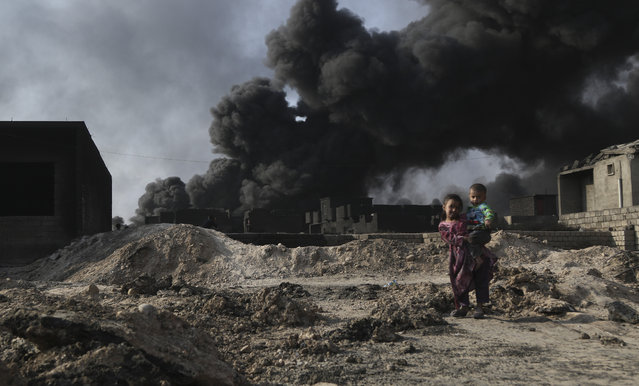
A girl holds her brother in her arm as black smoke rises after an oil well set on fire in the center of al-Kayyara town to the south of Daesh terror organization-held Mosul in Iraq on October 25, 2016. The oil well in the center of al-Kayyara town, which was set alight by retreating Daesh militants in advance of the Iraqi army's takeover of the town on August 24, 2016 has still not entirely been put out. The raw petrol which is still alight is creating black clouds above the city. The residents and wildlife beneath this polluting smoke cloud may find their health at risk. The effects of the fire in the town center on unprotected civilians' health can easily be seen on the hands and faces of children playing on the street. (Photo by dris Okuducu/Anadolu Agency/Getty Images)

A girl holds her brother in her arm as black smoke rises after an oil well set on fire in the center of al-Kayyara town to the south of Daesh terror organization-held Mosul in Iraq on October 25, 2016. The oil well in the center of al-Kayyara town, which was set alight by retreating Daesh militants in advance of the Iraqi army's takeover of the town on August 24, 2016 has still not entirely been put out. The raw petrol which is still alight is creating black clouds above the city. The residents and wildlife beneath this polluting smoke cloud may find their health at risk. The effects of the fire in the town center on unprotected civilians' health can easily be seen on the hands and faces of children playing on the street. (Photo by dris Okuducu/Anadolu Agency/Getty Images)
Details
27 Oct 2016 11:54:00
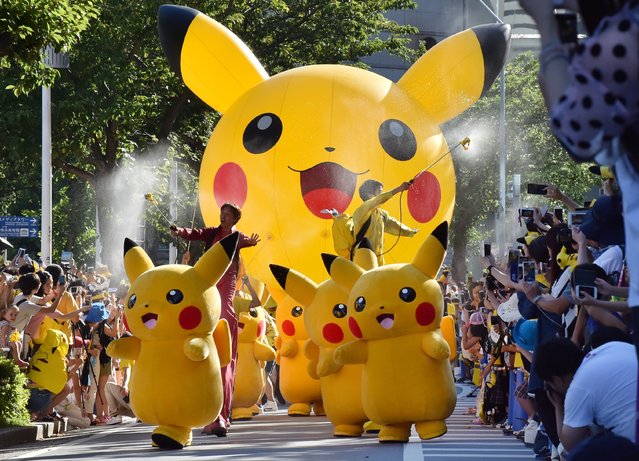
Performers dressed as Pikachu, the popular animation Pokemon series character, perform in the Pikachu parade in Yokohama on August 7, 2016. Some 50 life-size Pikachu characters, the most famous from the Pokemon game, marched along the city’s waterfront street as visitors took mobile phone pictures and videos of them in scorching sunshine. Some participants said they attended the event to search for rare characters of Pokemon – a word short for “pocket monster” – for the megahit smartphone app, which was launched in several countries around the world last month. (Photo by Kazuhiro Nogi/AFP Photo)

Performers dressed as Pikachu, the popular animation Pokemon series character, perform in the Pikachu parade in Yokohama on August 7, 2016. Some 50 life-size Pikachu characters, the most famous from the Pokemon game, marched along the city’s waterfront street as visitors took mobile phone pictures and videos of them in scorching sunshine. Some participants said they attended the event to search for rare characters of Pokemon – a word short for “pocket monster” – for the megahit smartphone app, which was launched in several countries around the world last month. (Photo by Kazuhiro Nogi/AFP Photo)
Details
08 Aug 2016 10:41:00
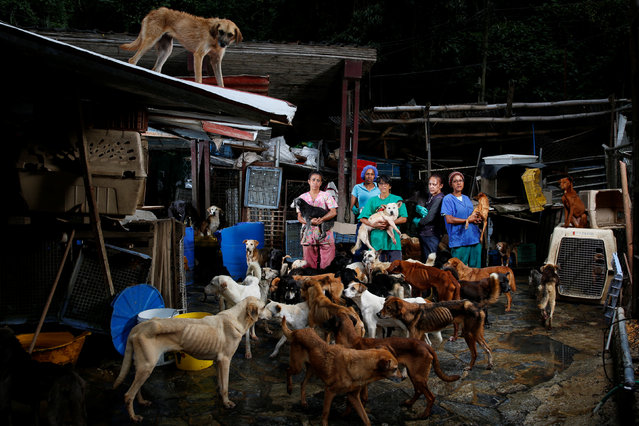
(L-R) Maria Silva, Milena Cortes, Maria Arteaga, Jackeline Bastidas and Gissy Abello pose for a picture at the Famproa dogs shelter where they work, in Los Teques, Venezuela, August 25, 2016. Venezuelans struggling to feed their families let alone their pets are dumping animals on the streets, in parks and at makeshift homes overrun with scrawny animals amid an economic crisis. An hour from Caracas in Los Teques, hundreds of dogs bark and run around the streets scavenging for food outside a makeshift shelter. People come by every few hours to hand over scrawny dogs which are fed by volunteers every day. Venezuela is undergoing a major economic and social crisis, with shortages of basic foods and medicines. Triple digit inflation is hitting everybody hard, including those who own pets. (Photo by Carlos Garcia Rawlins/Reuters)

(L-R) Maria Silva, Milena Cortes, Maria Arteaga, Jackeline Bastidas and Gissy Abello pose for a picture at the Famproa dogs shelter where they work, in Los Teques, Venezuela, August 25, 2016. Venezuelans struggling to feed their families let alone their pets are dumping animals on the streets, in parks and at makeshift homes overrun with scrawny animals amid an economic crisis. An hour from Caracas in Los Teques, hundreds of dogs bark and run around the streets scavenging for food outside a makeshift shelter. (Photo by Carlos Garcia Rawlins/Reuters)
Details
08 Sep 2016 10:01:00
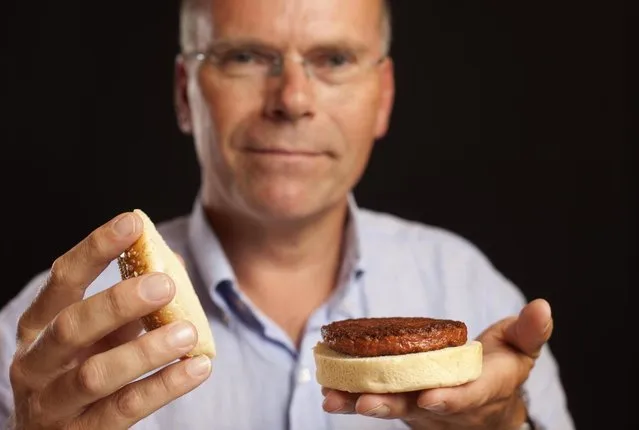
In this handout image provided by Ogilvy, a burger made from cultured beef, which has been developed by Professor Mark Post of Maastricht University in the Netherlands (pictured) is shown to the media during a press conference on August 5, 2013 in London, England. Cultured Beef could help solve the coming food crisis and combat climate change with commercial production of Cultured Beef beginning within ten to twenty years. (Photo by David Parry via Getty Images)

In this handout image provided by Ogilvy, a burger made from cultured beef, which has been developed by Professor Mark Post of Maastricht University in the Netherlands (pictured) is shown to the media during a press conference on August 5, 2013 in London, England. The in-vitro burger, cultured from cattle stem cells, the first example of what its creator says could provide an answer to global food shortages and help combat climate change, was fried in a pan and tasted by two volunteers. The burger is the result of years of research by Dutch scientist Mark Post, a vascular biologist at the University of Maastricht, who is working to show how meat grown in petri dishes might one day be a true alternative to meat from livestock.The meat in the burger has been made by knitting together around 20,000 strands of protein that has been cultured from cattle stem cells in Post's lab. (Photo by David Parry)
Details
06 Aug 2013 08:48:00
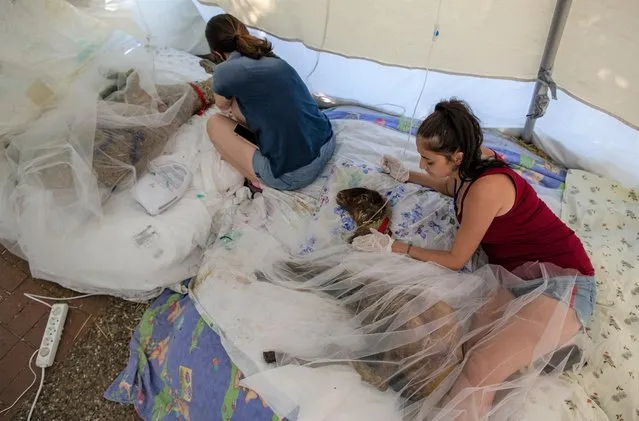
Volunteers care for burned sheeps in a field hospital established by HAYTAP (The Federation of the Animals Rights in Turkey) for animals after a wildfire at the Manavgat district of Antalya, Turkey, 09 August 2021. It is not known how many wild animals living in the forest died in the fires, but about 33,000 farm animals perished. About 30 veterinarians and hundreds of volunteers work around the clock at the field hospital. Sheep, covered in mosquito nets to protect their wounds from flies, lay there in the shade trying to recover, and various animals such as cats, dogs, owls, and cows have been treated or are still being treated there. (Photo by Erdem Sahin/EPA/EFE)

Volunteers care for burned sheeps in a field hospital established by HAYTAP (The Federation of the Animals Rights in Turkey) for animals after a wildfire at the Manavgat district of Antalya, Turkey, 09 August 2021. It is not known how many wild animals living in the forest died in the fires, but about 33,000 farm animals perished. About 30 veterinarians and hundreds of volunteers work around the clock at the field hospital. Sheep, covered in mosquito nets to protect their wounds from flies, lay there in the shade trying to recover, and various animals such as cats, dogs, owls, and cows have been treated or are still being treated there. (Photo by Erdem Sahin/EPA/EFE)
Details
27 Aug 2021 08:30:00
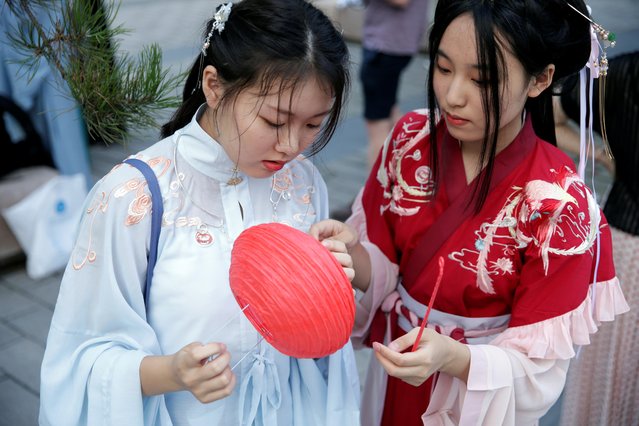
Girls dressed in “Hanfu”, or Han clothing, prepare for an event to mark the traditional Qixi festival, the Chinese equivalent of Valentine's Day, at a park in Beijing, China, August 7, 2019. Chinese for “Han clothing”, “Hanfu” is based on the idea of donning costumes worn in bygone eras by China's dominant Han ethnicity. Some of the most popular styles are from the Ming, Song and Tang dynasties. Hanfu enthusiasts doubled to two million in 2018 from a year earlier, according to a survey by Hanfu Zixun, a popular community account on the Wechat social media platform. (Photo by Jason Lee/Reuters)

Girls dressed in “Hanfu”, or Han clothing, prepare for an event to mark the traditional Qixi festival, the Chinese equivalent of Valentine's Day, at a park in Beijing, China, August 7, 2019. Chinese for “Han clothing”, “Hanfu” is based on the idea of donning costumes worn in bygone eras by China's dominant Han ethnicity. Some of the most popular styles are from the Ming, Song and Tang dynasties. Hanfu enthusiasts doubled to two million in 2018 from a year earlier, according to a survey by Hanfu Zixun, a popular community account on the Wechat social media platform. (Photo by Jason Lee/Reuters)
Details
23 Sep 2019 00:05:00
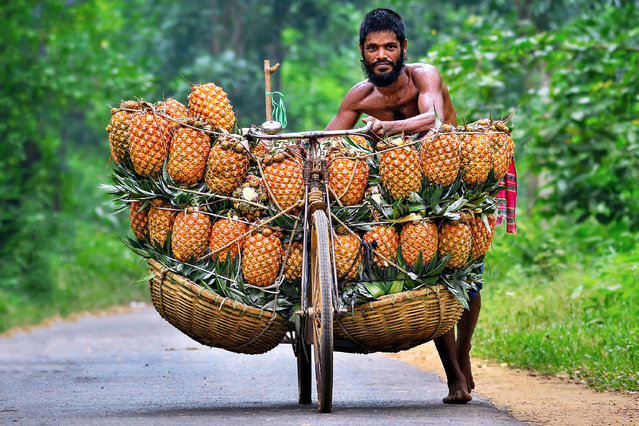
Cyclists desperately try to keep their heavily-laden bicycles upright as they arrive at a market with baskets full of pineapples on August 23, 2018. The men travel up to 12 and a half miles with two baskets tied to the sides of their bikes, carrying between 50 and 100 pineapples to sell. Each of the bicycles is so heavily laden with fruit it is impossible for the men to actually ride their bikes, instead having to walk alongside them. When they arrive at the market place in Madhupur, Bangladesh, buyers will pay up to 30 Taka for a pineapple – the equivalent of around 28 pence. (Photo by Abdul Momin/Solent News & Photo Agency UK)

Cyclists desperately try to keep their heavily-laden bicycles upright as they arrive at a market with baskets full of pineapples on August 23, 2018. The men travel up to 12 and a half miles with two baskets tied to the sides of their bikes, carrying between 50 and 100 pineapples to sell. Each of the bicycles is so heavily laden with fruit it is impossible for the men to actually ride their bikes, instead having to walk alongside them. When they arrive at the market place in Madhupur, Bangladesh, buyers will pay up to 30 Taka for a pineapple – the equivalent of around 28 pence. (Photo by Abdul Momin/Solent News & Photo Agency UK)
Details
21 Sep 2018 00:03:00