Loading...
Done
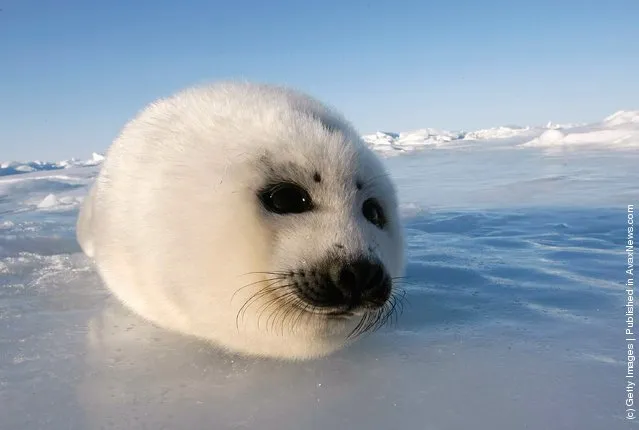
A harp seal pup

“The harp seal or saddleback seal is a species of earless seal native to the northernmost Atlantic Ocean and adjacent parts of the Arctic Ocean. Newborn pups weigh around 11 kilograms (24 lb) and are 80–85 centimetres (31–33 in) long. After birth, the mother only feeds that pup. During the 12 day nursing period, the mother does not eat, losing up to 3 kilograms (7 lb) per day. Harp seal milk contains up to 48% fat, so pups gain over 2.2 kilograms (4.9 lb) per day. During this time, the juvenile's “greycoat” grows in beneath the white neonatal coat, and it weighs 80 pounds (36 kg)”. – Wikipedia

Photo: A harp seal pup lies on an ice floe in the Gulf of Saint Lawrence March 24, 2008 in Charlottetown, Canada. (Photo by Joe Raedle/Getty Images)
Details
19 Sep 2011 15:49:00
Migrating gray cranes fly over the Hula Lakes in in northern Israel

Migrating gray cranes, on November 30, 2009 around the Hula Lakes in northern Israel. (Photo by Uriel Sinai/Getty Images)
Details
01 Dec 2011 12:49:00
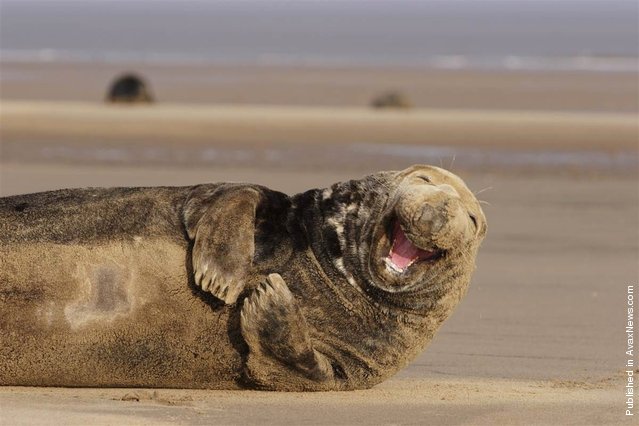
This grey adult male seal enjoys a good grin while lying on the beach

“This grey adult male seal enjoys a good grin while lying on the beach”. (Photo by Michael Hutch/SplashdownDirect via Rex USA)
Details
20 Apr 2012 13:30:00
A young Balinese man tries to kiss a woman during the Kissing Festival known as “Omed-Omedan” at Sesetan village on April 1, 2014 in Denpasar, Bali, Indonesia. (Photo by Agung Parameswara/Getty Images)

A young Balinese man tries to kiss a woman during the Kissing Festival known as “Omed-Omedan” at Sesetan village on April 1, 2014 in Denpasar, Bali, Indonesia. (Photo by Agung Parameswara/Getty Images)
Details
02 Apr 2014 10:32:00
A man watches Israeli Air Force planes fly over the Mediterranean Sea from a beach at Tel Aviv during an aerial show as part of celebrations for Israel's Independence Day to mark the 66th anniversary of the creation of the state, May 6, 2014. (Photo by Nir Elias/Reuters)

A man watches Israeli Air Force planes fly over the Mediterranean Sea from a beach at Tel Aviv during an aerial show as part of celebrations for Israel's Independence Day to mark the 66th anniversary of the creation of the state, May 6, 2014. (Photo by Nir Elias/Reuters)
Details
07 May 2014 12:35:00
Kirby Chambliss of the United States flies in formation with Matt Hall of Australia, Yoshihide Muroya of Japan and Nigel Lamb of Britain prior to the third stage of the Red Bull Air Race World Championship in front of the Petronas Towers in Kuala Lumpur, Malaysia, on May 15, 2014. (Photo by Joerg Mitter/Red Bull via Reuters)

Kirby Chambliss of the United States flies in formation with Matt Hall of Australia, Yoshihide Muroya of Japan and Nigel Lamb of Britain prior to the third stage of the Red Bull Air Race World Championship in front of the Petronas Towers in Kuala Lumpur, Malaysia, on May 15, 2014. (Photo by Joerg Mitter/Red Bull via Reuters)
Details
17 May 2014 12:56:00
Britain's BASE jumper Sam Hardy lives up to his name after throwing himself off the top of the 335m-high Kuala Lumpur Tower during the KL Tower International Jump in Kuala Lumpur, Malaysia, Saturday, September 27, 2014. BASE stands for the places such jumpers usually jump from: buildings, antennas, spans (bridges) and earth (cliffs). (Photo by Lai Seng Sin/AP Photo)

Britain's BASE jumper Sam Hardy lives up to his name after throwing himself off the top of the 335m-high Kuala Lumpur Tower during the KL Tower International Jump in Kuala Lumpur, Malaysia, Saturday, September 27, 2014. BASE stands for the places such jumpers usually jump from: buildings, antennas, spans (bridges) and earth (cliffs). (Photo by Lai Seng Sin/AP Photo)
Details
29 Sep 2014 10:41:00
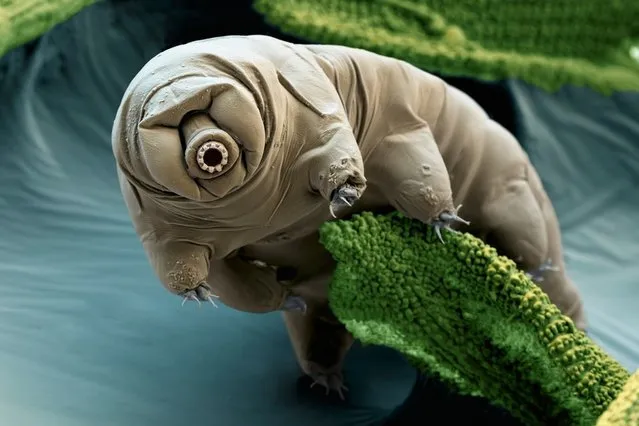
Tardigrades (commonly known as waterbears or moss piglets). (Photo by SPL/East News)

“Tardigrades (commonly known as waterbears or moss piglets) are small, water-dwelling, segmented animals with eight legs. Tardigrades were first discovered in 1773 by Johann August Ephraim Goeze, who called them kleiner Wasserbär, meaning “little water bear” in German. The name Tardigrada means “slow walker” and was given by Lazzaro Spallanzani in 1777. The name water bear comes from the way they walk, reminiscent of a bear's gait. The biggest adults may reach a body length of 1.5 millimetres (0.059 in), the smallest below 0.1 mm. Freshly hatched tardigrades may be smaller than 0.05 mm”. – Wikipedia. Photo: Tardigrades. (Photo by SPL/East News)
Details
26 Sep 2012 09:55:00