Loading...
Done
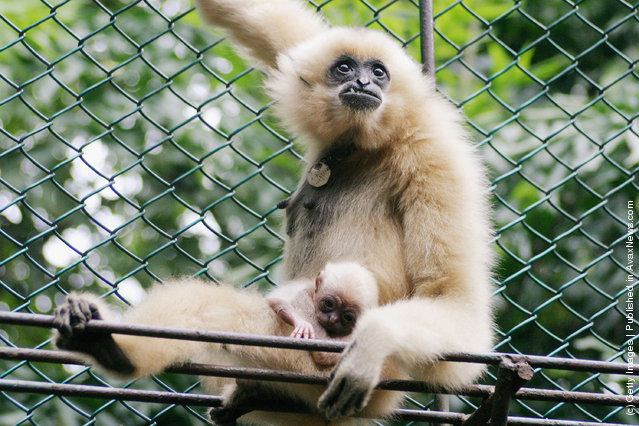
Newborn White-Cheeked Gibbon Nomascus

“Nomascus is the second most speciose genus of gibbons (family Hylobatidae). Originally this genus was a subgenus of Hylobates, and all individuals were considered one species, Hylobates concolor. Species within Nomascus are characterized by 52 chromosomes. Some species are all black, some light with a distinct black tuft of crown fur, and some by distinct, light-colored cheek patches. Nomascus is found from southern China (Yunnan) to southern Vietnam, and also on Hainan Island. One of the genus' species, Nomascus nasutus, has been deemed “the most critically endangered ape species in the world”. All of the species in this genus are endangered or critically endangered”. – Wikipedia

Photo: A newborn White-Cheeked Gibbon clings to its mother in the Nanning Zoo on April 12, 2004 in Nanning, Guangxi province, China. The White-Cheeked Gibbon's natural habitat is Southern China as well as Vietnam and Laos. They are classified as highly endangered and are on the brink of extinction due to poaching and reduction of natural rainforests. (Photo by Getty Images)
Details
12 Aug 2011 11:51:00
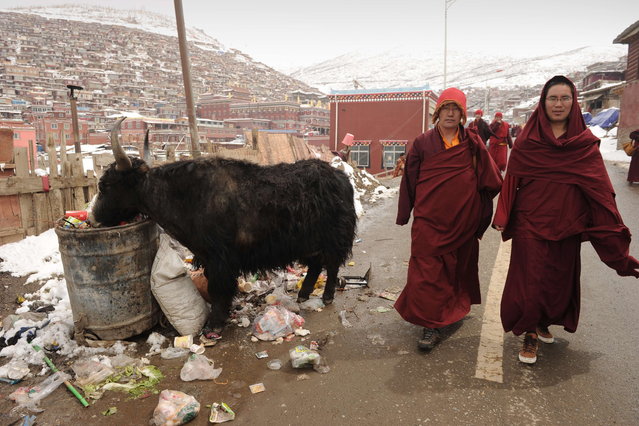
This photo taken on April 5, 2013 shows Buddhist monks passing a yak in Seda Monastery, the largest Tibetan Buddhist school in the world, with up to 40,000 monks and nuns in residence for some parts of the year. (Photo by Peter Parks/AFP Photo)

This photo taken on April 5, 2013 shows Buddhist monks passing a yak in Seda Monastery, the largest Tibetan Buddhist school in the world, with up to 40,000 monks and nuns in residence for some parts of the year. Seda, known to Tibetans as Serthar is located in Ganzi prefecture in the west of China's Sichuan province and has become a hotbed of protests and violence since the Tibetan uprisings of March 2008. (Photo by Peter Parks/AFP Photo)
Details
30 Apr 2013 08:56:00
In this March 18, 2015 photo, a boy rides a mechanical bull for children at the Texcoco Fair on the outskirts of Mexico City. In Mexico, these types of fairs date back to Spanish colonial times, and in some smaller communities they are organized around the feast days of Roman Catholic saints. (Photo by Eduardo Verdugo/AP Photo)

In this March 18, 2015 photo, a boy rides a mechanical bull for children at the Texcoco Fair on the outskirts of Mexico City. In Mexico, these types of fairs date back to Spanish colonial times, and in some smaller communities they are organized around the feast days of Roman Catholic saints. (Photo by Eduardo Verdugo/AP Photo)
Details
28 Apr 2015 13:45:00
In this Monday, January 18, 2016 photo,  Iranian rock climber, Farnaz Esmaeilzadeh, scales a climbing gym in the city of Zanjan, some 330 kilometers (207 miles) west of the capital Tehran, Iran. (Photo by Ebrahim Noroozi/AP Photo)

In this Monday, January 18, 2016 photo, Iranian rock climber, Farnaz Esmaeilzadeh, scales a climbing gym in the city of Zanjan, some 330 kilometers (207 miles) west of the capital Tehran, Iran. Esmaeilzadeh, 27, who has been climbing since she was 13, has distinguished herself in international competitions despite the barriers she faces as a female athlete in conservative Iran. (Photo by Ebrahim Noroozi/AP Photo)
Details
01 Feb 2016 13:04:00
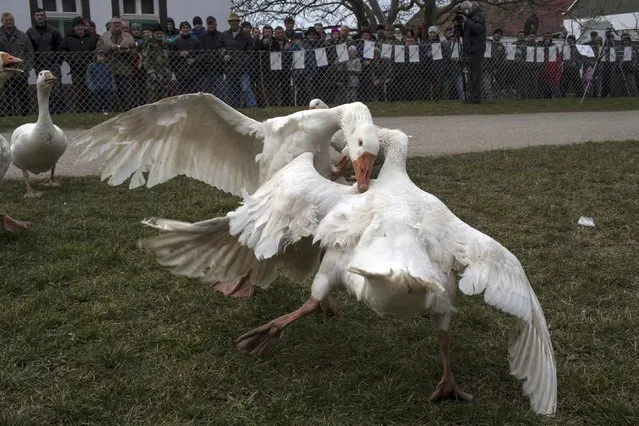
Geese fight during the annual Geese Fight Day in the northern Serbian village of Mokrin, some 160km (100 miles) from Belgrade February 22, 2015. (Photo by Marko Djurica/Reuters)

Geese fight during the annual Geese Fight Day in the northern Serbian village of Mokrin, some 160km (100 miles) from Belgrade February 22, 2015. Every year in the last week of February, goose fights are held in the northern Serbian village of Mokrin. Left alone, male geese, or ganders, are unlikely to fight each other, hence why females are brought along for whose affections the ganders then fight until one or the other gives up. (Photo by Marko Djurica/Reuters)
Details
23 Feb 2015 13:01:00
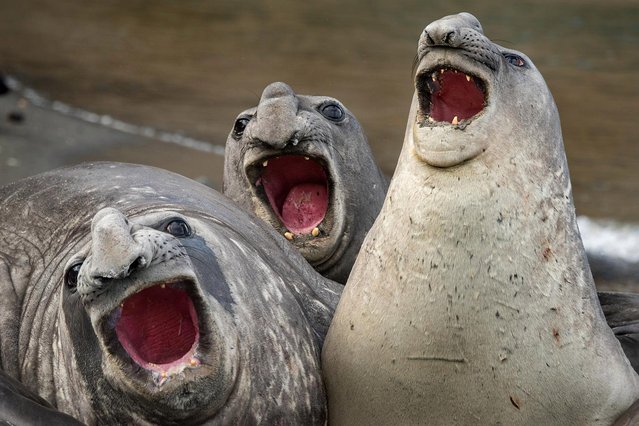
Three elephant seals put on a show in Roie Galitz's “Three Tanors”, taken on January 7, 2016 in South Georgia Island. (Photo by Roie Galitz/CWPA/Barcroft Images)

Three elephant seals put on a show in Roie Galitz's “Three Tanors”, taken on January 7, 2016 in South Georgia Island. The Comedy Wildlife Photography Awards are in full swing, so check out some of the fierce competitors jostling for the top prize this year. Photographers Paul Joynson-Hicks MBE and Tom Sullam founded the awards to spotlight wildlife conservation efforts and to inject some humour into the world of wildlife photography. (Photo by Roie Galitz/CWPA/Barcroft Images)
Details
07 Jul 2017 07:16:00
Festival-goers take a bath in a mud pool during the 20th Boryeong Mud Festival on Daecheon beach in Boryeong City, some 190 kilometers west of Seoul, South Korea, 22 July 2017. (Photo by Jeon Heon-Kyun/EPA/EFE)

Festival-goers take a bath in a mud pool during the 20th Boryeong Mud Festival on Daecheon beach in Boryeong City, some 190 kilometers west of Seoul, South Korea, 22 July 2017. Tourists flock to the area to experience the beneficial properties of the Boryeong mud, as well as for a variety of entertainment events. The festival runs from 21 until 30 July. (Photo by Jeon Heon-Kyun/EPA/EFE)
Details
25 Jul 2017 09:36:00
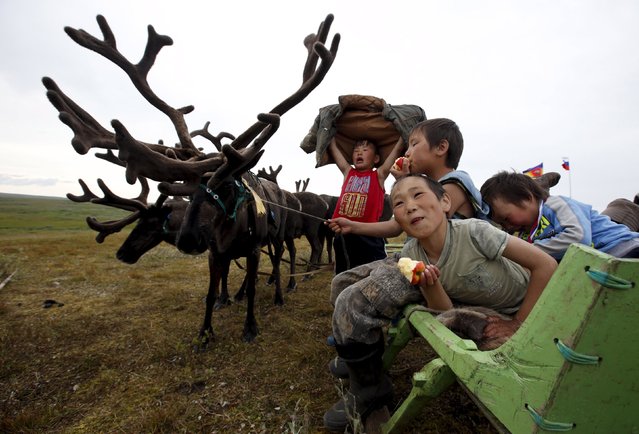
Children of local herders gather at a reindeer camping ground, some 200 km (124 miles) northeast of Naryan-Mar, the administrative centre of Nenets Autonomous Area, far northern Russia, August 2, 2015. (Photo by Sergei Karpukhin/Reuters)

Children of local herders gather at a reindeer camping ground, some 200 km (124 miles) northeast of Naryan-Mar, the administrative centre of Nenets Autonomous Area, far northern Russia, August 2, 2015. People, including local herders and members of their families, gathered at the site to mark Reindeer Day, a professional holiday of reindeer breeding workers, which is celebrated annually on August 2 in the region. (Photo by Sergei Karpukhin/Reuters)
Details
04 Aug 2015 12:29:00