Loading...
Done
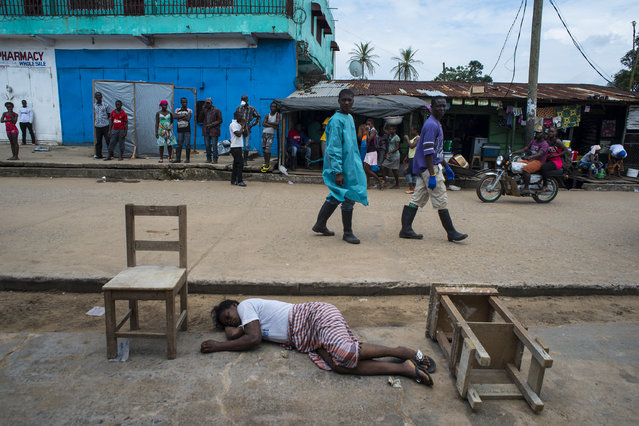
A woman lays dead outside the Redemption Hospital on Saturday September 20, 2014 in Monrovia, Liberia. Ebola patients come to the hospital, which has become a transfer and holding center to intake Ebola patients, but there is no space and some die while waiting outside. Redemption is located in one of the poorest neighborhoods of Monrovia that locals call "New Kru Town”. (Photo by Michel du Cille/The Washington Post)

A woman lays dead outside the Redemption Hospital on Saturday September 20, 2014 in Monrovia, Liberia. Ebola patients come to the hospital, which has become a transfer and holding center to intake Ebola patients, but there is no space and some die while waiting outside. Redemption is located in one of the poorest neighborhoods of Monrovia that locals call "New Kru Town”. Health workers are overwhelmed with a constant stream of new patients since the Ebola outbreak. (Photo by Michel du Cille/The Washington Post)
Details
16 Oct 2014 12:59:00
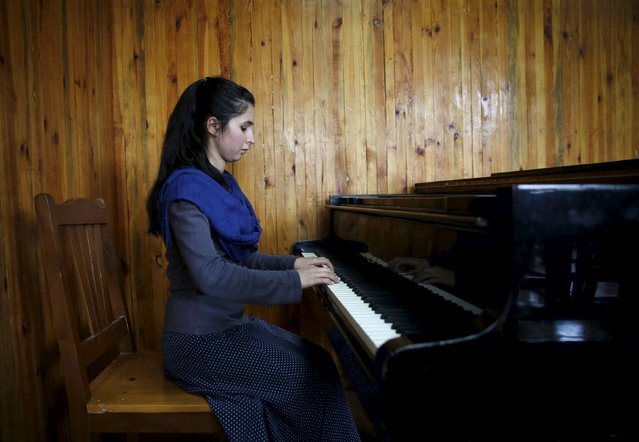
Negin Ekhpulwak, leader of the Zohra orchestra, an ensemble of 35 women, practises on a piano at Afghanistan's National Institute of Music, in Kabul, Afghanistan April 9, 2016. (Photo by Ahmad Masood/Reuters)

Negin Ekhpulwak, leader of the Zohra orchestra, an ensemble of 35 women, practises on a piano at Afghanistan's National Institute of Music, in Kabul, Afghanistan April 9, 2016. Playing instruments was banned under Taliban rule in Afghanistan, and even today, many conservative Muslims frown on most forms of music. Living in an orphanage in the capital, Kabul, 19-year-old Negin Ikhpolwak leads an ensemble of 35 women that plays both Western and Afghan musical instruments. In a country notorious internationally for harsh restrictions on women in most areas of life, Negin's story highlights a double challenge. (Photo by Ahmad Masood/Reuters)
Details
19 Apr 2016 13:47:00
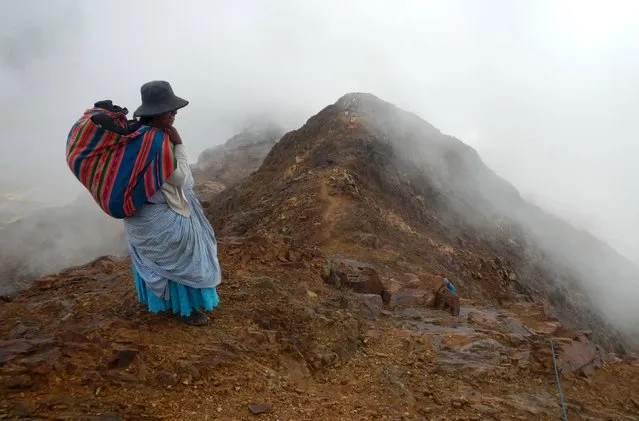
A porter stands at the bottom of the Illimani mountain, on the outskirts of La Paz, Bolivia, April 16, 2016. (Photo by David Mercado/Reuters)

A porter stands at the bottom of the Illimani mountain, on the outskirts of La Paz, Bolivia, April 16, 2016. For years, Lydia Huayllas, 48, has worked as a cook at base camps and mountain-climbing refuges on the steep, glacial slopes of Huayna Potosi, a 19,974-foot (6,088-meter) Andean peak outside of La Paz, Bolivia. But two years ago, she and 10 other Aymara indigenous women, ages 42 to 50, who also worked as porters and cooks for mountaineers, put on crampons – spikes fixed to a boot for climbing – under their wide traditional skirts and started to do their own climbing. (Photo by David Mercado/Reuters)
Details
22 Apr 2016 12:33:00
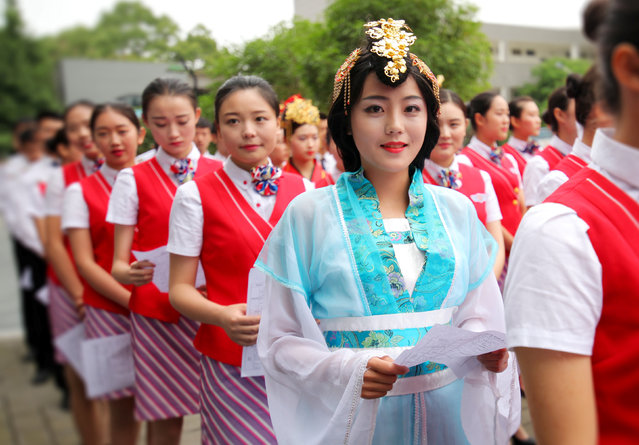
A student, wearing a traditional costume and headdress, stands in line for interviews during a recruitment held by an airline company, hoping to stand out from more than 500 candidates for airline stewardess positions, in Chengdu, Sichuan Province, China, May 27, 2016. (Photo by Reuters/Stringer)

A student, wearing a traditional costume and headdress, stands in line for interviews during a recruitment held by an airline company, hoping to stand out from more than 500 candidates for airline stewardess positions, in Chengdu, Sichuan Province, China, May 27, 2016. (Photo by Reuters/Stringer)
Details
03 Jun 2016 12:39:00
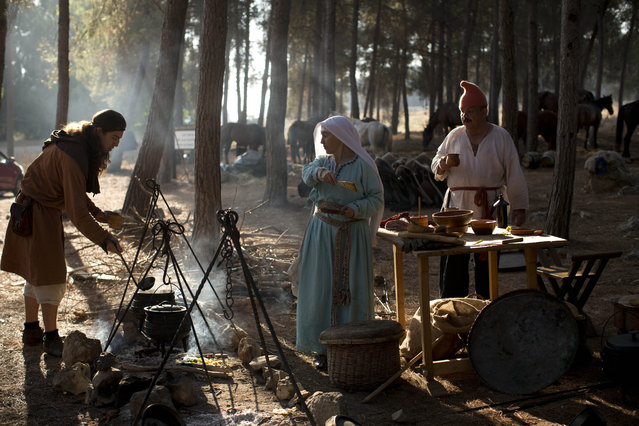
In this Saturday, July 4, 2015 photo, Israeli and Russian members of knight clubs cook their breakfast before the reenactment of the Battle of Hattin in Lavi Forest, northern Israel. (Photo by Oded Balilty/AP Photo)

In this Saturday, July 4, 2015 photo, Israeli and Russian members of knight clubs cook their breakfast before the reenactment of the Battle of Hattin in Lavi Forest, northern Israel. About a third of the participants arrived with their elaborate gear from Russia. The project is supported by the Lower Galilee Regional Council. (Photo by Oded Balilty/AP Photo)
Details
06 Jul 2015 09:58:00
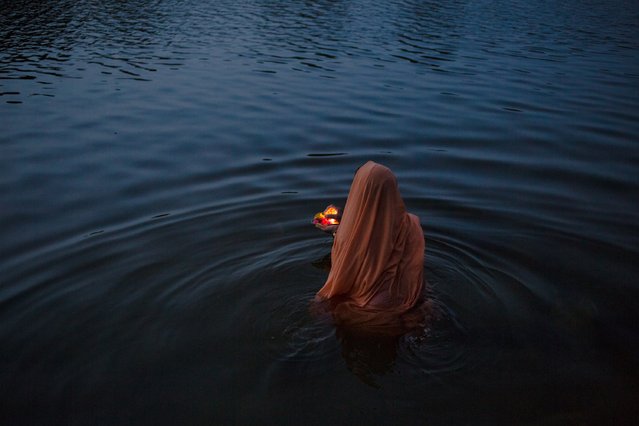
An Indian women offers early-morning prayers or a “puja” at a ghat early in the morning on the banks of the Betawa River in Orchha in the state of Madhya Pradesh on July 5, 2015. (Photo by Rebecca Conway/AFP Photo)

An Indian women offers early-morning prayers or a “puja” at a ghat early in the morning on the banks of the Betawa River in Orchha in the state of Madhya Pradesh on July 5, 2015. (Photo by Rebecca Conway/AFP Photo)
Details
08 Jul 2015 11:56:00
A demonstrator throw a firebomb during clashes with Turkish riot police officers in Istanbul, Turkey, Friday, May 1, 2015. The government assigned 30,000 police officers backed by helicopters as workers and demonstrators determined to defy a government ban, tried to march to iconic Taksim Square, where 35 people were killed during May Day celebration in 1977. (Photo by Emrah Gurel/AP Photo)

A demonstrator throw a firebomb during clashes with Turkish riot police officers in Istanbul, Turkey, Friday, May 1, 2015. The government assigned 30,000 police officers backed by helicopters as workers and demonstrators determined to defy a government ban, tried to march to iconic Taksim Square, where 35 people were killed during May Day celebration in 1977. (Photo by Emrah Gurel/AP Photo)
Details
03 May 2015 11:04:00
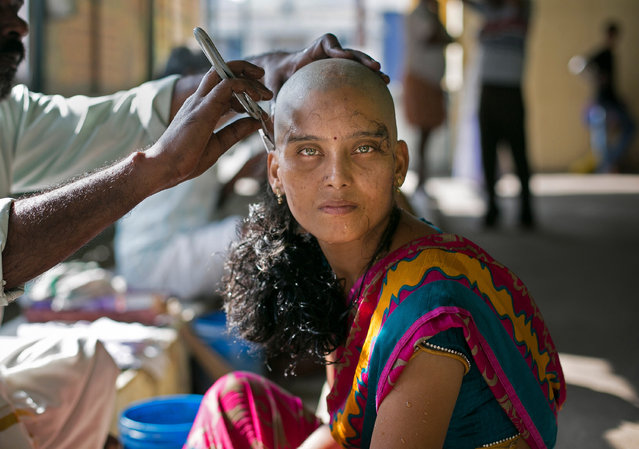
28 year old Rupa has her hair shaven to donate to the Gods at the Thiruthani Murugan Temple November 10, 2016 in Thiruttani, India. Rupa donated her hair with the wish that her daughter's illness is cured. The process of shaving ones hair and donating it to the Gods is known as tonsuring. It is common for Hindu believers to tonsure their hair at a temple as a young child, and also to celebrate a wish coming true, such as the birth of a baby or the curing of an illness. The “temple hair”, as it's known, is then auctioned off to a processing plant and then sold as pricey wigs and weaves in the US, Europe and Africa. (Photo by Allison Joyce/Getty Images)

28 year old Rupa has her hair shaven to donate to the Gods at the Thiruthani Murugan Temple November 10, 2016 in Thiruttani, India. Rupa donated her hair with the wish that her daughter's illness is cured. The process of shaving ones hair and donating it to the Gods is known as tonsuring. It is common for Hindu believers to tonsure their hair at a temple as a young child, and also to celebrate a wish coming true, such as the birth of a baby or the curing of an illness. The “temple hair”, as it's known, is then auctioned off to a processing plant and then sold as pricey wigs and weaves in the US, Europe and Africa. (Photo by Allison Joyce/Getty Images)
Details
21 Nov 2016 10:30:00