Loading...
Done
Alexei Gruk, 45, mechanic and supporter of presidential candidate Pavel Grudinin, poses for a picture in St. Petersburg, Russia, January 31, 2018. “The most important thing for me is that our foreign policy stays the same”, said Gruk. “To hell with the sanctions… So what if they don’t bring foreign stuff here anymore? As if that means we have to give up. I don't care”. (Photo by Anton Vaganov/Reuters)

Most Russians intending to vote for Vladimir Putin in Sunday's election say stability is at the root of their faith in their candidate – though many young voters believe it's time for a change of leader. Putin, 65, is expected to win a fourth term in office with 69 percent of the vote, according to the latest survey by a state-run pollster. Reuters correspondents and photographers who travelled around the country talking to voters ahead of the March 18 election found nothing to contradict expectation of an emphatic Putin victory. (Photo by Anton Vaganov/Reuters)
Details
15 Mar 2018 00:01:00
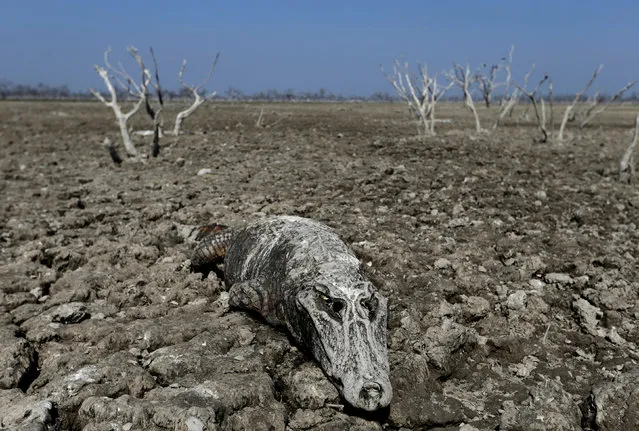
The carcass of a yacare caiman lies in the dried-up river bed of the Pilcomayo river in Boqueron, Paraguay, August 14, 2016. In Paraguay, alongside the Pilcomayo River, black vultures flew over a shrinking pond where a group of crocodilian reptiles known as yacare caimans sought refuge. Water from the river, which divides Paraguay and Argentina in the area of the Gran Chaco, was scarce. This is not an uncommon sight in the region of General Diaz, about 700 kilometres (435 miles) northwest of the country's capital Asuncion, where the Pilcomayo's waters form lakes and streams that give life to capybaras, birds and caimans. “The river's situation is critical. No water is forecast to enter the basin until December, as happens every year”, said Alcides Gonzalez, a resident of the area. (Photo by Jorge Adorno/Reuters)

The carcass of a yacare caiman lies in the dried-up river bed of the Pilcomayo river in Boqueron, Paraguay, August 14, 2016. In Paraguay, alongside the Pilcomayo River, black vultures flew over a shrinking pond where a group of crocodilian reptiles known as yacare caimans sought refuge. Water from the river, which divides Paraguay and Argentina in the area of the Gran Chaco, was scarce. This is not an uncommon sight in the region of General Diaz, about 700 kilometres (435 miles) northwest of the country's capital Asuncion, where the Pilcomayo's waters form lakes and streams that give life to capybaras, birds and caimans. (Photo by Jorge Adorno/Reuters)
Details
03 Nov 2016 12:40:00
In this handout provided by the National Aeronautics and Space Administration (NASA), SpaceX's Falcon 9 is moved to the launch pad prior to the rocket's Thales Alenia Space launch attempt on April 26, 2015 in Cape Canaveral, Florida. (Photo by NASA via Getty Images)

In this handout provided by the National Aeronautics and Space Administration (NASA), SpaceX's Falcon 9 is moved to the launch pad prior to the rocket's Thales Alenia Space launch attempt on April 26, 2015 in Cape Canaveral, Florida. (Photo by NASA via Getty Images)
Details
05 Jun 2017 07:25:00
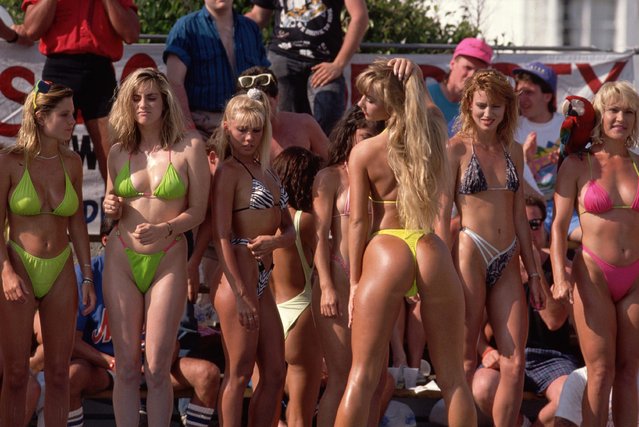
Competitors bear more than their bikinis during a spring break bikini contest at Summers' in Fort Lauderdale, Florida, circa 1985. (Photo by Nik Wheeler/Corbis via Getty Images)

Competitors bear more than their bikinis during a spring break bikini contest at Summers' in Fort Lauderdale, Florida, USA circa 1985. (Photo by Nik Wheeler/Corbis via Getty Images)
Details
01 Apr 2018 00:05:00
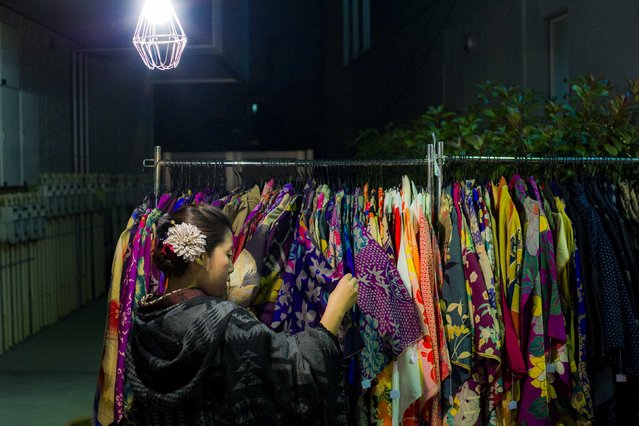
A woman browses through kimonos for sale at Boroichi flea market in Tokyo December 15, 2014. In the 16th century, Boroichi was a place for farmers to buy and sell rags, known as boro, for mending clothes and weaving sandals. Now in its 436th year, the original spirit lingers, with about 700 stands hawking fabric, used clothes and piles of rags. Others sell kitchen tools, pottery, seaweed and spices. (Photo by Thomas Peter/Reuters)

A woman browses through kimonos for sale at Boroichi flea market in Tokyo December 15, 2014. In the 16th century, Boroichi was a place for farmers to buy and sell rags, known as boro, for mending clothes and weaving sandals. Now in its 436th year, the original spirit lingers, with about 700 stands hawking fabric, used clothes and piles of rags. Others sell kitchen tools, pottery, seaweed and spices. About 200,000 people flock to the market, which is only open for four mid-winter days a year – two in December and two in January. (Photo by Thomas Peter/Reuters)
Details
19 Dec 2014 12:50:00
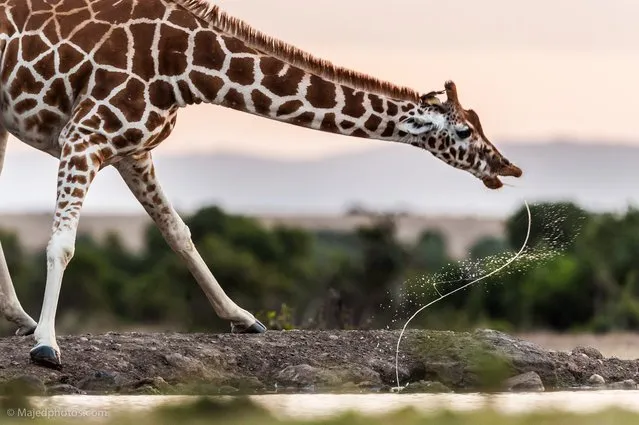
“We just want to move to search to the Leopard at that morning but we found a group of giraffes come toward a small lake and start drinking it was a nice moment when the Giraffe finish from drinking and leave a letters S with motion in the air”. (Photo and caption by Majed Ali)

National Geographic invites photographers from around the world to enter the 2013 National Geographic Photography Contest. The grand-prize winner will receive $10,000 (USD) and a trip to National Geographic headquarters in Washington, D.C., to participate in the annual National Geographic Photography Seminar in January 2014. Photo: “We just want to move to search to the Leopard at that morning but we found a group of giraffes come toward a small lake and start drinking it was a nice moment when the Giraffe finish from drinking and leave a letters “S” with motion in the air”. (Photo and caption by Majed Ali/National Geographic Photography Contest)
Details
15 Nov 2013 14:34:00
Tridacna Gigas, or Giant Clams

“The giant clam, Tridacna gigas (known as pā’ua in Cook Islands Māori), is the largest living bivalve mollusc. T. gigas is one of the most endangered clam species. It was mentioned as early as 1825 in scientific reports. One of a number of large clam species native to the shallow coral reefs of the South Pacific and Indian oceans, they can weigh more than 200 kilograms (440 lb) measure as much as 120 cm (47 in) across, and have an average lifespan in the wild of 100 years or more”. – Wikipedia

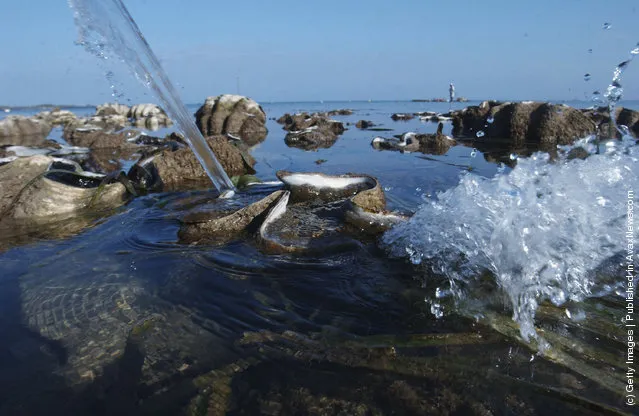
Photo: Tridacna Gigas, or Giant Clams spew water as a traditional fisherman passes by a small sanctuary on January 23, 2004 near Bolinao in the Northern Philippines. The clams, prime builders for coral reefs and providing shelter for spawning fish and other marine life, are exposed by low tides in the sanctuary. Overfishing and pollution throughout the country are not only threatening food security, but are also starting to choke one of the few working clam sanctuaries in the world. (Photo by David Greedy/Getty Images)
Details
01 Oct 2011 13:10:00
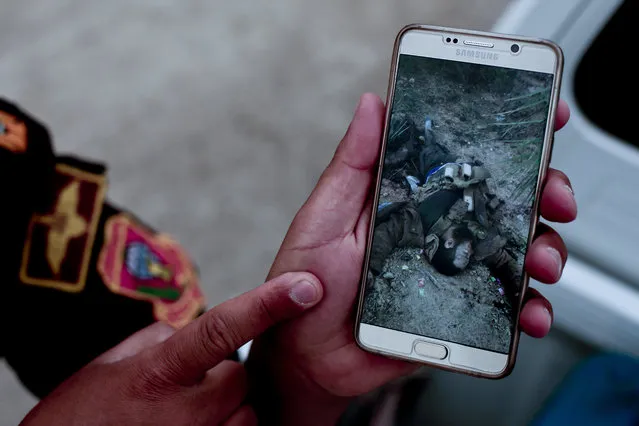
In this March 20, 2016 photo, Maj. Mohammed Hussein, an officer with Iraq's elite counterterrorism forces, shows a photo of a slain Islamic State group militant still wearing in a suicide vest, taken during fighting that freed the city of Ramadi from IS control earlier this year. As they fled, the militants destroyed some buildings and booby-trapped others with explosives, leaving behind an empty prize for government forces retaking the city. (Photo by Maya Alleruzzo/AP Photo)

In this March 20, 2016 photo, Maj. Mohammed Hussein, an officer with Iraq's elite counterterrorism forces, shows a photo of a slain Islamic State group militant still wearing in a suicide vest, taken during fighting that freed the city of Ramadi from IS control earlier this year. As they fled, the militants destroyed some buildings and booby-trapped others with explosives, leaving behind an empty prize for government forces retaking the city. (Photo by Maya Alleruzzo/AP Photo)
Details
05 May 2016 12:57:00