Loading...
Done
A journalist (R) is attacked by residents who are trying to prevent migrants from disembarking on the Greek island of Lesbos, on March 1, 2020. The United Nation called on March 1 for calm and urged states to refrain from “excessive” force, as thousands of migrants have flooded to Turkey's border with Greece in a bid to enter the EU. A massive influx of migrants swelled along the border over the weekend after Turkey's President Recep Tayyip Erdogan threatened to open its frontier to Europe as tensions mount over its deepening conflict in Syria. (Photo by AFP Photo/Stringer)

A journalist (R) is attacked by residents who are trying to prevent migrants from disembarking on the Greek island of Lesbos, on March 1, 2020. The United Nation called on March 1 for calm and urged states to refrain from “excessive” force, as thousands of migrants have flooded to Turkey's border with Greece in a bid to enter the EU. A massive influx of migrants swelled along the border over the weekend after Turkey's President Recep Tayyip Erdogan threatened to open its frontier to Europe as tensions mount over its deepening conflict in Syria. (Photo by AFP Photo/Stringer)
Details
03 Mar 2020 00:07:00
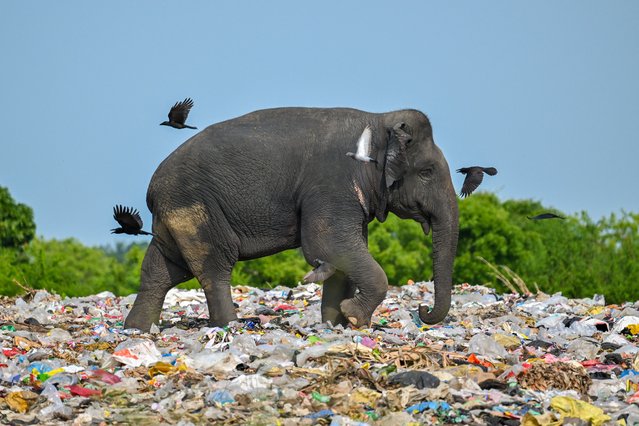
A wild elephant eats garbage containing plastic waste at a dump in Sri Lanka's eastern district of Ampara on June 3, 2023. Sri Lanka is set to launch a nation-wide clean up of plastic waste ahead of new laws banning the sale of single use plastics, the Environmental ministry said, after a spate of deaths of elephants and deer in the island's northeast after foraging at open garbage tips filled with plastic waste, whilst shrinking habitat has led to jumbos raiding villages looking for food. (Photo by Ishara S. Kodikara/AFP Photo)

A wild elephant eats garbage containing plastic waste at a dump in Sri Lanka's eastern district of Ampara on June 3, 2023. Sri Lanka is set to launch a nation-wide clean up of plastic waste ahead of new laws banning the sale of single use plastics, the Environmental ministry said, after a spate of deaths of elephants and deer in the island's northeast after foraging at open garbage tips filled with plastic waste, whilst shrinking habitat has led to jumbos raiding villages looking for food. (Photo by Ishara S. Kodikara/AFP Photo)
Details
30 Sep 2024 04:49:00
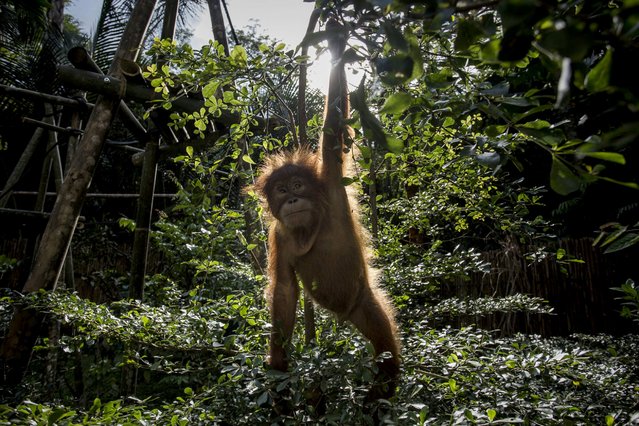
A Baby sumatran orangutan (Pongo abelii) plays around in a tree as they train at Sumatran Orangutan Conservation Programme's rehabilitation center on November 12, 2016 in Kuta Mbelin, North Sumatra, Indonesia. The Orangutans in Indonesia have been known to be on the verge of extinction as a result of deforestation and poaching. Found mostly in South-East Asia, where they live on the islands of Sumatra and Borneo, the endangered species continue to lose their habitat as a result of corporate expansion in a developing economy. Indonesia approved palm oil concessions on nearly 15 million acres of peatlands over the past years and thousands of square miles have been cleared for plantations, including the lowland areas that are the prime habitat for orangutans. (Photo by Ulet Ifansasti/Getty Images)

A Baby sumatran orangutan (Pongo abelii) plays around in a tree as they train at Sumatran Orangutan Conservation Programme's rehabilitation center on November 12, 2016 in Kuta Mbelin, North Sumatra, Indonesia. The Orangutans in Indonesia have been known to be on the verge of extinction as a result of deforestation and poaching. Found mostly in South-East Asia, where they live on the islands of Sumatra and Borneo, the endangered species continue to lose their habitat as a result of corporate expansion in a developing economy. Indonesia approved palm oil concessions on nearly 15 million acres of peatlands over the past years and thousands of square miles have been cleared for plantations, including the lowland areas that are the prime habitat for orangutans. (Photo by Ulet Ifansasti/Getty Images)
Details
16 Nov 2016 11:14:00
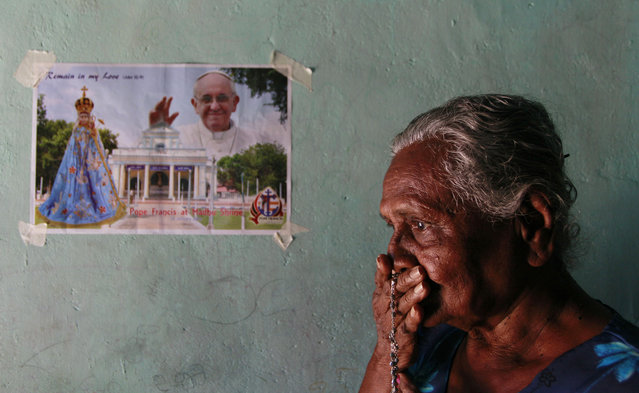
In this Wednesday, January 7, 2015 photo, a Sri Lankan Catholic devotee Rita Anthony kisses her rosary as she prays inside her house in Colombo, Sri Lanka. The Vatican has said that it hopes that Sri Lanka's Christians can play a role in helping heal the wounds of the island nation's bloody 25-year civil war, when the Tamil Tiger rebels fought to create a separate homeland in the north for the minority Tamils, who are mostly Hindu. (Photo by Eranga Jayawardena/AP Photo)

In this Wednesday, January 7, 2015 photo, a Sri Lankan Catholic devotee Rita Anthony kisses her rosary as she prays inside her house in Colombo, Sri Lanka. The Vatican has said that it hopes that Sri Lanka's Christians can play a role in helping heal the wounds of the island nation's bloody 25-year civil war, when the Tamil Tiger rebels fought to create a separate homeland in the north for the minority Tamils, who are mostly Hindu. The war came to a bloody end in 2009, but many Tamils say they feel forgotten by the central government, which is dominated by the country's ethnic Sinhala majority, which is overwhelmingly Buddhist. Sri Lanka's Christians come from both the Tamil and the Sinhala communities, making them a natural bridge between the two sides. (Photo by Eranga Jayawardena/AP Photo)
Details
11 Jan 2015 13:40:00
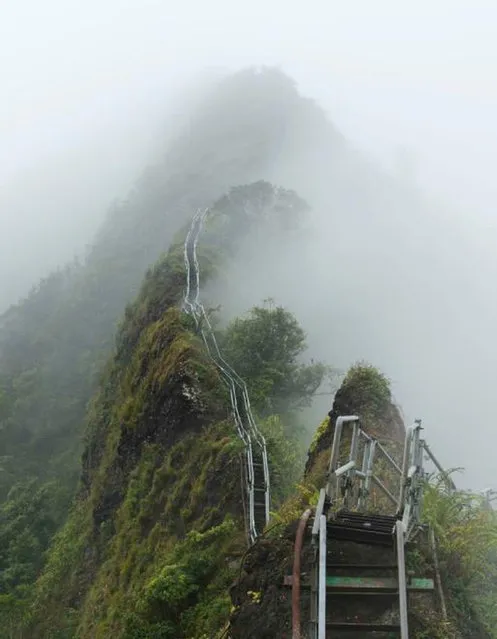
Stairway To Heaven In Hawaii

The Haʻikū Stairs, also known as the Stairway to Heaven or Haʻikū Ladder, is a steep hiking trail on the island of Oʻahu. The trail began as a wooden ladder spiked to the cliff on the south side of the Haʻikū Valley. It was installed in 1942 to enable antenna cables to be strung from one side of the cliffs above Haʻikū Valley to the other. A building to provide a continuous communication link between Wahiawā and Haʻikū Valley Naval Radio Station was constructed at the peak of Puʻukeahiakahoe, elevation about 2,800 feet (850 m). The antennae transmitted very low frequency radio signals from a 200,000-watt Alexanderson alternator in the center of Haʻikū valley. The signals could reach US Navy submarines as far away as Tokyo Bay while the submarines were submerged.
Details
30 Nov 2013 12:47:00
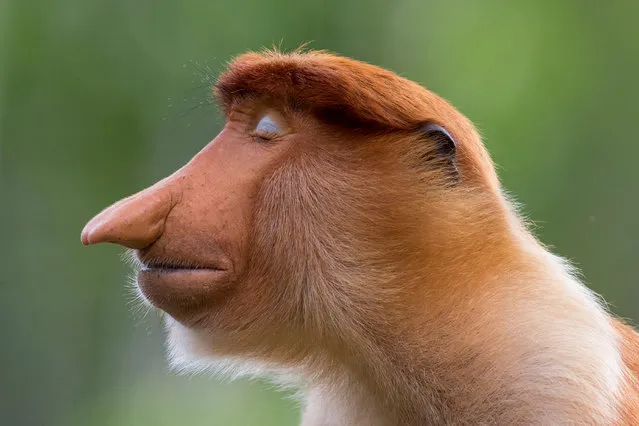
Winner – Animal Portraits: The pose by Mogens Trolle, Denmark. A young male proboscis monkey cocks his head slightly and closes his eyes. Unexpected pale blue eyelids now complement his immaculately groomed auburn hair. He poses for a few seconds as if in meditation. He is a wild visitor to the feeding station at Labuk Bay Proboscis Monkey Sanctuary in Sabah, Borneo – “the most laid-back character”, says Trolle, “quite unlike anything I’ve ever seen on another monkey” – connects us, he hopes, with a fellow primate. (Photo by Mogens Trolle/Wildlife Photographer of the Year 2020)

Winner – Animal Portraits: The pose by Mogens Trolle, Denmark. A young male proboscis monkey cocks his head slightly and closes his eyes. Unexpected pale blue eyelids now complement his immaculately groomed auburn hair. He poses for a few seconds as if in meditation. He is a wild visitor to the feeding station at Labuk Bay Proboscis Monkey Sanctuary in Sabah, Borneo – “the most laid-back character”, says Trolle, “quite unlike anything I’ve ever seen on another monkey” – connects us, he hopes, with a fellow primate. (Photo by Mogens Trolle/Wildlife Photographer of the Year 2020)
Details
16 Oct 2020 00:03:00


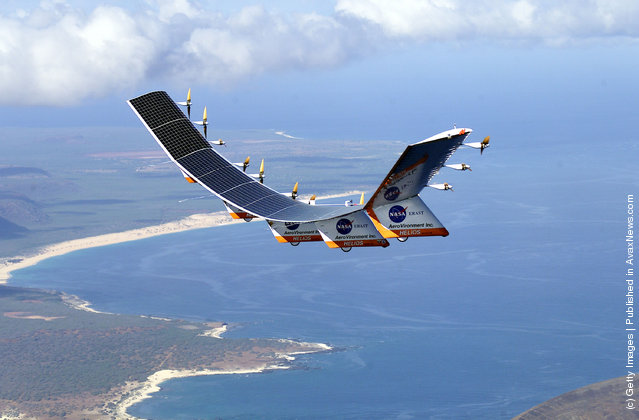
“NASA's Pathfinder, Pathfinder Plus, Centurion and Helios Prototype were an evolutionary series of solar- and fuel-cell-system-powered unmanned aerial vehicles. AeroVironment, Inc. developed the vehicles under NASA's Environmental Research Aircraft and Sensor Technology (ERAST) program. They were built to develop the technologies that would allow long-term, high-altitude aircraft to serve as “atmospheric satellites”, to perform atmospheric research tasks as well as serve as communications platforms”. – Wikipedia

Photo: The solar-electric Helios Prototype flying wing is flies over the Hawaiian islands of Niihau and Lehua during the first solar-powered test flight July 14, 2001 from the U.S. Navy's Pacific Missile Range Facility on Kauai, HI. The 18-hour flight was a functional checkout of the aircraft's systems and performance in preparation for an attempt to reach sustained flight at 100,000 feet altitude later in the summer. (Photo Courtesy of NASA/Getty Images)
Details
14 Jul 2011 09:24:00
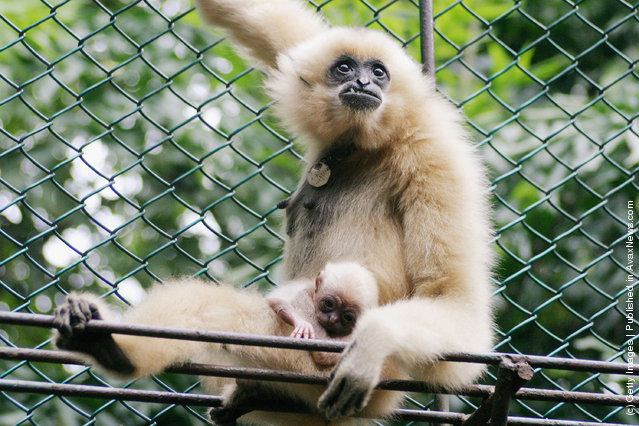
Newborn White-Cheeked Gibbon Nomascus

“Nomascus is the second most speciose genus of gibbons (family Hylobatidae). Originally this genus was a subgenus of Hylobates, and all individuals were considered one species, Hylobates concolor. Species within Nomascus are characterized by 52 chromosomes. Some species are all black, some light with a distinct black tuft of crown fur, and some by distinct, light-colored cheek patches. Nomascus is found from southern China (Yunnan) to southern Vietnam, and also on Hainan Island. One of the genus' species, Nomascus nasutus, has been deemed “the most critically endangered ape species in the world”. All of the species in this genus are endangered or critically endangered”. – Wikipedia

Photo: A newborn White-Cheeked Gibbon clings to its mother in the Nanning Zoo on April 12, 2004 in Nanning, Guangxi province, China. The White-Cheeked Gibbon's natural habitat is Southern China as well as Vietnam and Laos. They are classified as highly endangered and are on the brink of extinction due to poaching and reduction of natural rainforests. (Photo by Getty Images)
Details
12 Aug 2011 11:51:00