Loading...
Done
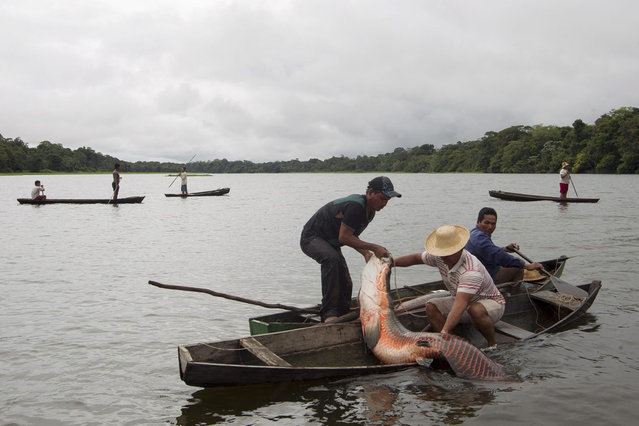
Villagers from the Porto Novo community load into their canoes arapaima or pirarucu, the largest freshwater fish species in South America and one of the largest in the world, while fishing in Poco Fundo lake along a branch of the Solimoes river, one of the main tributaries of the Amazon, in the Mamiraua nature reserve near Fonte Boa about 600 km (373 miles) west of Manaus, November 26, 2013. (Photo by Bruno Kelly/Reuters)

Villagers from the Porto Novo community load into their canoes arapaima or pirarucu, the largest freshwater fish species in South America and one of the largest in the world, while fishing in Poco Fundo lake along a branch of the Solimoes river, one of the main tributaries of the Amazon, in the Mamiraua nature reserve near Fonte Boa about 600 km (373 miles) west of Manaus, November 26, 2013. Catching the arapaima, a fish that is sought after for its meat and is considered by biologists to be a living fossil, is only allowed once a year by Brazil's environmental protection agency. The minimum size allowed for a fisherman to keep an arapaima is 1.5 meters (4.9 feet). (Photo by Bruno Kelly/Reuters)
Details
17 Dec 2013 08:03:00
Mikhail Kalashnikov, the father of the world's most popular assault rifle, is handed  an AK-74 November 23, 2002 in Izhevsk,1000 East km. from Moscow. November 23 marked the 55th anniversary of the release of the first Kalashnikov gun. According to the Moscow-based Center for Analysis of Strategic and Technologies some 70 million to 100 million Kalashnikovs have been built worldwide since 1947, compared about 7 million to Kalashnikov's Western rival the M-16 assault rifles. (Photo by Oleg Nikishin/Getty Images)

Mikhail Kalashnikov, the father of the world's most popular assault rifle, is handed an AK-74 November 23, 2002 in Izhevsk,1000 East km. from Moscow. November 23 marked the 55th anniversary of the release of the first Kalashnikov gun. According to the Moscow-based Center for Analysis of Strategic and Technologies some 70 million to 100 million Kalashnikovs have been built worldwide since 1947, compared about 7 million to Kalashnikov's Western rival the M-16 assault rifles. (Photo by Oleg Nikishin/Getty Images)
Details
24 Dec 2013 09:12:00
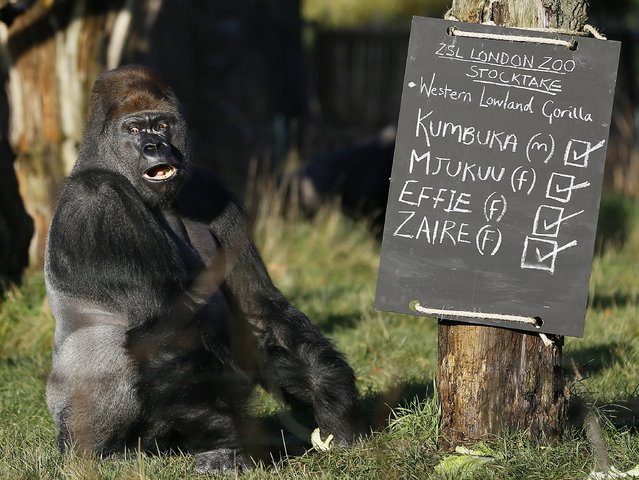
Kumbuka, a male silverback gorilla sits next to the keeper's chalk board in his enclosure at London Zoo, Thursday, January 2, 2014. Home to more than 850 different species, zoo keepers welcomed in the New Year armed with clipboards as they made a note of every single animal. The compulsory annual count is required as part of ZSL London Zoo's zoo license, and every creature, from the tiny leaf cutter ants to the huge silverback gorilla is duly noted and accounted for. (Photo by Kirsty Wigglesworth/AP Photo)

Kumbuka, a male silverback gorilla sits next to the keeper's chalk board in his enclosure at London Zoo, Thursday, January 2, 2014. Home to more than 850 different species, zoo keepers welcomed in the New Year armed with clipboards as they made a note of every single animal. The compulsory annual count is required as part of ZSL London Zoo's zoo license, and every creature, from the tiny leaf cutter ants to the huge silverback gorilla is duly noted and accounted for. (Photo by Kirsty Wigglesworth/AP Photo)
Details
03 Jan 2014 11:03:00
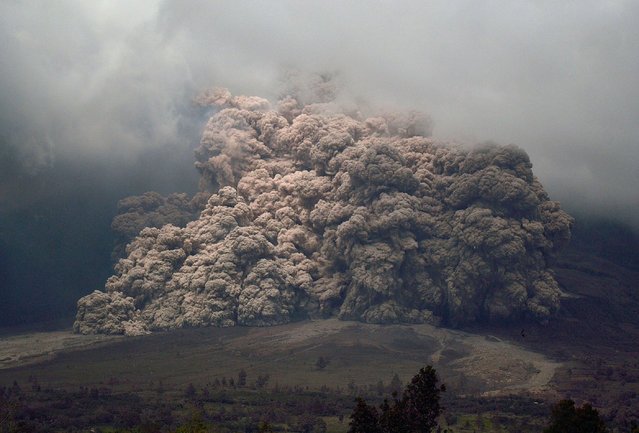
Sinabung mount spews ash to the air during an eruption near from Karo, North Sumatra on January 7, 2014. An Indonesian volcano that has erupted relentlessly for months shot volcanic ash into the air 30 times on January 4, forcing further evacuations with more than 20,000 people now displaced, an official said. (Photo by Sutanta Aditya/AFP Photo)

Sinabung mount spews ash to the air during an eruption near from Karo, North Sumatra on January 7, 2014. An Indonesian volcano that has erupted relentlessly for months shot volcanic ash into the air 30 times on January 4, forcing further evacuations with more than 20,000 people now displaced, an official said. (Photo by Sutanta Aditya/AFP Photo)
Details
09 Jan 2014 09:33:00
1948年3月,外滩,便衣警察棒打偷拿棉花的老太。 (In March 1948, the Bund, plainclothes police officers wreck stole cotton Granny)

Photos from 虹桥故事's photostream. Attention! From Chinese to English translated by Google!

Photo: 1948年3月,外滩,便衣警察棒打偷拿棉花的老太。 (In March 1948, the Bund, plainclothes police officers wreck stole cotton Granny)
Details
12 Aug 2012 08:41:00
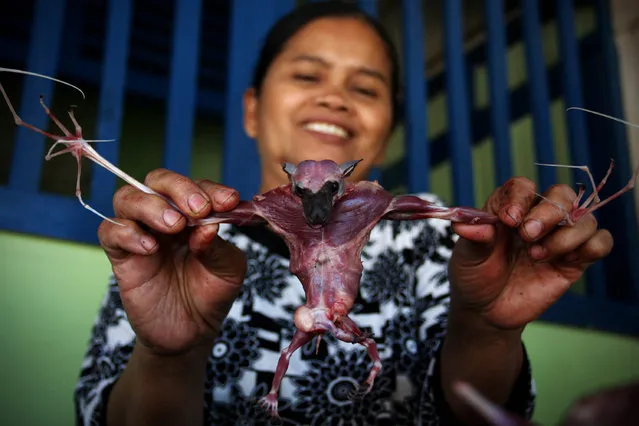
Bat seller Sukarwati shows a skinned bat on July 30, 2009 in Yogyakarta, Indonesia. Sukarwati and her family have hunted bats in the Imogiri region for generations, capturing more than 800 bats per month. The Sukarwati family believe that the meat from the bat heals asthma and respiratory problems and it is a great honour for them knowing that the meat that they provide will help ease people's health ailments

Bat seller Sukarwati shows a skinned bat on July 30, 2009 in Yogyakarta, Indonesia. Sukarwati and her family have hunted bats in the Imogiri region for generations, capturing more than 800 bats per month. The Sukarwati family believe that the meat from the bat heals asthma and respiratory problems and it is a great honour for them knowing that the meat that they provide will help ease people's health ailments. (Photo by Ulet Ifansasti)
Details
20 Sep 2012 08:57:00
NASA's rover Opportunity visits Victoria Crater, viewed from orbit by the High Resolution Imaging Science Experiment on NASA's Mars Reconnaissance Orbiter in october of 2006. Opportunity is a small dot on the crater's lip, at top right. Opportunity first reached the crater's rim on September 27, 2006. (Photo by NASA/JPL-Caltech/University of Arizona/The Atlantic)

“NASA's Mars rover Opportunity just celebrated its ninth anniversary on Mars – a mission that was originally meant to last just 90 days...” – The Atlantic. Photo: NASA's rover Opportunity visits Victoria Crater, viewed from orbit by the High Resolution Imaging Science Experiment on NASA's Mars Reconnaissance Orbiter in october of 2006. Opportunity is a small dot on the crater's lip, at top right. Opportunity first reached the crater's rim on September 27, 2006. (Photo by NASA/JPL-Caltech/University of Arizona via The Atlantic)


Details
14 Feb 2013 10:58:00
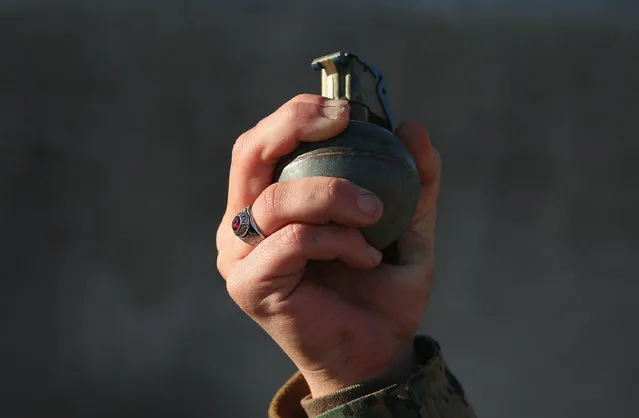
A female Marine prepares to throw a practice grenade during Marine Combat Training (MCT) on February 21, 2013 at Camp Lejeune, North Carolina.  Since 1988 all non-infantry enlisted male Marines have been required to complete 29 days of basic combat skills training at MCT after graduating from boot camp. MCT has been required for all enlisted female Marines since 1997. About six percent of enlisted Marines are female.  (Photo by Scott Olson)

A female Marine prepares to throw a practice grenade during Marine Combat Training (MCT) on February 21, 2013 at Camp Lejeune, North Carolina. Since 1988 all non-infantry enlisted male Marines have been required to complete 29 days of basic combat skills training at MCT after graduating from boot camp. MCT has been required for all enlisted female Marines since 1997. About six percent of enlisted Marines are female. (Photo by Scott Olson)
Details
22 Feb 2013 11:34:00