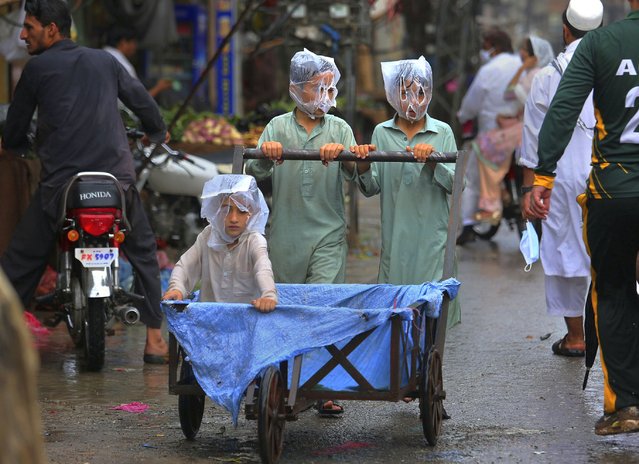
Youths cover their faces with plastic bags while pushing a handcart during rainfall in Peshawar, Pakistan, Sunday, July 12, 2020. (Photo by Muhammad Sajjad/AP Photo)
A woman wearing a face mask has her hair curled by a special equipment at a beauty salon in Bangkok on July 12, 2020. (Photo by Mladen Antonov/AFP Photo)
A model wears a face mask to help prevent the spread of the coronavirus, designed by Iraqi designer Ziad Tariq at his workshop in Basra, Iraq, Monday, July 20, 2020. (Photo by Nabil al-Jurani/AP Photo)
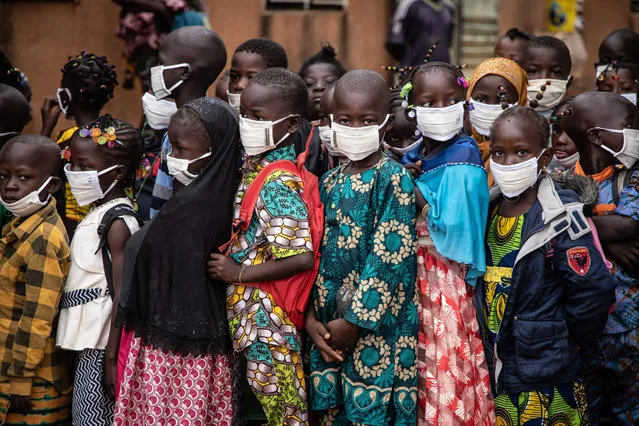
Pupils wearing face masks wait for the opening of their primary school on the first day of the new school year, in Ouagadougou, on October 1, 2020. (Photo by Olympia de Maismont/AFP Photo)
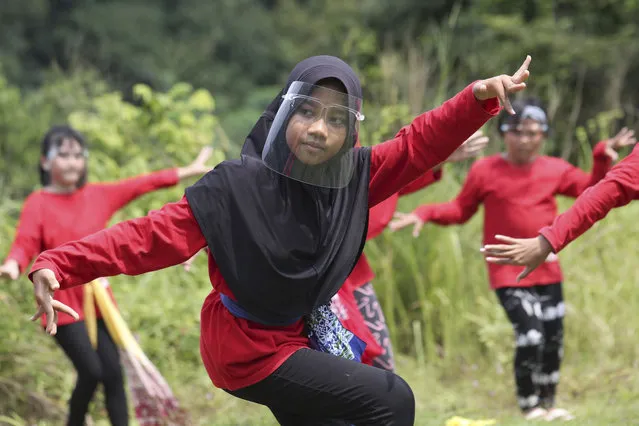
Dancers wearing face shields to prevent the spread of the coronavirus perform during an exercise in Tangerang, Indonesia, Saturday, November 28, 2020, (Photo by Tatan Syuflana/AP Photo)
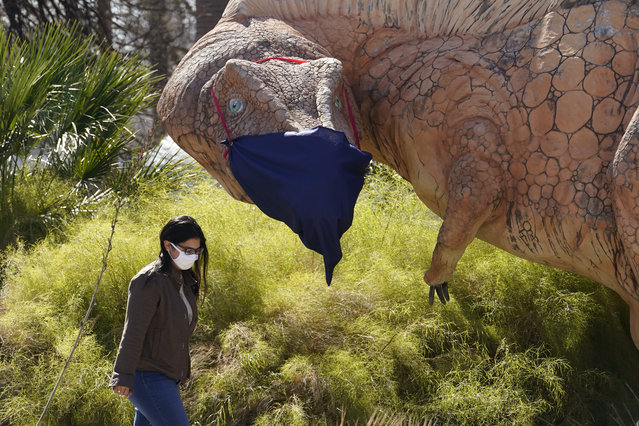
A woman wearing a face mask to protect against the spread of COVID-19 walks past a mask clad Acrocanthosaurus display at the Witte Museum, Thursday, January 28, 2021, in San Antonio. (Photo by Eric Gay/AP Photo)
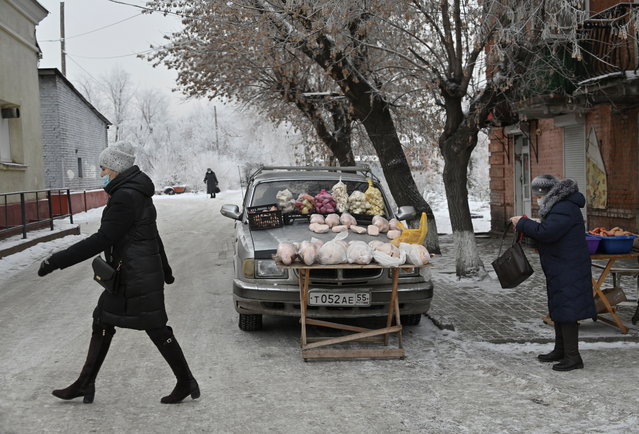
People wearing protective face masks amid the coronavirus disease (COVID-19) outbreak are seen near foodstuffs, which are displayed for sale on a car in Omsk, Russia on December 4, 2020. (Photo by Alexey Malgavko/Reuters)
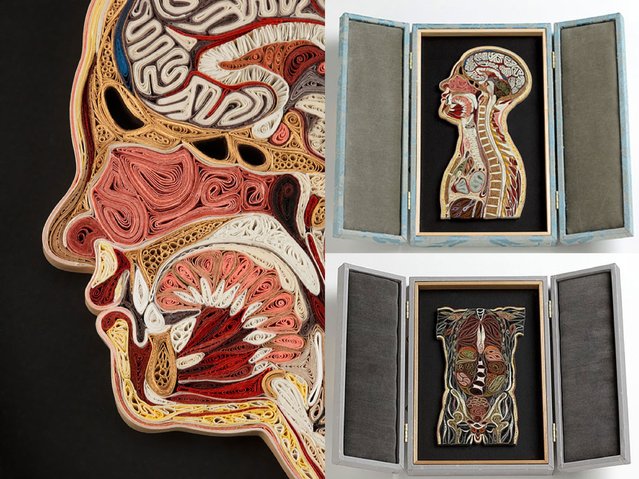
These pieces are made of Japanese mulberry paper and the gilded edges of old books. They are constructed by a technique of rolling and shaping narrow strips of paper called quilling or paper filigree. Quilling was first practiced by Renaissance nuns and monks who are said to have made artistic use of the gilded edges of worn out bibles, and later by 18th century ladies who made artistic use of lots of free time. I find quilling exquisitely satisfying for rendering the densely squished and lovely internal landscape of the human body in cross section.