Loading...
Done
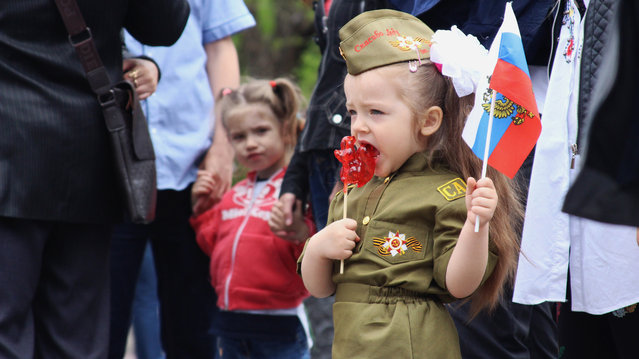
A young Crimean girl wears military-type clothes during a Victory Day celebration in Sevastopol on May 9, 2018. (Photo by Oleksandra Surgan/Radio Free Europe/Radio Liberty)

Children carrying guns and flags or wearing Soviet-style uniforms have become a common sight at Victory Day parades and other events in Russian-controlled Crimea. Russian and Ukrainian human rights activists have warned that such displays point to a growing trend of promoting Russian patriotism among kids on the Crimean peninsula, annexed from Ukraine in 2014. Here: A young Crimean girl wears military-type clothes during a Victory Day celebration in Sevastopol on May 9, 2018. (Photo by Oleksandra Surgan/Radio Free Europe/Radio Liberty)
Details
18 May 2019 00:03:00
Cats crowd the harbour on Aoshima Island in the Ehime prefecture in southern Japan February 25, 2015. An army of cats rules the remote island in southern Japan, curling up in abandoned houses or strutting about in a fishing village that is overrun with felines outnumbering humans six to one. Picture taken February 25, 2015.  REUTERS/Thomas Peter

Cats crowd the harbour on Aoshima Island in the Ehime prefecture in southern Japan February 25, 2015. An army of cats rules the remote island in southern Japan, curling up in abandoned houses or strutting about in a fishing village that is overrun with felines outnumbering humans six to one. Picture taken February 25, 2015. REUTERS/Thomas Peter
Details
04 Mar 2015 14:16:00
A pro-Russian armed man secures crash site wreckage of the Malaysia Airlines Boeing 777 plane (flight MH17) at the site of the plane crash near the settlement of Grabovo in the Donetsk region November 16, 2014. Local emergency services have begun collecting parts of the wreckage from its crash site in the middle of the conflict zone, Dutch air accident investigators said on Sunday. (Photo by Antonio Bronic/Reuters)

A pro-Russian armed man secures crash site wreckage of the Malaysia Airlines Boeing 777 plane (flight MH17) at the site of the plane crash near the settlement of Grabovo in the Donetsk region November 16, 2014. Local emergency services have begun collecting parts of the wreckage from its crash site in the middle of the conflict zone, Dutch air accident investigators said on Sunday. Dutch inspectors had hoped to collect the parts themselves, following the downing of the flight on July 17 that killed 298 people, two thirds of them Dutch citizens. But they remain concerned about the safety of their staff in the rebel-held conflict zone, and so have decided to work with local services following an initial focus on finding human remains and belongings. (Photo by Antonio Bronic/Reuters)
Details
17 Nov 2014 12:47:00
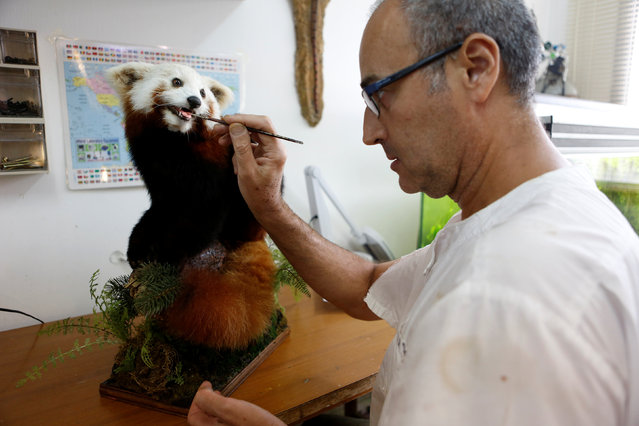
Igor Gavrilov, the main taxidermist of the Zoological centre at Tel Aviv University, works on a taxidermied animal, part of a collection which will be housed at the Steinhardt Museum of Natural History, a new Israeli natural history museum set to open next year in Tel Aviv, Israel June 8, 2016. Legions of insects, sea creatures and ancient fossils are lining up in a new museum shaped liked a giant Noah's Ark, telling the story of a crucial evolutionary byway across Israel. Experts say all humans and other animals had to pass through Israel on their first journey out of Africa into Europe and Asia. (Photo by Nir Elias/Reuters)

Igor Gavrilov, the main taxidermist of the Zoological centre at Tel Aviv University, works on a taxidermied animal, part of a collection which will be housed at the Steinhardt Museum of Natural History, a new Israeli natural history museum set to open next year in Tel Aviv, Israel June 8, 2016. Legions of insects, sea creatures and ancient fossils are lining up in a new museum shaped liked a giant Noah's Ark, telling the story of a crucial evolutionary byway across Israel. (Photo by Nir Elias/Reuters)
Details
25 Aug 2016 09:42:00
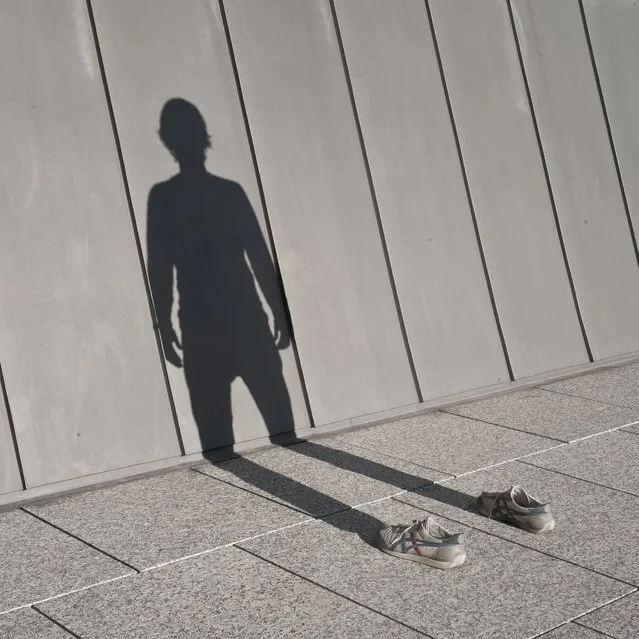
I’m Not There by Pol Ubeda Hervas

Photographer’s Pol Ubeda Hervas perspective in his “I’m not There” series, is going against the flow. While the focus of modern photography is set on the human interaction with his surroundings, Hervas changes thing up by capturing the human absence from said surroundings. The concept behind the series is deeply metaphorical, visual food for though reflecting the situations where the change is irreversible and we cannot even recognize ourselves.
Details
04 Oct 2013 11:58:00
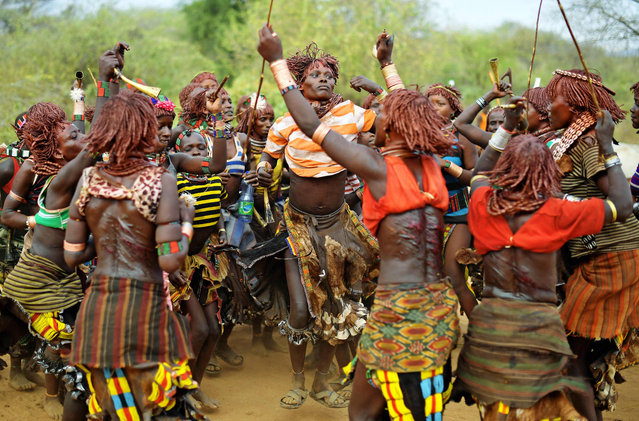
Hamar women dance before a bull jumping ceremony in Ethiopia's southern Omo Valley region near Turmi on September 19, 2016. The Hamar are a Nilotic ethnic group in Ethiopia. The construction of the Gibe III dam, the third largest hydroelectric plant in Africa, and large areas of very “thirsty” cotton and sugar plantations and factories along the Omo river are impacting heavily on the lives of tribes living in the Omo Valley who depend on the river for their survival and way of life. Human rights groups fear for the future of the tribes if they are forced to scatter, give up traditional ways through loss of land or ability to keep cattle as globalisation and development increases. (Photo by Carl De Souza/AFP Photo)

Hamar women dance before a bull jumping ceremony in Ethiopia's southern Omo Valley region near Turmi on September 19, 2016. The Hamar are a Nilotic ethnic group in Ethiopia. The construction of the Gibe III dam, the third largest hydroelectric plant in Africa, and large areas of very “thirsty” cotton and sugar plantations and factories along the Omo river are impacting heavily on the lives of tribes living in the Omo Valley who depend on the river for their survival and way of life. (Photo by Carl De Souza/AFP Photo)
Details
02 Oct 2016 08:45:00
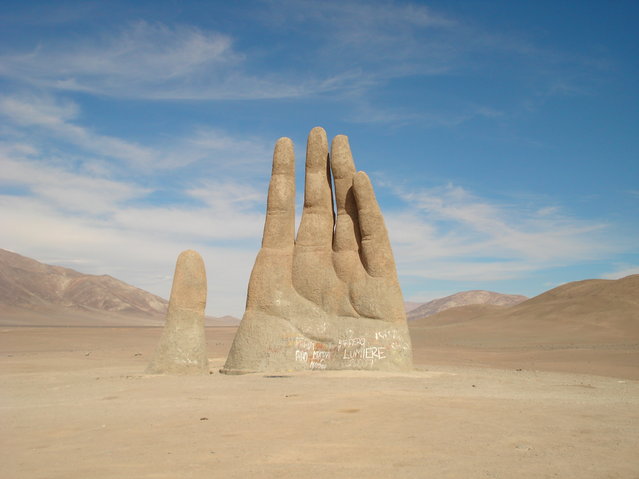
The Giant Hand of Atacama

The Mano de Desierto is a large-scale sculpture of a hand located in the Atacama Desert in Chile, 75 km to the south of the city of Antofagasta, on the Panamerican Highway. The nearest point of reference is the “Ciudad Empresarial La Negra” (La Negra Business City). The sculpture was constructed by the Chilean sculptor Mario Irarrázabal at an altitude of 1,100 meters above sea level. Irarrázabal used the human figure to express emotions like injustice, loneliness, sorrow and torture. Its exaggerated size is said to emphasize human vulnerability and helplessness. The work has a base of iron and cement, and stands 11 metres (36 ft) tall. Funded by Corporación Pro Antofagasta, a local booster organization, the sculpture was inaugurated on March 28, 1992.
Details
21 Dec 2013 10:18:00
Senji Nakajima sleeps with his Love Doll “Saori” at Love Hotel on June 4, 2016 in Nagano, Japan. Senji Nakajima, 61 years old, lives with his life-size 'love doll' named “Saori” in his apartment in Tokyo, Japan. Nakajima, married with two children, who lives away from home for work, first started his life with Saori six years ago. At first, he used to imagine as if the doll was his first girl friend, and used it only for sexual purposes to fill the loneliness, but months later, he started to find Saori actually has an original personality. “She never betrays, not after only money. I'm tired of modern rational humans. They are heartless”, Nakajima says, “for me, she is more than a doll. Not just a silicon rubber. She needs much help, but still is my perfect partner who shares precious moments with me and enriches my life”. (Photo by Taro Karibe/Getty Images)

Senji Nakajima sleeps with his Love Doll “Saori” at Love Hotel on June 4, 2016 in Nagano, Japan. Senji Nakajima, 61 years old, lives with his life-size “love doll” named “Saori” in his apartment in Tokyo, Japan. Nakajima, married with two children, who lives away from home for work, first started his life with Saori six years ago. (Photo by Taro Karibe/Getty Images)
Details
07 Aug 2016 09:21:00