Loading...
Done
Arctic Hare

The arctic hare, or polar rabbit, is a species of hare which is adapted largely to polar and mountainous habitats. The arctic hare survives with a thick coat of fur and usually digs holes in the ground or under snow to keep warm and sleep. Arctic hares look like rabbits but have shorter ears, are taller when standing, and, unlike rabbits, can thrive in cold climates. They can travel together with many other hares, sometimes huddling with dozens or more, but are usually found alone, taking, in some cases, more than one partner. The arctic hare can run up to 60 kilometres per hour (40 mph). Its predators include the arctic wolf, arctic fox, and ermine.
Details
17 Mar 2014 13:56:00
Chernobyl Disaster – Disaster Fighters

“The Chernobyl disaster was a catastrophic nuclear accident that occurred on 26 April 1986 at the Chernobyl Nuclear Power Plant in Ukrainian SSR, which was under the direct jurisdiction of the central authorities in Moscow. An explosion and fire released large quantities of radioactive contamination into the atmosphere, which spread over much of Western USSR and Europe. It is widely considered to have been the worst nuclear power plant accident in history, and is one of only two classified as a level 7 event on the International Nuclear Event Scale (the other being the Fukushima Daiichi nuclear disaster)”. – Wikipedia (Photos by Alexandr Strannik, August 1986; Source: LiveJournal)
Details
26 Apr 2012 13:20:00
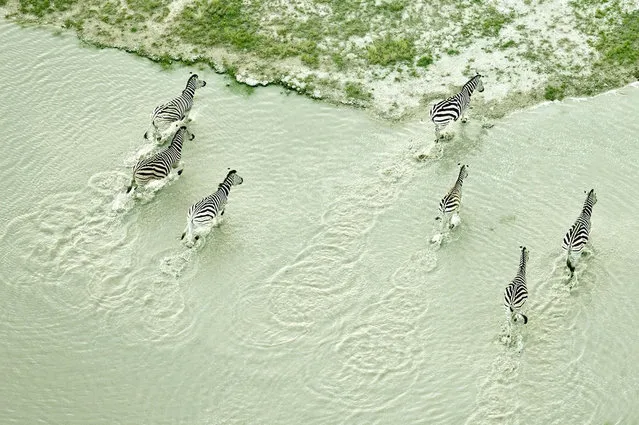
Botswana By Zack Seckler

Aerial shots always amaze us by their magnificence. Human-sized footprints look like ant trails, trees resemble little pieces of broccoli, and landscapes are transformed into breathtaking images, which look like something that can be seen under a microscope. This set of pictures features surreal aerial shots of Botswana taken by Zack Seckler. In the past, to make these kinds of shots, someone had to go up in a helicopter to take a picture. However, today, such images can be easily made using quadcopters, such as DJI Phantom or any other. Thanks to the new technology, we are able to view our world in new ways, allowing us to better appreciate its complexity and beauty. (Photo by Zack Seckler)
Details
14 Dec 2014 11:32:00
Regenwurmlager, Poland. The Regenwurmlager is an extensive underground fortification area constructed by Germany in 1920s-1940s, now in western Poland, near the city of Międzyrzecz. (Photo by Anna Arinova/Caters News)

Stunning silhouettes under European cities reveal the size and splendor of the continent’s urban foundations. Photographer and content-manager Anna Arinova, 28, from Moscow, captured the awe-inspiring labyrinths in Russia and Germany. Here: Regenwurmlager, Poland. The Regenwurmlager is an extensive underground fortification area constructed by Germany in 1920s-1940s, now in western Poland, near the city of Międzyrzecz. (Photo by Anna Arinova/Caters News)
Details
29 Dec 2016 07:53:00
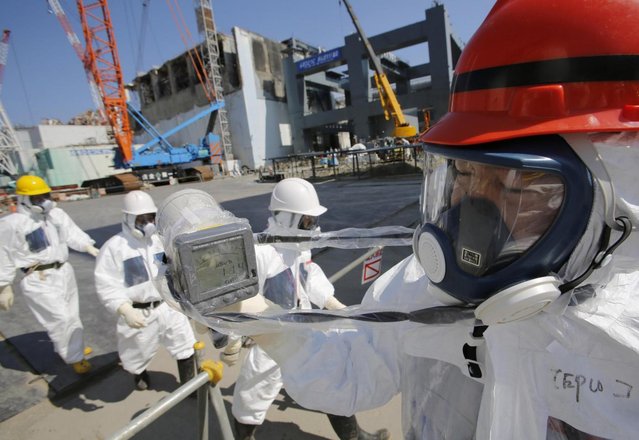
A radiation monitor indicates 114.00 microsieverts per hour near the building housing the plant's No. 4 reactor, center, and an under construction foundation, right, which will store the reactor's melted fuel rods at Tokyo Electric Power Co.'s tsunami-crippled Fukushima Dai-ichi nuclear power plant in Okuma, Fukushima prefecture, Wednesday, March 6, 2013, ahead of the second anniversary of the March 11, 2011 tsunami and earthquake. (Photo by Issei Kato/AP Photo/Pool)

A radiation monitor indicates 114.00 microsieverts per hour near the building housing the plant's No. 4 reactor, center, and an under construction foundation, right, which will store the reactor's melted fuel rods at Tokyo Electric Power Co.'s tsunami-crippled Fukushima Dai-ichi nuclear power plant in Okuma, Fukushima prefecture, Wednesday, March 6, 2013, ahead of the second anniversary of the March 11, 2011 tsunami and earthquake. Some 110,000 people living around the nuclear plant were evacuated after the massive March 11, 2011, earthquake and tsunami knocked out the plant's power and cooling systems, causing meltdowns in three reactors and spewing radiation into the surrounding air, soil and water. (Photo by Issei Kato/AP Photo/Pool)
Details
06 Mar 2013 13:19:00
Scenes from the popular Walking Street normally packed with tourists filled with bars and restaurants in Pattaya, Thailand on March 10, 2020. Thailand depends on tourism, currently tourist arrivals have plunged more than 50% and are expected to continue for months ahead. According to the World Health Organization (WHO) in Thailand there has been 59 confirmed cases of Coronavirus ( COVID-19 ) with 6 new, only one death with around 1,903 persons under treatment. Latest information on the Novel Coronavirus has infected more than 118,000 people and killed close to 4,300. (Photo by Paula Bronstein/Getty Images)

Scenes from the popular Walking Street normally packed with tourists filled with bars and restaurants in Pattaya, Thailand on March 10, 2020. Thailand depends on tourism, currently tourist arrivals have plunged more than 50% and are expected to continue for months ahead. According to the World Health Organization (WHO) in Thailand there has been 59 confirmed cases of Coronavirus ( COVID-19 ) with 6 new, only one death with around 1,903 persons under treatment. Latest information on the Novel Coronavirus has infected more than 118,000 people and killed close to 4,300. (Photo by Paula Bronstein/Getty Images)
Details
16 Mar 2020 00:01:00
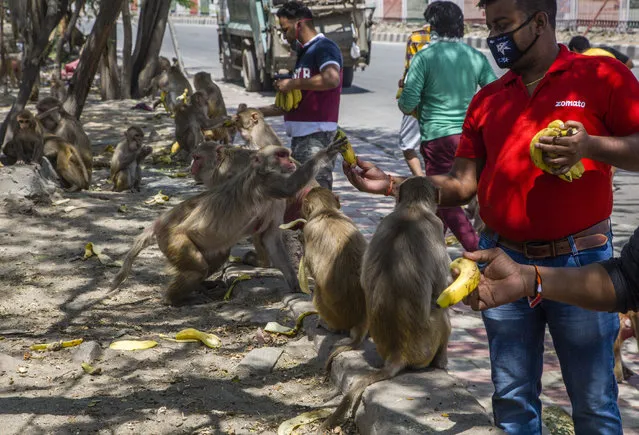
Men give bananas to monkeys gathered on the side of the road as India remains under an unprecedented lockdown over the highly contagious coronavirus (COVID-19) on April 08, 2020 in New Delhi, India. Wild animals, including monkeys, are roaming human settlements in India as people are staying indoors due to the 21-day lockdown. With India's 1.3 billion population and tens of millions of cars off the roads, wildlife is moving towards areas inhabited by humans. Wild animals in many countries have been seen roaming streets. A study says some 60 percent of the new diseases found around the globe every year are zoonotic, meaning they originate in animals and are passed on to humans. COVID-19 is a zoonotic disease that is suspected to have come from the wet markets of Wuhan, China. (Photo by Yawar Nazir/Getty Images)

Men give bananas to monkeys gathered on the side of the road as India remains under an unprecedented lockdown over the highly contagious coronavirus (COVID-19) on April 08, 2020 in New Delhi, India. Wild animals, including monkeys, are roaming human settlements in India as people are staying indoors due to the 21-day lockdown. (Photo by Yawar Nazir/Getty Images)
Details
12 Apr 2020 00:05:00
The face of a graduating student is displayed on a tablet attached to a robot during a “cyber graduation” ceremony at a school on May 22, 2020 in Taguig, Metro Manila, Philippines. Robots represented some 179 graduating students of the Senator Rene Cayetano Science and Technology High School during a graduation ceremony that was streamed online, as mass gatherings remain prohibited in the country under the Philippine government's lockdown to curb the spread of the coronavirus. The robots were developed by alumni of the school's robotics club, which used tablets to display the faces of the graduating students as they “marched” on stage to receive their diplomas. The Philippines' Department of Health has so far reported 13,434 cases of the coronavirus in the country, with at least 846 recorded fatalities. (Photo by Ezra Acayan/Getty Images)

The face of a graduating student is displayed on a tablet attached to a robot during a “cyber graduation” ceremony at a school on May 22, 2020 in Taguig, Metro Manila, Philippines. Robots represented some 179 graduating students of the Senator Rene Cayetano Science and Technology High School during a graduation ceremony that was streamed online, as mass gatherings remain prohibited in the country under the Philippine government's lockdown to curb the spread of the coronavirus. The robots were developed by alumni of the school's robotics club, which used tablets to display the faces of the graduating students as they “marched” on stage to receive their diplomas. The Philippines' Department of Health has so far reported 13,434 cases of the coronavirus in the country, with at least 846 recorded fatalities. (Photo by Ezra Acayan/Getty Images)
Details
24 May 2020 00:07:00