Loading...
Done
Mick Dodge AKA "The Barefoot Sensei

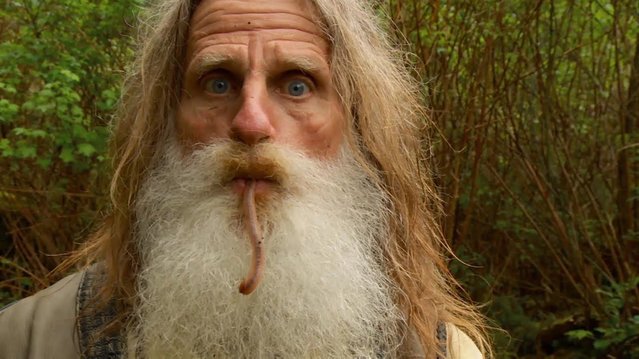
If you were to meet this guy in the woods, especially if it’s nighttime, you’d probably think that it’s a local troll or a yeti. However, in reality, he’s no yeti. His name is Mick Dodge, and before deciding to live in the woods, he was a marine for six years at Fort Lewis. It is hard to tell what moved him to leave the busy life of the city and start living in the Hoh Rain Forest. It could have been that he decided the leave the stressful life of the city, or maybe he simply loves the solitary life of a hermit. Another thing that is peculiar about Mick Dodge is that most of the time he walks barefoot, hence the nickname “The Barefoot Sensei”.
Details
27 Nov 2014 14:54:00
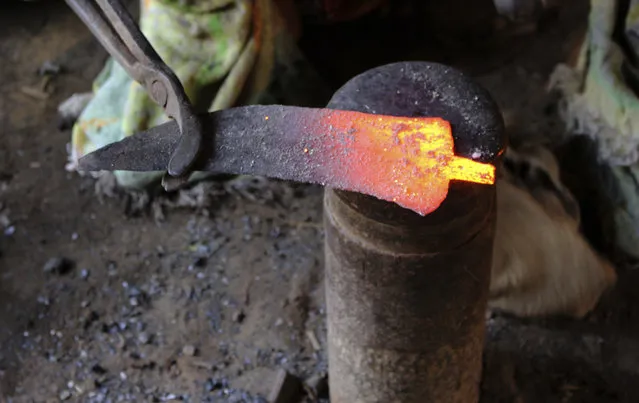
In this October 6, 2018, photo, a craftsman makes daggers or “Jambiyya” in Yemeni Arabic, made out of remains of missiles, at his workshop, in Hajjah, Yemen. (Photo by Hammadi Issa/AP Photo)

In this October 6, 2018, photo, a craftsman makes daggers or “Jambiyya” in Yemeni Arabic, made out of remains of missiles, at his workshop, in Hajjah, Yemen. Missiles raining on Yemen from the jets of the Saudi-led coalition fighting Houthi rebels are killing thousands of civilians and militiamen alike, but amid crashing economy, some Yemenis see the bright side of it: they make daggers out of the fragments of the missiles for ordinary men traditionally wear for prestige and a show of courage. (Photo by Hammadi Issa/AP Photo)
Details
10 Oct 2018 00:01:00
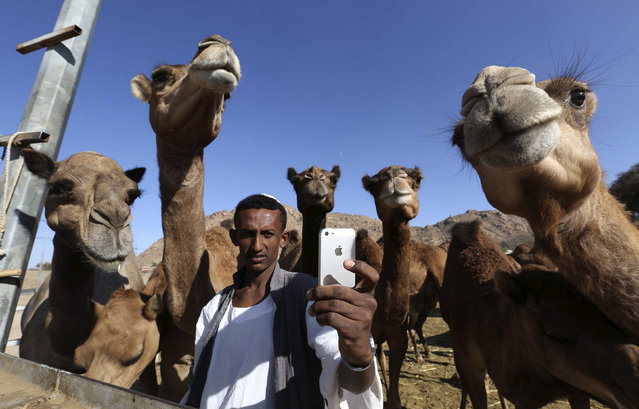
A man takes a “selfie” with camels at a farm in Taif November 1, 2014. Saudi Arabia said late on Wednesday it had detected six new cases of the deadly Middle East Respiratory Syndrome (MERS) in 24 hours, the biggest daily jump for months with officials blaming lax hospital procedures. (Photo by Mohamed Alhwaity/Reuters)

A man takes a “selfie” with camels at a farm in Taif November 1, 2014. Saudi Arabia said late on Wednesday it had detected six new cases of the deadly Middle East Respiratory Syndrome (MERS) in 24 hours, the biggest daily jump for months with officials blaming lax hospital procedures. Scientists are not sure of the origin of the virus, but several studies have linked it to camels and some experts think it is being passed to humans through close physical contact or through the consumption of camel meat or camel milk. (Photo by Mohamed Alhwaity/Reuters)
Details
08 Nov 2014 12:33:00
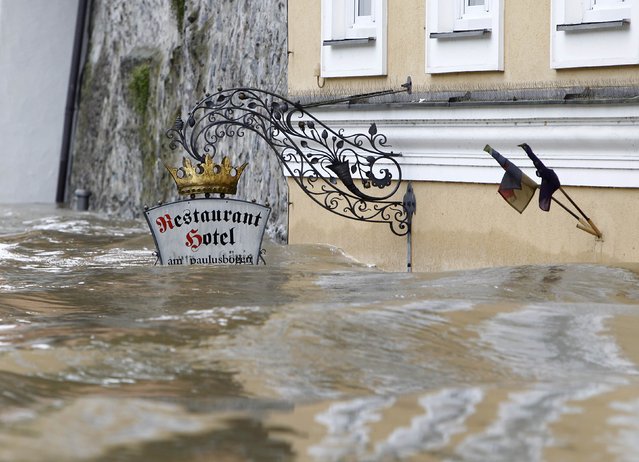
The sign above the door of restaurant and hotel 'Am Paulusbogen' is partially submerged in the flooded centre of the Bavarian town of Passau, about 200 km (124 miles) north-east of Munich June 3, 2013. Torrential rain in the south and south-east of Germany caused heavy flooding over the weekend, forcing people to evacuate their homes. (Photo by Michaela Rehle/Reuters)

The sign above the door of restaurant and hotel “Am Paulusbogen” is partially submerged in the flooded centre of the Bavarian town of Passau, about 200 km (124 miles) north-east of Munich June 3, 2013. (Photo by Michaela Rehle/Reuters)
Details
05 Jun 2013 08:43:00
Tim Laman - Wildlife Photojournalist

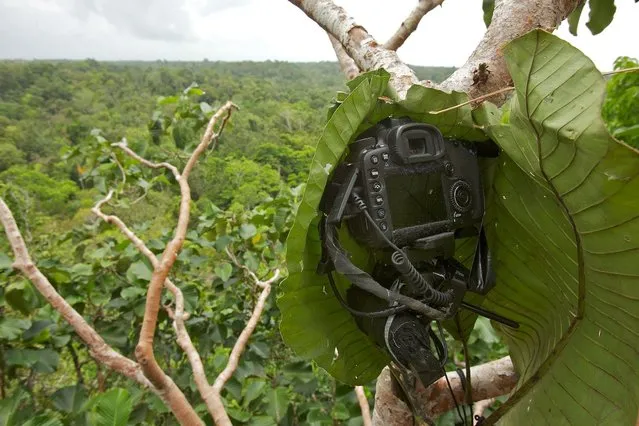
Tim Laman is a field biologist and wildlife photojournalist. His pioneering research in the rain forest canopy in Borneo led to a PhD from Harvard and his first National Geographic article in 1997. Since then, he has pursued his passion for exploring wild places and documenting little-known and endangered wildlife by becoming a regular contributor to National Geographic. He has eighteen articles to his credit to date, all of which have had a conservation message. Some have focused on endangered species such as Orangutans or Hornbills, while others, such as a series of articles on Conservation International’s Biodiversity Hotspots, have highlighted regions under intense pressure.
Details
14 Sep 2013 10:13:00
Cenote In Mexico

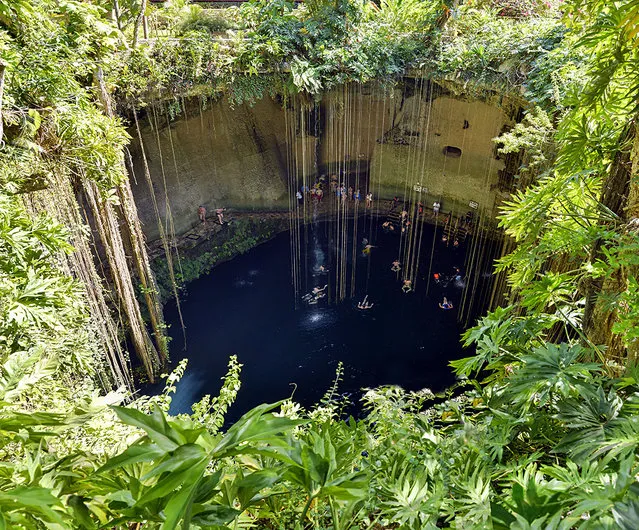
A cenote is a natural phenomenon, a sinkhole in the Earth’s surface. The Yucatan Peninsula in Mexico has an estimated 7,000 cenotes because it is primarily made up of porous limestone. For millions of years, rainfall slowly ate away at the limestone and a huge system of underground caves and caverns was formed. Many filled with water from rain or from the underground water table. When the roof of a water filled cave collapses, a cenote is born. The water found in a cenote may be fresh water, salt water, or both. Structurally it may be completely open, like a lake, almost completely closed with just a small opening at the top, or somewhere in between.
Details
06 Oct 2013 09:45:00


“NTV (Cyrillic: НТВ) is a Russian television channel. As a subsidiary of Vladimir Gusinsky's company Media-Most, it was a pioneer in the post-Soviet independent television media, but was later taken over by state-owned Gazprom”. – Wikipedia

Photo: A woman with “I love NTV” painted on here face cheers in support of the independent Russian NTV television station April 7, 2001 during a rally in Moscow. Thousands of people gathered in the rain to show their support for Russia's only national independent television station in its fight against new owners. (Photo by Oleg Nikishin/Newsmakers)
Details
15 Apr 2011 10:53:00


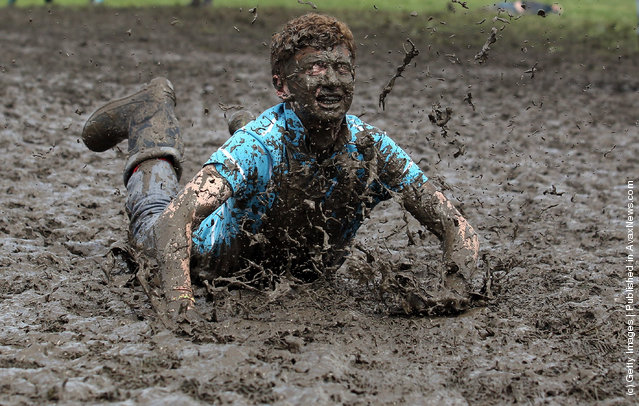
Tom Wilder, 17 from Kent, dives in the mud at the Glastonbury Festival site at Worthy Farm, Pilton on June 23, 2011 in Glastonbury, England. Music fans had to brave more rain today at the five-day festival which opened yesterday. This year the festival will feature headline acts U2, Coldplay and Beyonce. The festival, which started in 1970 when several hundred hippies paid 1 GBP to watch Marc Bolan, has grown into Europe's largest music festival attracting more than 175,000 people over five days. (Photo by Matt Cardy/Getty Images)
Details
24 Jun 2011 10:01:00