Loading...
Done
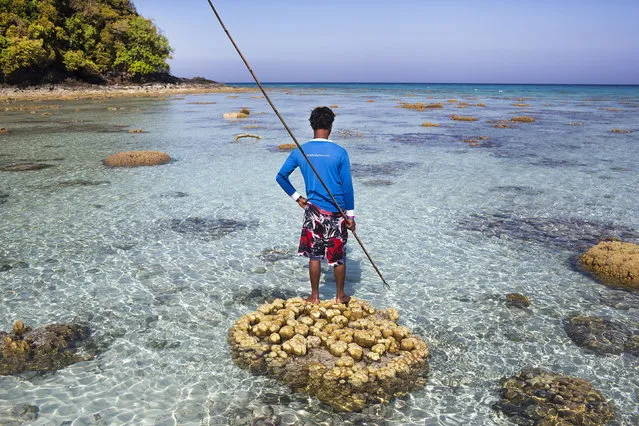
Hook, an indigenous Moken man, holds a three-pronged throwing spear and searches for fish in the waters of Ko Surin National Park. March 1, 2013 – Ko Surin, Thailand. (Photo by Taylor Weidman/zReportage via ZUMA Press)

“For centuries, the Moken sea nomads have traveled the islands between Thailand and Myanmar fishing and foraging for food on the sea floor. Throughout the Mergui Archipelago, Moken migrate in flotillas of Kabangs (traditional boat of the Moken people), stopping at different islands and beaches. Expert freedivers, the Moken have adapted physically to an aquatic life, developing unique characteristics that let them see better and hold their breath longer while underwater”. – Taylor Weidman. Photo: Hook, an indigenous Moken man, holds a three-pronged throwing spear and searches for fish in the waters of Ko Surin National Park. March 1, 2013 – Ko Surin, Thailand. (Photo by Taylor Weidman/zReportage via ZUMA Press)
Details
24 Mar 2014 06:45:00
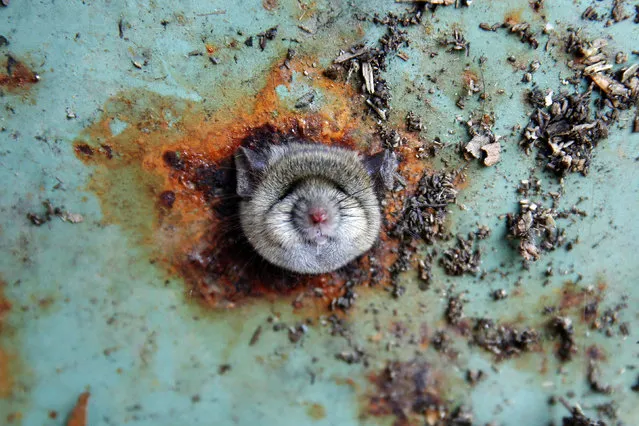
A rat's head rests as it is constricted in an opening in the bottom of a garbage can in the Brooklyn borough of New York, U.S., October 18, 2016. (Photo by Lucas Jackson/Reuters)

A rat's head rests as it is constricted in an opening in the bottom of a garbage can in the Brooklyn borough of New York, U.S., October 18, 2016. The Brooklyn rat was saved on Tuesday after getting its head stuck in the dumpster while scavenging for food, according to the New York Daily News. As the rat was scurrying around the bottom of the trash can, it came across a few ventilation holes. The hungry creature poked his head into one of them, but to its dismay couldn't get back out,Reuters photographer Lucas Jackson told the Daily News. Jackson was able to take some adorable photos of the rat's unfortunate situation before it was rescued. (Photo by Lucas Jackson/Reuters)
Details
19 Oct 2016 12:26:00
Spectators pose for a photo upon entry for Derby Day at Flemington Racecourse on October 30, 2021 in Melbourne, Australia. Victoria's COVID-19 restrictions have eased to allow spectators to return to Flemington racecourse for the first time since 2019. Up to 5,500 fully vaccinated fans are permitted to attend Derby Day, while the remainder of the Melbourne Cup Carnival Race days will have a spectator limit of 10,000 people. Under COVID-19 restrictions, all patrons to the Melbourne Cup Carnival will be separated into three zones, with allocated seats for the service of food and drink. Spectators will be required to wear masks at Flemington, despite Victoria's outdoor mask mandate easing on Friday. (Photo by Asanka Ratnayake/Getty Images)

Spectators pose for a photo upon entry for Derby Day at Flemington Racecourse on October 30, 2021 in Melbourne, Australia. Victoria's COVID-19 restrictions have eased to allow spectators to return to Flemington racecourse for the first time since 2019. (Photo by Asanka Ratnayake/Getty Images)
Details
18 Jun 2022 04:34:00
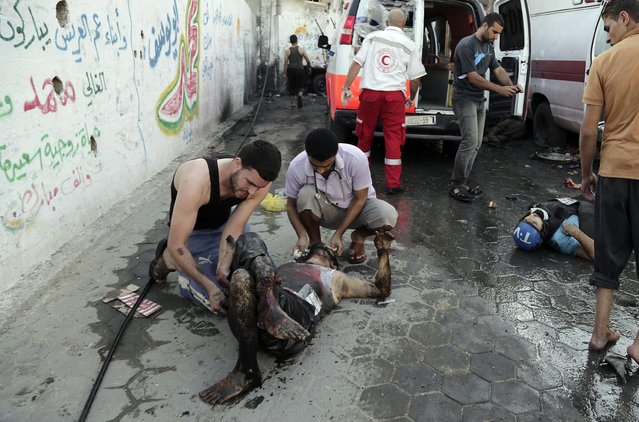
In this July 30, 2014 photo, neighbors help gravely injured Mohammed al-Selek, 39, wounded by an Israeli mortar strike as he lays next to the body of Palestinian journalist Rami Reyan who was killed, in the Shijaiyah neighborhood of the northern Gaza Strip. Al-Selek's life changed forever last July 30, when the shells slammed into his home killing all his three children, his father and six other relatives. (Photo by Adel Hana/AP Photo)

In this July 30, 2014 photo, neighbors help gravely injured Mohammed al-Selek, 39, wounded by an Israeli mortar strike as he lays next to the body of Palestinian journalist Rami Reyan who was killed, in the Shijaiyah neighborhood of the northern Gaza Strip. Al-Selek's life changed forever last July 30, when the shells slammed into his home killing all his three children, his father and six other relatives. A year later, al-Selek, who lost his leg during the airstrike, still struggles to recover and come to terms with his family's loss in the 50-day Israel-Hamas war. (Photo by Adel Hana/AP Photo)
Details
07 Jul 2015 11:28:00
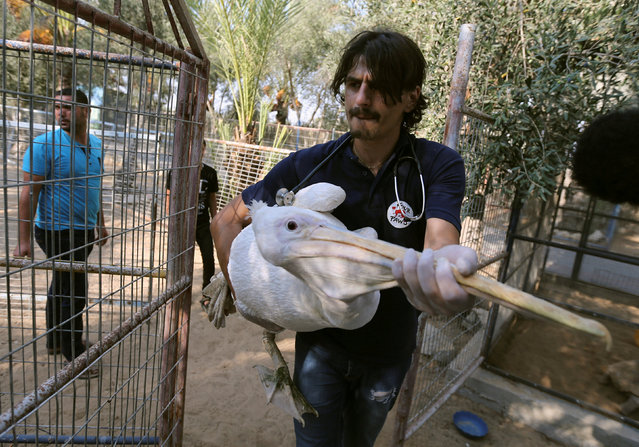
A member of Four Paws International team carries a pelican to be taken out of Gaza, at a zoo in Khan Younis in the southern Gaza Strip August 23, 2016. Fifteen animals including a bengal tiger were removed from “the world’s worst zoo” in the Gaza town of Khan Younis as it was finally closed down. Animal welfare group, Four Paws International, will help bring most of the refugees to a zoo in Jordan, but the tiger will be taken to a refuge in South Africa. Five monkeys, a porcupine, an emu and the tiger, among others, crossed from the occupied territory into Israel after the zoo suffered from years of difficulty. With lack of awareness of animal welfare in Gaza, the densely-populated territory has previously made headlines after another zoo painted donkeys with stripes to resemble zebras in 2009. (Photo by Ibraheem Abu Mustafa/Reuters)

A member of Four Paws International team carries a pelican to be taken out of Gaza, at a zoo in Khan Younis in the southern Gaza Strip August 23, 2016. Fifteen animals including a bengal tiger were removed from “the world’s worst zoo” in the Gaza town of Khan Younis as it was finally closed down. Animal welfare group, Four Paws International, will help bring most of the refugees to a zoo in Jordan, but the tiger will be taken to a refuge in South Africa. (Photo by Ibraheem Abu Mustafa/Reuters)
Details
26 Aug 2016 10:22:00
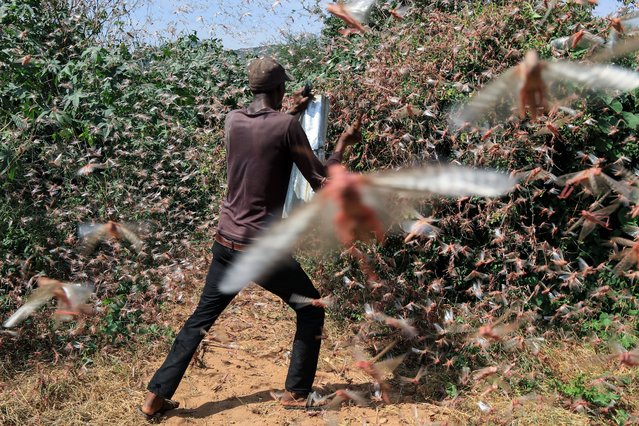
A man uses iron sheet to make noises, as a way of trying to disperse desert locusts that had invaded their farms during the second wave invasion in Kakongo village, in Nuu-Mwingi East, in Kitui, Kenya, 06 February 2021. The second wave invasion of the desert locusts in the country comes at a time where most famers are expecting to harvest their farm produce in the country. According to the United Nations Food and Agriculture Organization (FAO), on 04 February, warned numerous immature desert locust swarms persist in southern Ethiopia and Kenya. Some of the swarms are in community areas and therefore cannot be treated. In Kenya, immature swarms continue to spread westwards across northern and central counties where there are currently about 20 small swarms present, mostly about 50 hectares in size, it said. (Photo by Daniel Irungu/EPA/EFE)

A man uses iron sheet to make noises, as a way of trying to disperse desert locusts that had invaded their farms during the second wave invasion in Kakongo village, in Nuu-Mwingi East, in Kitui, Kenya, 06 February 2021. The second wave invasion of the desert locusts in the country comes at a time where most famers are expecting to harvest their farm produce in the country. (Photo by Daniel Irungu/EPA/EFE)
Details
25 Feb 2021 08:17:00
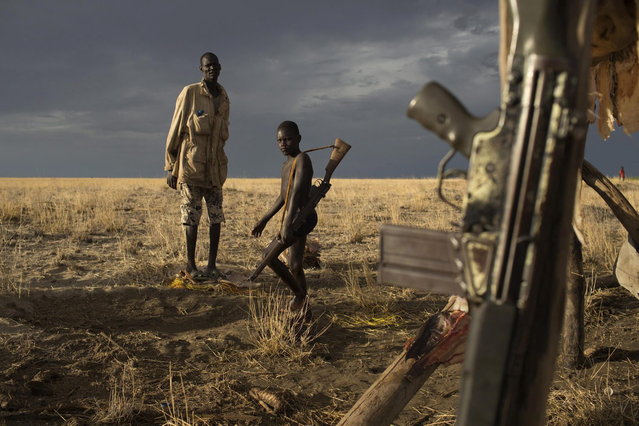
A Turkana man and a boy carrying a gun look on as a G3 battle rifle hangs from a structure used to dry fish at a fishing camp on the shores of Lake Turkana, some kilometres from Todonyang near the Kenya-Ethiopia border in northwestern Kenya October 12, 2013. (Photo by Siegfried Modola/Reuters)

A Turkana man and a boy carrying a gun look on as a G3 battle rifle hangs from a structure used to dry fish at a fishing camp on the shores of Lake Turkana, some kilometres from Todonyang near the Kenya-Ethiopia border in northwestern Kenya October 12, 2013The Turkana are traditionally nomadic pastoralists, but they have seen the pasture that they need to feed their herds suffer from recurring droughts and many have turned to fishing. However, Lake Turkana is overfished, and scarcity of food and pastureland is fuelling long-standing conflict with Ethiopian indigenous Dhaasanac, who have seen grazing grounds squeezed by large-scale government agricultural schemes in southern Ethiopia. The Dhaasanac now venture ever deeper into Kenyan territory in search of fish and grass, clashing with neighbours. Fighting between the communities has a long history, but the conflict has become ever more fatal as automatic weapons from other regional conflicts seep into the area. While the Turkana region is short of basics like grass and ground-water, it contains other resources including oil reserves and massive, newly discovered underground aquifers. (Photo by Siegfried Modola/Reuters)
Details
05 Dec 2013 12:08:00
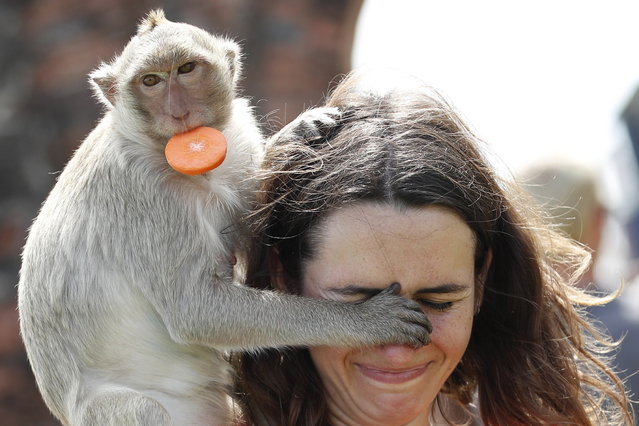
A monkey is being fed by a foreign tourist during the annual Monkey Banquet at Phra Prang Sam Yod ancient temple in Lopburi, some 180km from Bangkok, central Thailand, 24 November 2024. The annual gala has been organized since 1989 by Lopburi's entrepreneur Yongyuth Kitwatananusont, offering all-you-can-eat fruits, vegetables, and desserts for monkeys to honor the long-tailed macaques to attract tourists to visit the town to promote tourism. According to the Wildlife Department, more than 2,000 urban monkeys were captured in 2024 by authorities to control the monkey population after the growing complaints of residents that the macaques maraud food, frequently confront residents, causing accidents as well as their properties, assets, and the ancient city to be overrun and damaged by the monkeys. (Photo by Rungroj Yongrit/EPA)

A monkey is being fed by a foreign tourist during the annual Monkey Banquet at Phra Prang Sam Yod ancient temple in Lopburi, some 180km from Bangkok, central Thailand, 24 November 2024. The annual gala has been organized since 1989 by Lopburi's entrepreneur Yongyuth Kitwatananusont, offering all-you-can-eat fruits, vegetables, and desserts for monkeys to honor the long-tailed macaques to attract tourists to visit the town to promote tourism. (Photo by Rungroj Yongrit/EPA)
Details
08 Dec 2024 04:22:00