Loading...
Done
Japanese Yuuka Hasumi, 17, and Ibuki Ito, 17, also from Japan, who want to become K-pop stars, perform during their street performance in Hongdae area of Seoul, South Korea, March 21, 2019. Hasumi put high school in Japan on hold and flew to South Korea in February to try her chances at becoming a K-pop star, even if that means long hours of vocal and dance training, no privacy, no boyfriend, and even no phone. “It is tough”, Hasumi said. “Going through a strict training and taking my skill to a higher level to a perfect stage, I think that's when it is good to make a debut”. (Photo by Kim Hong-Ji/Reuters)

Japanese Yuuka Hasumi, 17, and Ibuki Ito, 17, also from Japan, who want to become K-pop stars, perform during their street performance in Hongdae area of Seoul, South Korea, March 21, 2019. (Photo by Kim Hong-Ji/Reuters)
Details
28 Feb 2021 10:09:00
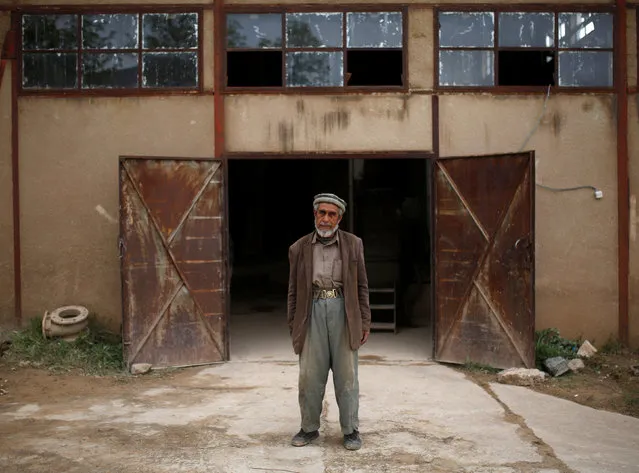
A worker at the Jabal Saraj cement factory poses for a photograph in Jabal Saraj, north of Kabul, Afghanistan April 19, 2016. (Photo by Ahmad Masood/Reuters)

A worker at the Jabal Saraj cement factory poses for a photograph in Jabal Saraj, north of Kabul, Afghanistan April 19, 2016. In an area desperately short of industry and jobs, local workers hope that the relaunch of the plant in Jabal Saraj, built by Czech engineers in 1957 and closed down by the Taliban in 1995, can show that Afghanistan's shattered industry can climb back to its feet after decades of war and destruction. But the outdated state-owned plant some 75 kilometres outside Kabul also shows how far it has to go before that promise can be achieved and there are serious questions over whether it has a viable future unless a new, modern facility is built to replace it. (Photo by Ahmad Masood/Reuters)
Details
31 May 2016 11:29:00
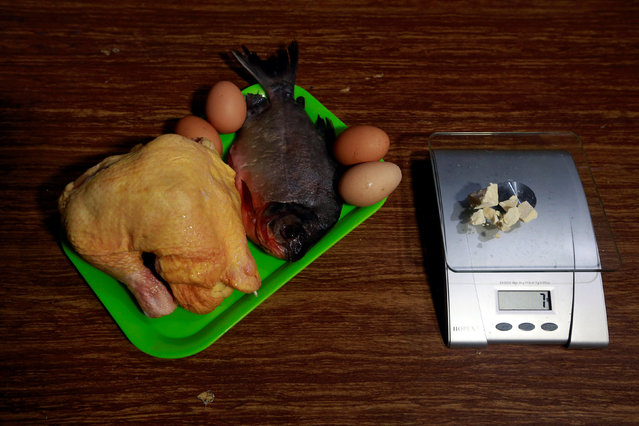
Chicken, fish and eggs lie next to coca paste worth $14,000 Colombian pesos at a local store in Guyabero Region, Guaviare, Colombia, May 24, 2016. (Photo by John Vizcaino/Reuters)

Chicken, fish and eggs lie next to coca paste worth $14,000 Colombian pesos at a local store in Guyabero Region, Guaviare, Colombia, May 24, 2016. As the government nears a historic peace deal with the rebels of the Revolutionary Armed Forces of Colombia (FARC), the nation's authorities are struggling to tame an increase in farming of coca, the raw material used to make cocaine. In the Guyabero Region, where many people work on coca plantations, locals barter coca paste to buy groceries at the local shop. (Photo by John Vizcaino/Reuters)

Details
03 Jun 2016 12:46:00
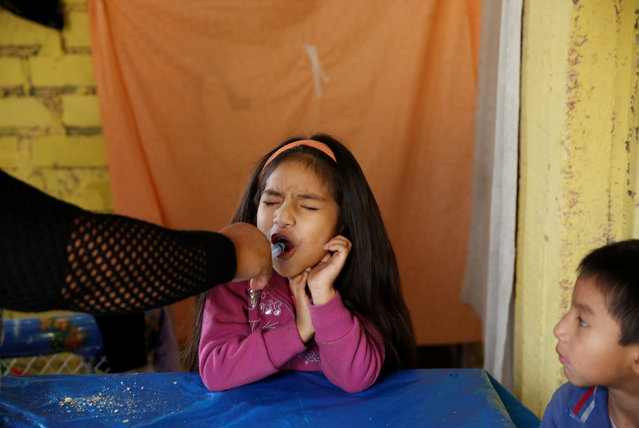
Jazmin, 6, sister of Jose Luis, receives Isoniazid Preventive Therapy in Carabayllo in Lima, Peru July 14, 2016. (Photo by Mariana Bazo/Reuters)

Jazmin, 6, sister of Jose Luis, receives Isoniazid Preventive Therapy in Carabayllo in Lima, Peru July 14, 2016. At least 30,000 Peruvians are infected with tuberculosis, an ancient disease that killed 1.8 million globally last year, more than AIDS-related and malaria deaths combined. Partners in Health, a Boston-based non-profit that works with Peru's health ministry, offers a simple solution. It trains community volunteers to tend to tuberculosis sufferers in their homes – ensuring patients take medicine daily and helping them navigate the public health bureaucracy. (Photo by Mariana Bazo/Reuters)
Details
23 Nov 2016 11:25:00
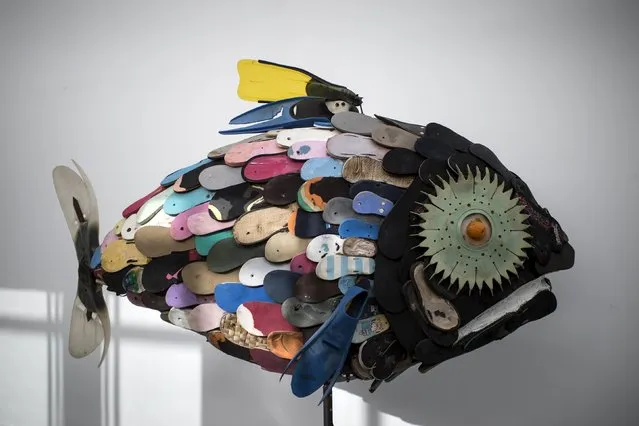
A sculpture of a fish made from waste products collected from the sea is displayed during the exhibition Keep The Oceans Clean by art collective Skeleton Sea, at the Torre Madariaga Biodiversity Centre in Busturia, Spain, May 17, 2015. (Photo by Vincent West/Reuters)

A sculpture of a fish made from waste products collected from the sea is displayed during the exhibition Keep The Oceans Clean by art collective Skeleton Sea, at the Torre Madariaga Biodiversity Centre in Busturia, Spain, May 17, 2015. Skeleton Sea, a group of surfers and artists, recycle waste collected from the world's oceans to create artworks and draw attention to the dangers faced from overfishing, pollution and oil spills. (Photo by Vincent West/Reuters)
Details
19 May 2015 11:16:00
 Kyaiktiyo Pagoda AKA  Golden Rock In Burma

Kyaiktiyo Pagoda, also known as Golden Rock is a well-known Buddhist pilgrimage site in Mon State, Burma. It is a small pagoda (7.3 metres (24 ft)) built on the top of a granite boulder covered with gold leaves pasted on by devotees. According to legend, the Golden Rock itself is precariously perched on a strand of the Buddha's hair. The balancing rock seems to defy gravity, as it perpetually appears to be on the verge of rolling down the hill. The rock and the pagoda are at the top of Mt. Kyaiktiyo. It is the third most important Buddhist pilgrimage site in Burma after the Shwedagon Pagoda and the Mahamuni Pagoda. A glimpse of the "gravity defying" Golden Rock is believed to be enough of an inspiration for any person to turn to Buddhism.
Details
04 Jun 2015 11:42:00
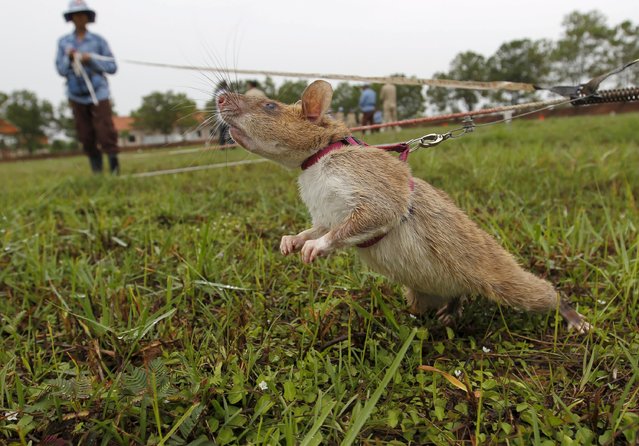
A rat being trained by the Cambodian Mine Action Centre (CMAC) is pictured on an inactive landmine field in Siem Reap province July 9, 2015. Gambian pouched rats were deployed to Cambodia from Tanzania in April by a Belgian non-profit organization, APOPO, to help clear mines. (Photo by Samrang Pring/Reuters)

A rat being trained by the Cambodian Mine Action Centre (CMAC) is pictured on an inactive landmine field in Siem Reap province July 9, 2015. Gambian pouched rats were deployed to Cambodia from Tanzania in April by a Belgian non-profit organization, APOPO, to help clear mines. They've been trained since they were 4 weeks old. Cambodia is still littered with landmines after emerging from decades of civil war, including the 1970s Khmer Rough “Killing Fields” genocide, leaving it with one of the world's highest disability rates. APOPO has used the rodents for mine-clearing projects in several countries, including Angola, Mozambique, Thailand, Laos, and Vietnam. (Photo by Samrang Pring/Reuters)
Details
14 Jul 2015 13:35:00
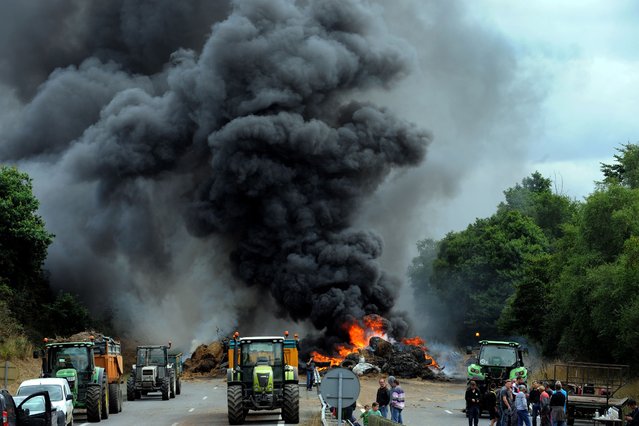
Farmers use tractors and burn tires, hay and manure as they block the highway between Morlaix and Brest during a demonstration against the market prices of their product, on July 22, 2015 in Morlaix, western of France. French farmers protesting over falling food prices threatened to step up blockades of cities, roads and tourist sites, as the government prepared to unveil emergency aid for them. (Photo by Fred Tanneau/AFP Photo)

Farmers use tractors and burn tires, hay and manure as they block the highway between Morlaix and Brest during a demonstration against the market prices of their product, on July 22, 2015 in Morlaix, western of France. French farmers protesting over falling food prices threatened to step up blockades of cities, roads and tourist sites, as the government prepared to unveil emergency aid for them. Farmers have dumped manure in cities, blocked access roads and motorways and hindered tourists from reaching Mont St-Michel in northern France, one of France's most visited sites. (Photo by Fred Tanneau/AFP Photo)
Details
23 Jul 2015 10:39:00