Loading...
Done
Masooma Alizada (L) and Frozan Rasooli (R), members of Afghanistan's Women's National Cycling Team prepare a bicycle before training on the outskirts of Kabul February 20, 2015. (Photo by Mohammad Ismail/Reuters)

Masooma Alizada (L) and Frozan Rasooli (R), members of Afghanistan's Women's National Cycling Team prepare a bicycle before training on the outskirts of Kabul February 20, 2015. Afghanistan's Women's National Cycling Team has been breaking new ground for women's sports and pushing the boundaries of what is – and is not – acceptable for young women in the conservative Muslim country. (Photo by Mohammad Ismail/Reuters)
Details
15 Mar 2015 05:58:00
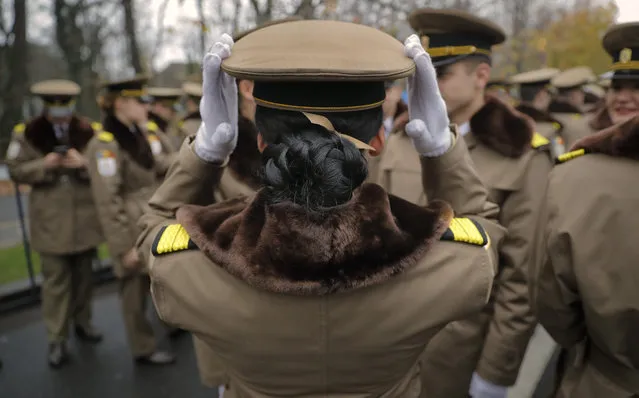
A female member of Romania's military adjusts her hat before taking part in the national day military parade in Bucharest, Romania, Friday, December 1, 2017. (Photo by Vadim Ghirda/AP Photo)

A female member of Romania's military adjusts her hat before taking part in the national day military parade in Bucharest, Romania, Friday, December 1, 2017. Thousands of Romanian troops staged a military parade to celebrate Romania's national day, but key politicians didn't attend, signaling tensions between the president and the ruling left-wing coalition over plans to revamp the justice system. (Photo by Vadim Ghirda/AP Photo)
Details
03 Dec 2017 05:57:00
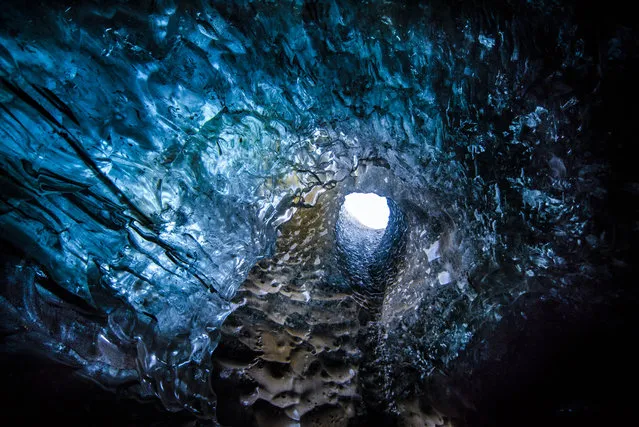
The ice caves, taken in the Vatnajokull National Park in Iceland, on November 11, 2017. (Photo by Matej Kriz/Caters News Agency)

These frozen caves seem almost otherworldly as they daylight illuminates them. Matej Kriz’s shots reveal the beauty of the brilliant caves, but he’s also very aware of how deadly they can be. The photographer captured the amazing shots in the Vatnajokull National Park on the Breidamerkurjokull glacier tongue. Here: The ice caves, taken in the Vatnajokull National Park in Iceland, on November 11, 2017. (Photo by Matej Kriz/Caters News Agency)
Details
17 Jan 2018 07:45:00

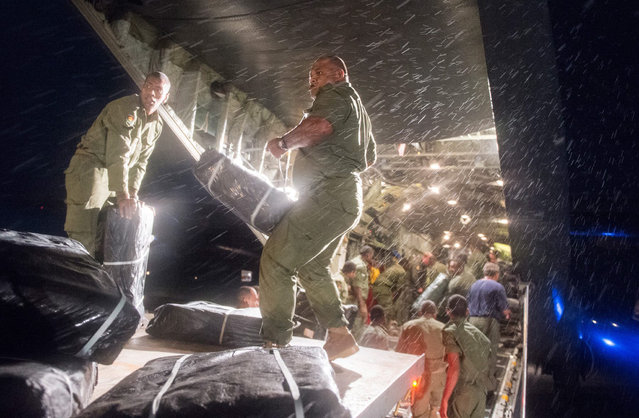
A handout image provided by the New Zealand Defence Force shows aid supplies being unloaded by Fijian soldiers from an Royal New Zealand Airforce C-130 Hercules plane in Suva, Fiji, 23 February 2016. Tool kits, generators, ration packs, water containers and chainsaws make up part of the New Zealand relief following Tropical Cyclone Winston. The death toll from the cyclone that hit Fiji over the weekend climbed to 29, local media reported ON 23 February. (Photo by Sam Shepherd/EPA/NZ Defence Force)

A handout image provided by the New Zealand Defence Force shows aid supplies being unloaded by Fijian soldiers from an Royal New Zealand Airforce C-130 Hercules plane in Suva, Fiji, 23 February 2016. Tool kits, generators, ration packs, water containers and chainsaws make up part of the New Zealand relief following Tropical Cyclone Winston. The death toll from the cyclone that hit Fiji over the weekend climbed to 29, local media reported ON 23 February. Cyclone Winston, the most powerful storm in Fiji's history, battered the country's main island of Viti Levu and other smaller surrounding islands on Saturday, the Fiji Broadcasting Corporation reported. (Photo by Sam Shepherd/EPA/NZ Defence Force)
Details
24 Feb 2016 12:56:00
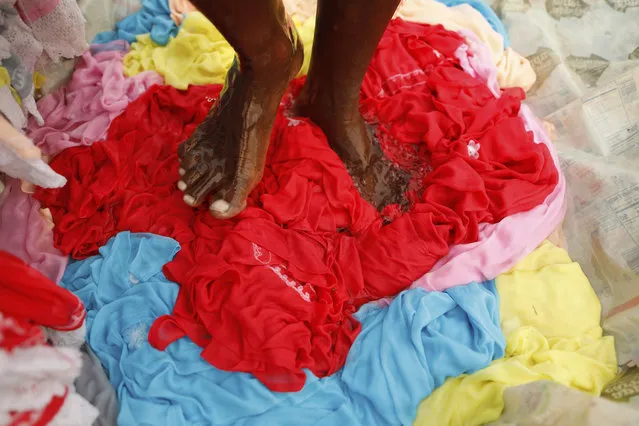
A dhobi, or a washerman washes cloths on the banks of the River Gomti in Lucknow, India, Saturday, September 12, 2020. Dhobis are traditional laundry workers who wash clothes by hand and dry them in the sun, an occupation which has been in existence for generations. Most cities in India have a Dhobi Ghat, or washermen's area, where the city's pile of clothes is laundered. This practice is still popular in India, despite of modern technology. Around 1,000 families work in Lucknow's Dhobi Ghat. However, in light of the novel coronavirus, their wages have decreased drastically. With each family earning around US$100-200 per month. (Photo by Rajesh Kumar Singh/AP Photo)

A dhobi, or a washerman washes cloths on the banks of the River Gomti in Lucknow, India, Saturday, September 12, 2020. Dhobis are traditional laundry workers who wash clothes by hand and dry them in the sun, an occupation which has been in existence for generations. Most cities in India have a Dhobi Ghat, or washermen's area, where the city's pile of clothes is laundered. This practice is still popular in India, despite of modern technology. Around 1,000 families work in Lucknow's Dhobi Ghat. However, in light of the novel coronavirus, their wages have decreased drastically. With each family earning around US$100-200 per month. (Photo by Rajesh Kumar Singh/AP Photo)
Details
25 Sep 2020 00:03:00
Kliluk, the Spotted Lake, Canada

Originally known to the First Nations of the Okanagan Valley as Khiluk, which was- and remains today revered as a sacred site producing therapeutic waters. During World War I the minerals of Spotted Lake were used in manufacturing ammunition. Later the area came under the control of the Ernest Smith Family, for a term of about 40 years. In 1979 Smith attempted to create interest in a spa at the lake. The First Nations responded with an effort to buy the lake; in October 2001 they finally struck a deal. First Nations arranged the purchase of 22 hectares of land for a total of $720,000, and contributed about 20% of the cost. The Indian Affairs Department paid the remainder.
Details
06 Mar 2015 12:59:00
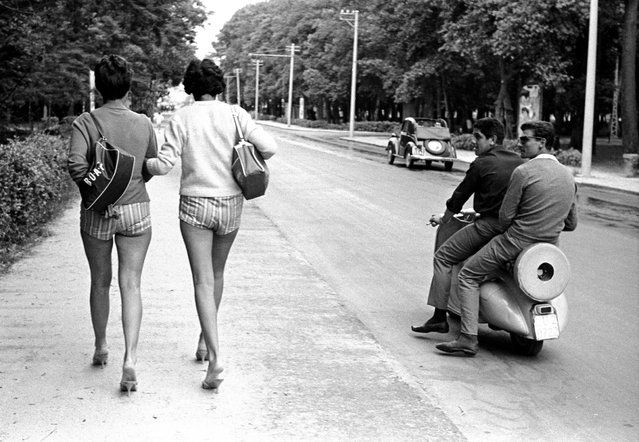
Viareggio in 1959. (Photo by Paolo Di Paolo/National Museum of 21st Century Arts)

The “Paolo Di Paolo: Lost World” exhibition presents more than 250 largely unseen images from the photographer’s archive. Di Paolo chronicled life in his country as an economic boom followed the destruction of the second world war. Although those were the years of la dolce vita he was an anti-paparazzo – he shunned the salacious and respected his subjects. The exhibition is at MAXXI, the National Museum of 21st Century Arts in Rome until 30 June. Here: Viareggio in 1959. (Photo by Paolo Di Paolo/National Museum of 21st Century Arts)
Details
01 May 2019 00:03:00
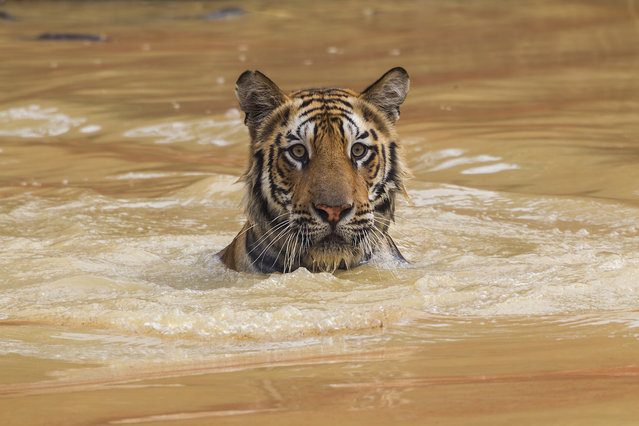
A 14-month-old cub, cooling off in a pond, is riveted by a deer that appeared near the shore. Tigers are powerful swimmers; they can easily cross rivers four to five miles wide and have been known to swim distances of up to 18 miles. (Photo by Steve Winter/National Geographic)

National Geographic photographer Steve Winter has spent most of his adult life shooting wild cats. Photo: A 14-month-old cub, cooling off in a pond, is riveted by a deer that appeared near the shore. Tigers are powerful swimmers; they can easily cross rivers four to five miles wide and have been known to swim distances of up to 18 miles. (Photo by Steve Winter/National Geographic)
Details
08 Apr 2014 11:52:00