Loading...
Done


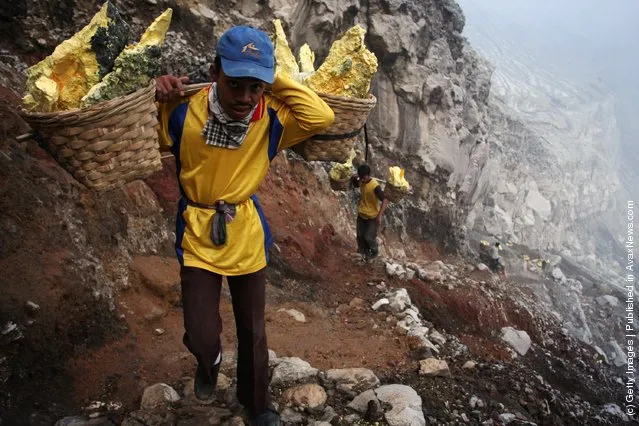
Traditional miners carry sulphur on the Ijen volcano complex on May 25, 2009 outside Banyuwangi, East Java, Indonesia. Miners carry the solidified yellow sulphur blocks from the crater floor to the rim for as many hours a day as they can tolerate, paid by the kilogram of sulphur they extract. The average wage is USD $.05 per kilogram of sulphur and a worker, depending on his strength and stamina, carry on average 3 baskets of 70-80kg per day, earning him around USD $11. (Photo by Ulet Ifansasti/Getty Images)
Details
08 Jul 2011 10:53:00
A baby Common Wombat

“Wombats are Australian marsupials; they are short-legged, muscular quadrupeds, approximately 1 metre (39 in) in length with a short, stubby tail. They are adaptable in their habitat tolerances, and are found in forested, mountainous, and heathland areas of south-eastern Australia, including Tasmania, as well as an isolated patch of about 300 ha in Epping Forest National Park in central Queensland”. – Wikipedia

Photo: “Abdul”, a baby Common Wombat, is one of the marsupials on show during the spring baby boom at Taronga Zoo September 1, 2005 in Sydney, Australia. “Abdul” was orphaned when his mother was killed by a car. (Photo by Mark Nolan/Getty Images)
Details
20 Aug 2011 11:23:00
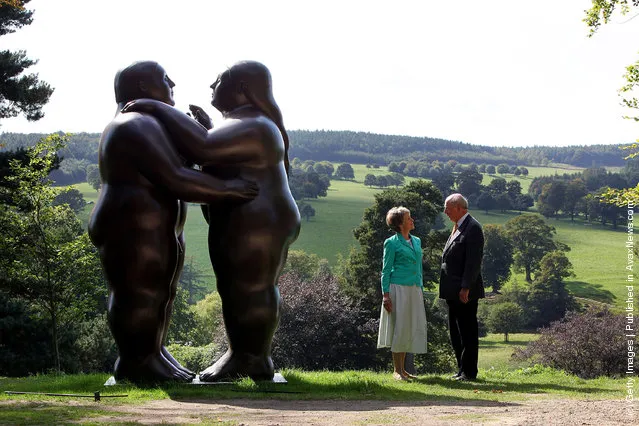
Dancers  by artist Fernando Botero

“Fernando Botero Angulo (born April 19, 1932) is a Colombian figurative artist. His works feature a figurative style, called by some “Boterismo”, which gives them an unmistakable identity. Botero depicts women, men, daily life, historical events and characters, milestones of art, still-life, animals and the natural world in general, with exaggerated and disproportionate volumetry, accompanied by fine details of scathing criticism, irony, humor, and ingenuity”. – Wikipedia

Photo: The Duke and Duchess of Devonshire view “Dancers” by artist Fernando Botero in the gardens of their home Chatsworth House on September 10, 2009, Chatsworth, England. (Photo by Christopher Furlong/Getty Images)
Details
29 Nov 2011 10:02:00
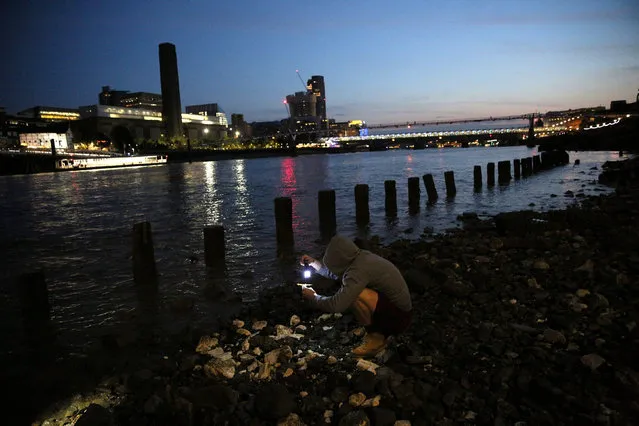
A mudlark uses a torch to look for items on the bank of the River Thames in London, Britain June 06, 2016. Mudlarking is believed to trace its origins to the 18th and 19th century, when scavengers searched the Thames' shores for items to sell. These days, history and archaeology fans are the ones hoping to find old relics such as coins, ceramics, artifacts or everyday items from across centuries. They wait for the low tide and then scour specific areas of exposed shores. "If you're in a field you could be out all day long, with the river you're restricted to about two or three hours," mudlark Nick Stevens said. While many just use the naked eye for their searches, others rely on metal detectors for which a permit from the Port of London Authority is needed. Digging also requires consent. (Photo by Neil Hall/Reuters)

A mudlark uses a torch to look for items on the bank of the River Thames in London, Britain June 06, 2016. Mudlarking is believed to trace its origins to the 18th and 19th century, when scavengers searched the Thames' shores for items to sell. These days, history and archaeology fans are the ones hoping to find old relics such as coins, ceramics, artifacts or everyday items from across centuries. their finds with the Portable Antiquities Scheme. Any item over 300 years old must be recorded. (Photo by Neil Hall/Reuters)
Details
27 Aug 2016 10:43:00
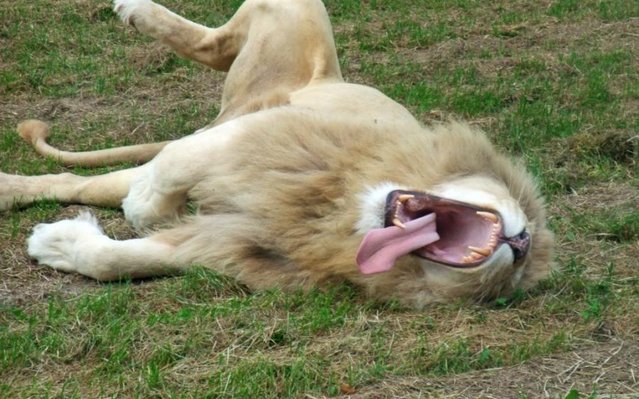
Animals Yawning

In animals, yawning can serve as a warning signal. For example, Charles Darwin, in his book The Expression of the Emotions in Man and Animals, mentioned that baboons yawn to threaten their enemies, possibly by displaying large canine teeth. Similarly, Siamese fighting fish yawn only when they see a conspecific (same species) or their own mirror-image, and their yawn often accompanies aggressive attack. Guinea pigs also yawn in a display of dominance or anger, displaying their impressive incisor teeth. This is often accompanied by teeth chattering, purring and scent marking.

Details
11 Aug 2012 09:12:00
Students Protest Over The Cuts In The Education Budget

A protester uses his laptop computer in the “Occupy LSX” camp outside St. Paul's Cathedral ahead of a demonstration against higher tuition fees and privatisation in universities on November 9, 2011 in London, England. Around 4000 police officers are on duty and are to be allowed to deploy baton rounds if needed. The march is expected to finish at London Wall in the heart of the capital's financial district. (Photo by Oli Scarff/Getty Images)
Details
10 Nov 2011 09:58:00
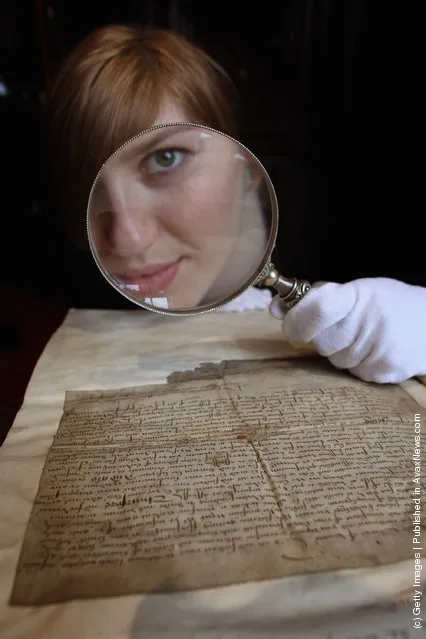
Charlotte Roirdan from Lyon & Turnbull views a letter written by Mary Queen of Scots

Charlotte Roirdan from Lyon & Turnbull views a letter written by Mary Queen of Scots on March 8, 2012 in Edinburgh, Scotland. The 450 year old letter, unearthed in Blair Castle in Ayrshire, has been verified as the hand writing of Mary Queen of Scotts and has been valued at 3,000 GBP. The letter, dated March 20, 1554, relieves the then laird of Blair from his duties due to gout and will be put up for sale next week at an auction in Edinburgh. (Photo by Jeff J. Mitchell/Getty Images)
Details
11 Mar 2012 10:19:00
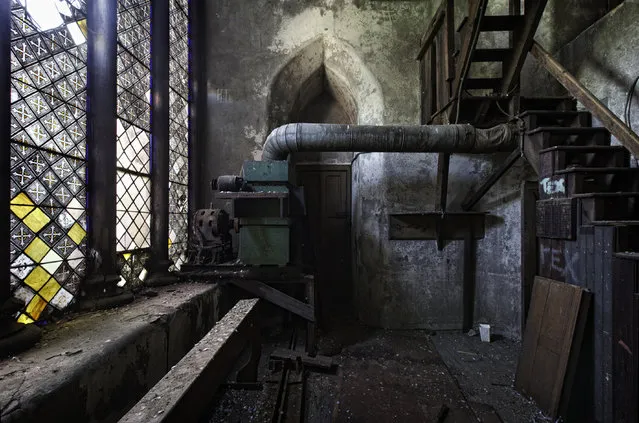
St. Boniface Church, Philadelphia Pa. (Photo by Matthew Christopher/Caters News)

“These are the stunning images of some of Americas most breathtaking churches – all of which are abandoned. Matthew Christopher travels around the United States taking shots of its most beautiful decaying wonders. He shot those in his churches series in Philadelphia, Pennsylvania, where he works as a photographer and lecturer. Matthew’s fascination with such abandoned spaces started when he was a child when he enjoyed looking at artwork set in buildings that have since decayed”. – Caters News. Photo: St. Boniface Church, Philadelphia Pa. (Photo by Matthew Christopher/Caters News)
Details
10 Aug 2014 10:23:00