Loading...
Done
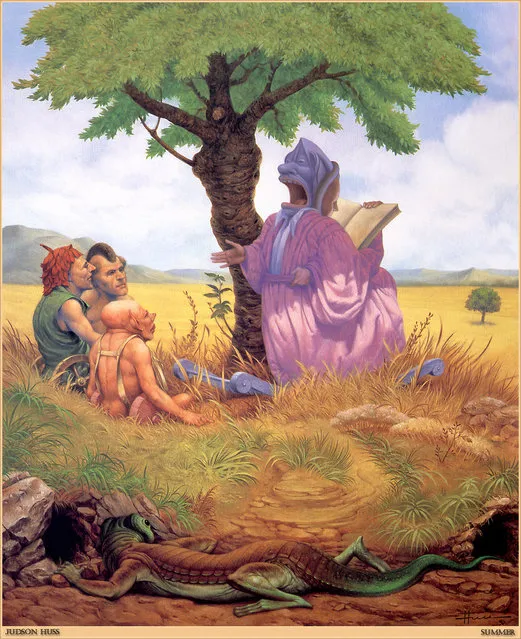
Judson Huss - Summer

Judson Huss (8 May 1942 – 25 July 2008), born Clifford Judson Huss, was an American-born painter and sculptor of fantastic art. Photo: Judson Huss – “Summer” (please click to enlarge).
Details
16 Oct 2012 14:12:00
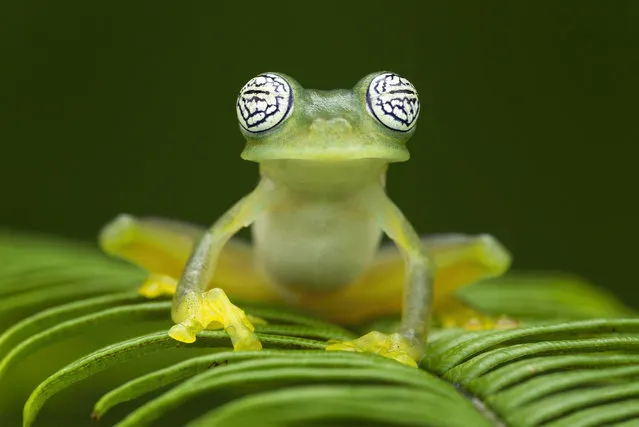
A ghost glass frog in the Chocó rainforest, Ecuador in November 2020. The marbled swirling “hypnotising” eyes are thought to be helpful in attracting a mate. (Photo by David Weiller/WENN)


A ghost glass frog in the Chocó rainforest, Ecuador in November 2020. The marbled swirling “hypnotising” eyes are thought to be helpful in attracting a mate. (Photo by David Weiller/WENN)
Details
19 May 2022 04:36:00
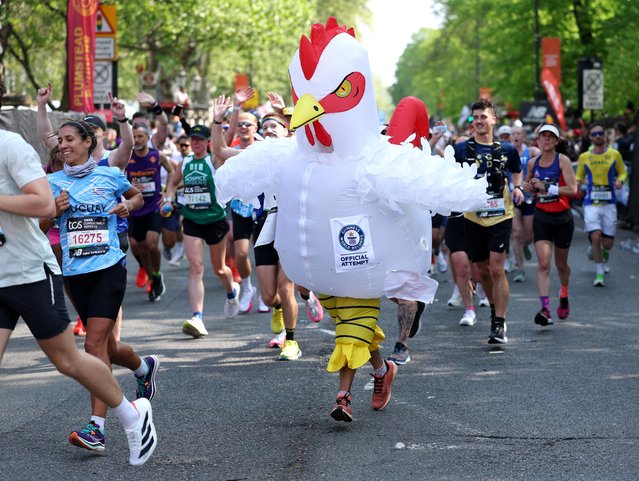
A runner in fancy dress attempts a record in the TCS London Marathon on Sunday, April 27, 2025. (Photo by John Sibley/Action Images via Reuters)

A runner in fancy dress attempts a record in the TCS London Marathon on Sunday, April 27, 2025. (Photo by John Sibley/Action Images via Reuters)
Details
12 May 2025 04:09:00
A "scissors" dancer grabs her shoe with her mouth while performing in a national scissors dance competition in the outskirts of Lima December 1, 2013. (Photo by Enrique Castro-Mendivil/Reuters)

A “scissors” dancer grabs her shoe with her mouth while performing in a national scissors dance competition in the outskirts of Lima December 1, 2013. The Danza de las tijeras, or scissors dance, is a traditional dance from the Peruvian southern region of the Andes, in which two or more performers take turns dancing while accompanied with music from a harp and a violin. Dancers would display various skills and moves, which include cutting the air with the use of a scissors. (Photo by Enrique Castro-Mendivil/Reuters)
Details
03 Dec 2013 11:43:00
Novice DSLR, 2nd Place. “Smile of a Friend”, American Crocodile (Crocodylus acutus) in Jucaro, Cuba. (Photo by Antonio Pastrana/The Ocean Art 2018 Underwater Photography Competition)

Novice DSLR (Digital single-lens reflex camera), 2nd Place. “Smile of a Friend”, American Crocodile (Crocodylus acutus) in Jucaro, Cuba. (Photo by Antonio Pastrana/The Ocean Art 2018 Underwater Photography Competition)
Details
21 Jan 2019 00:05:00
Highly commended, mammals: Gelada after the storm – Marco Gaiotti (Italy). “Gelada baboons are the only monkey species in the world that feed on grasses. They are native to the tableland of Ethiopia. Every morning large family groups wander from their sleeping places in the steep rock face, up to 1,000 metres high, to the feeding grounds at the tablelands. This image clearly depicts their feeding strategy: they pull out bunches of grass, sort the stalks and then lift them to their mouth. This shot was taken towards the end of the rainy season after a heavy storm”. (Photo by Marco Gaiotti/2019 GDT European Wildlife Photographer of the Year)

Highly commended, mammals: Gelada after the storm – Marco Gaiotti (Italy). “Gelada baboons are the only monkey species in the world that feed on grasses. They are native to the tableland of Ethiopia. Every morning large family groups wander from their sleeping places in the steep rock face, up to 1,000 metres high, to the feeding grounds at the tablelands. This image clearly depicts their feeding strategy: they pull out bunches of grass, sort the stalks and then lift them to their mouth. This shot was taken towards the end of the rainy season after a heavy storm”. (Photo by Marco Gaiotti/2019 GDT European Wildlife Photographer of the Year)
Details
31 Oct 2019 00:03:00
New York Rangers right wing Ryan Reaves punches Minnesota Wild left wing Marcus Foligno (17) during a third-period fight in an NHL hockey game Thursday, October 13, 2022, in St. Paul, Minn. (Photo by Aaroan Lavinsky/Star Tribune via AP Photo)

New York Rangers right wing Ryan Reaves punches Minnesota Wild left wing Marcus Foligno (17) during a third-period fight in an NHL hockey game Thursday, October 13, 2022, in St. Paul, Minn. (Photo by Aaroan Lavinsky/Star Tribune via AP Photo)
Details
20 Oct 2022 04:02:00
“Cassowaries are large, flightless birds related to emus and (more distantly) to ostriches, rheas, and kiwis”, writes Olivia Judson in the September issue of National Geographic magazine. (Photo by Christian Ziegler/National Geographic)

“Cassowaries are large, flightless birds related to emus and (more distantly) to ostriches, rheas, and kiwis”, writes Olivia Judson in the September issue of National Geographic magazine. How large? People-size: Adult males stand well over five foot five and top 110 pounds. Females are even taller, and can weigh more than 160 pounds. Dangerous when roused, they’re shy and peaceable when left alone. But even birds this big and tough are prey to habitat loss. The dense New Guinea and Australia rain forests where they live have dwindled. Today cassowaries might number 1,500 to 2,000. And because they help shape those same forests – by moving seeds from one place to another – “if they vanish”, Judson writes, “the structure of the forest would gradually change” too. (Photo by Christian Ziegler/National Geographic)
Details
06 Jan 2014 12:21:00