Loading...
Done
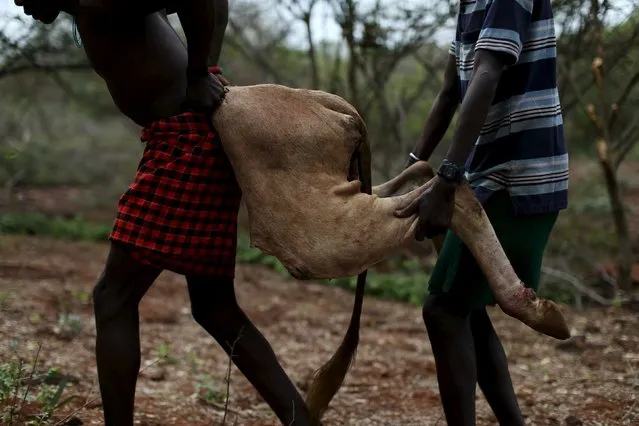
Pokot men carry a part of a carcass of a bull killed by a young man during an initiation ceremony in Baringo County, Kenya, January 20, 2016. (Photo by Siegfried Modola/Reuters)

Pokot men carry a part of a carcass of a bull killed by a young man during an initiation ceremony in Baringo County, Kenya, January 20, 2016. Far from the bustling city of Nairobi, in an isolated corner of Kenya's Rift Valley, young men from the Pokot community spear a bull in a ceremony called Sapana that takes them into adulthood. (Photo by Siegfried Modola/Reuters)
Details
11 Feb 2016 12:52:00
A staff member removes a coffin from a room of the “Corpse Hotel” in Kawasaki, Japan, April 20, 2016. (Photo by Thomas Peter/Reuters)

A staff member removes a coffin from a room of the “Corpse Hotel” in Kawasaki, Japan, April 20, 2016. Many so-called corpse hotels have emerged as a flourishing business in the city following a crunch in crematoriums. Families can rent a room in Sousou on a daily charge of 9,000 Japanese yen (£58, €74, $84) to keep the body of the deceased relative for up to four days until they find a crematorium. (Photo by Thomas Peter/Reuters)
Details
30 Apr 2016 09:46:00
A tea garden worker plucks tea leaves inside Aideobarie Tea Estate in Jorhat in Assam, India, April 21, 2015. (Photo by Ahmad Masood/Reuters)

A tea garden worker plucks tea leaves inside Aideobarie Tea Estate in Jorhat in Assam, India, April 21, 2015. Unrest is brewing among Assam's so-called Tea Tribes as changing weather patterns upset the economics of the industry. Scientists say climate change is to blame for uneven rainfall that is cutting yields and lifting costs for tea firms. (Photo by Ahmad Masood/Reuters)
Details
05 May 2015 11:21:00
This picture taken on October 18, 2018 shows a “trolley boy” pushing a home- made cart along a train track in Manila, Philippines. (Photo by Noel Celis/AFP Photo)

This picture taken on October 18, 2018 shows a “trolley boy” pushing a home- made cart along a train track in Manila, Philippines. Scores of commuters in the city of about 12 million are propelled to their destinations daily by so-called “trolley boys” pushing metal carts that ply a few segments of the sprawling capital's railroads. (Photo by Noel Celis/AFP Photo)

Details
29 Nov 2018 00:01:00
Real-Time Face Tracking And Projection Mapping By Nobumichi Asai

Nobumichi Asai has used projection mapping to put CGI onto cars, docks, building and more. What is his latest canvas? A real, live human face! Asai used Omote, a combination of real-time face tracking and projection mapping to transform a model's face into mesmerizing patterns. It's called “electronic makeup”, but as you will see in the (creepy-ish) video, it goes much, much beyond anything makeup can possibly do.
Details
20 Aug 2014 10:49:00
A model in Mongolia costumes prepares backstage in Xiangshawan Desert, also called Sounding Sand Desert on July 18, 2013 in Ordos of Inner Mongolia Autonomous Region, China. Xiangshawan is China's famous tourist resort in the desert. It is located along the middle section of Kubuqi Desert on the south tip of Dalate League under Ordos City. Sliding down from the 110-metre-high, 45-degree sand hill, running a course of 200 metres, the sands produce the sound of automobile engines, a natural phenomenon that nobody can explain. (Photo by Feng Li/Getty Images)

A model in Mongolia costumes prepares backstage in Xiangshawan Desert, also called Sounding Sand Desert on July 18, 2013 in Ordos of Inner Mongolia Autonomous Region, China. Xiangshawan is China's famous tourist resort in the desert. It is located along the middle section of Kubuqi Desert on the south tip of Dalate League under Ordos City. Sliding down from the 110-metre-high, 45-degree sand hill, running a course of 200 metres, the sands produce the sound of automobile engines, a natural phenomenon that nobody can explain. (Photo by Feng Li)
Details
26 Aug 2013 08:43:00
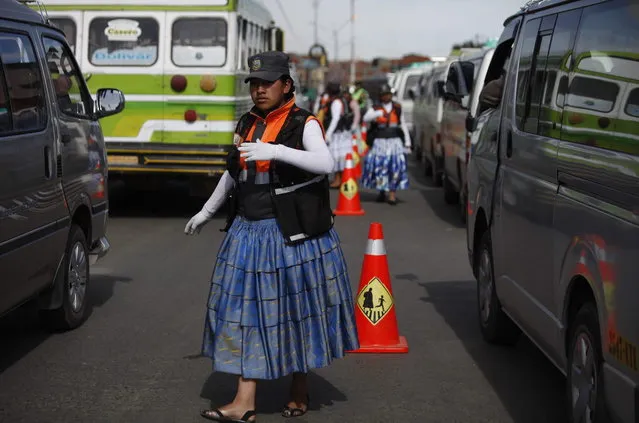
In this December 3, 2013 photo, an Aymara woman cops directs traffic on the streets of El Alto, Bolivia. The women wear the bright petticoats and shawls of indigenous women in the Andes, called cholitas in Bolivian slang, the main difference being that instead of bowler hats they wear khaki green police-style caps. Some don fluorescent traffic vests. (Photo by Juan Karita/AP Photo)

“This city in Bolivia's highlands has hired Aymara women dressed in traditional multilayered Andean skirts and brightly embroidered vests to work as traffic cops and bring order to its road chaos. About 20 of the “traffic cholitas” have been trained to direct cars and buses in El Alto, a teeming, impoverished sister city of La Paz in Bolivia's Andes mountains”. – El Alto via Associated Press. Photo: In this December 3, 2013 photo, an Aymara woman cops directs traffic on the streets of El Alto, Bolivia. The women wear the bright petticoats and shawls of indigenous women in the Andes, called cholitas in Bolivian slang, the main difference being that instead of bowler hats they wear khaki green police-style caps. Some don fluorescent traffic vests. (Photo by Juan Karita/AP Photo)
Details
25 Dec 2013 10:48:00
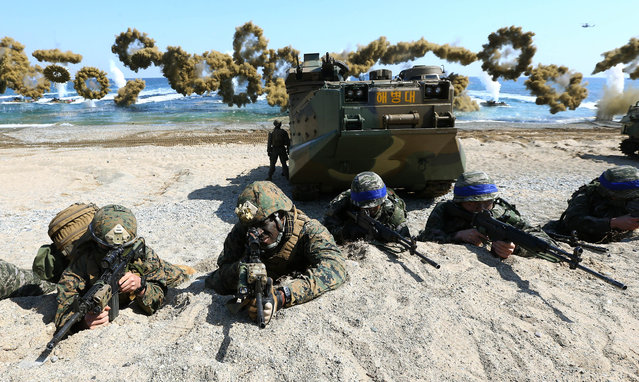
U.S. Marines, left, and South Korean Marines, wearing blue headbands on their helmets, take positions after landing on the beach during the joint military combined amphibious exercise, called Ssangyong, part of the Key Resolve and Foal Eagle military exercises, in Pohang, South Korea, Saturday, March 12, 2016. North Korea said Saturday its military is ready to pre-emptively attack and “liberate” the South in its latest outburst against the annual joint military drills by the United States and South Korea. (Photo by Kim Jun-bum/Yonhap via AP Photo)

U.S. Marines, left, and South Korean Marines, wearing blue headbands on their helmets, take positions after landing on the beach during the joint military combined amphibious exercise, called Ssangyong, part of the Key Resolve and Foal Eagle military exercises, in Pohang, South Korea, Saturday, March 12, 2016. North Korea said Saturday its military is ready to pre-emptively attack and “liberate” the South in its latest outburst against the annual joint military drills by the United States and South Korea. (Photo by Kim Jun-bum/Yonhap via AP Photo)
Details
12 Mar 2016 15:17:00