Loading...
Done
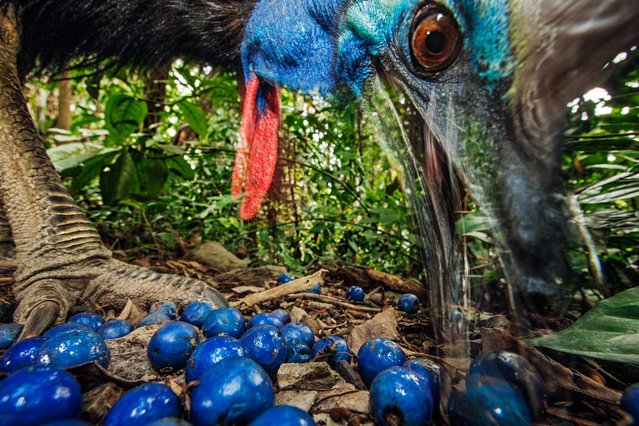
“Cassowaries are large, flightless birds related to emus and (more distantly) to ostriches, rheas, and kiwis”, writes Olivia Judson in the September issue of National Geographic magazine. (Photo by Christian Ziegler/National Geographic)

“Cassowaries are large, flightless birds related to emus and (more distantly) to ostriches, rheas, and kiwis”, writes Olivia Judson in the September issue of National Geographic magazine. How large? People-size: Adult males stand well over five foot five and top 110 pounds. Females are even taller, and can weigh more than 160 pounds. Dangerous when roused, they’re shy and peaceable when left alone. But even birds this big and tough are prey to habitat loss. The dense New Guinea and Australia rain forests where they live have dwindled. Today cassowaries might number 1,500 to 2,000. And because they help shape those same forests – by moving seeds from one place to another – “if they vanish”, Judson writes, “the structure of the forest would gradually change” too. (Photo by Christian Ziegler/National Geographic)
Details
06 Jan 2014 12:21:00


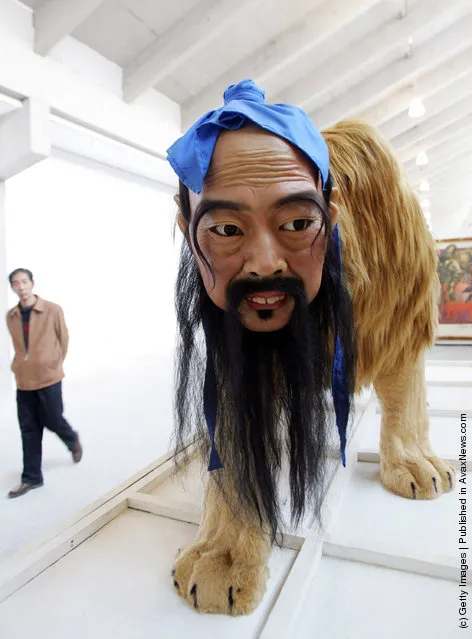
A visitor walks past an installation artwork entitled “Confuciuse” which combines the word “Confucius” and “confuse” in the contemporary art exhibition at “Fun and Art” Festival on December 13, 2008 in Xian of Shaanxi Province, China. (Photo by China Photos/Getty Images)
Details
12 May 2011 08:35:00


A member of the Eton public school O.T.C. (Officers Training Corps) practising shouting out orders during a training session, 20th January 1940. (Photo by Hulton Archive/Getty Images)
Details
04 Jun 2011 06:46:00


Finia, a visiting student from Hanover, cools off under a water sprinkler in front of the Chancellery on June 10, 2010 in Berlin, Germany. (Photo by Sean Gallup/Getty Images)
Details
13 Jul 2011 10:38:00
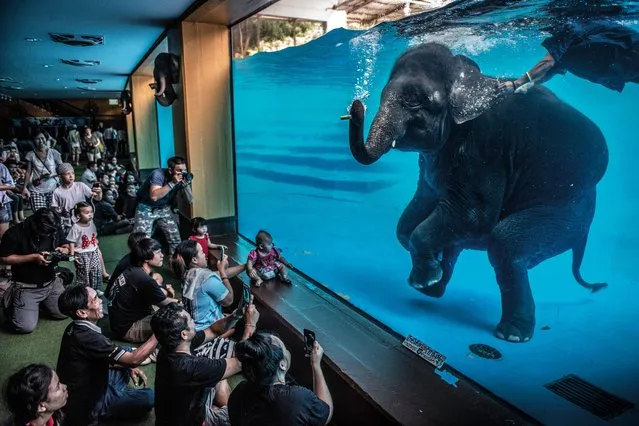
Winner, photojournalism. Elephant in the room, by Adam Oswell, Australia Zoo. Visitors watch a young elephant performing underwater. Oswell was disturbed by this scene, and organisations concerned with the welfare of captive elephants say performances like this encourage unnatural behaviour. In Thailand, there are now more elephants in captivity than in the wild. With the Covid pandemic causing tourism to collapse, elephant sanctuaries are becoming overwhelmed with animals that can no longer be looked after by their owners. (Photo by Adam Oswell/Wildlife Photographer of the Year 2021)

Winner, photojournalism. Elephant in the room, by Adam Oswell, Australia Zoo. Visitors watch a young elephant performing underwater. Oswell was disturbed by this scene, and organisations concerned with the welfare of captive elephants say performances like this encourage unnatural behaviour. In Thailand, there are now more elephants in captivity than in the wild. With the Covid pandemic causing tourism to collapse, elephant sanctuaries are becoming overwhelmed with animals that can no longer be looked after by their owners. (Photo by Adam Oswell/Wildlife Photographer of the Year 2021)
Details
30 Oct 2021 08:40:00
A man, wearing a protective mask following an outbreak of the coronavirus disease (COVID-19), walks in Tokyo, Japan on March 17, 2020. (Photo by Edgard Garrido/Reuters)

A man, wearing a protective mask following an outbreak of the coronavirus disease (COVID-19), walks in Tokyo, Japan on March 17, 2020. (Photo by Edgard Garrido/Reuters)
Details
20 Mar 2020 00:07:00
Revellers participate in the annual gay pride parade in Amsterdam, Netherlands on August 4, 2018. (Photo by Piroschka van de Wouw/Reuters)

Revellers participate in the annual gay pride parade in Amsterdam, Netherlands on August 4, 2018. (Photo by Piroschka van de Wouw/Reuters)
Details
06 Aug 2018 08:57:00
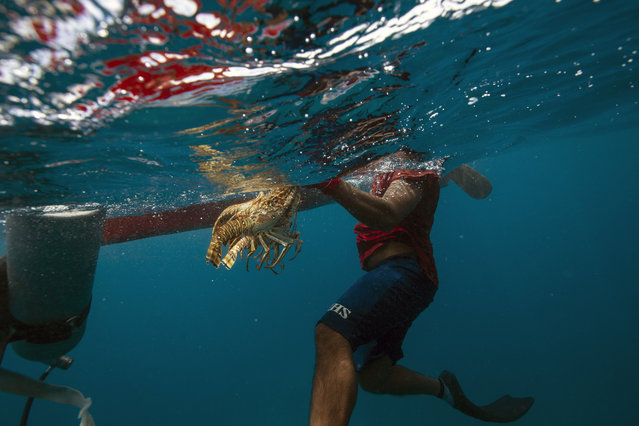
In this September 9, 2018 photo, a diver holds onto his catch of lobsters during a fishing journey in the Miskito coast near Cay Savannah, Honduras. A diver makes 75 lempiras ($3) per pound of lobster. An average 10-pound daily haul of lobster is a windfall for people in one of the most impoverished regions of the Americas, so many take the risk, and many suffer for it. (Photo by Rodrigo Abd/AP Photo)

In this September 9, 2018 photo, a diver holds onto his catch of lobsters during a fishing journey in the Miskito coast near Cay Savannah, Honduras. A diver makes 75 lempiras ($3) per pound of lobster. An average 10-pound daily haul of lobster is a windfall for people in one of the most impoverished regions of the Americas, so many take the risk, and many suffer for it. (Photo by Rodrigo Abd/AP Photo)
Details
23 Jan 2019 00:01:00