Loading...
Done


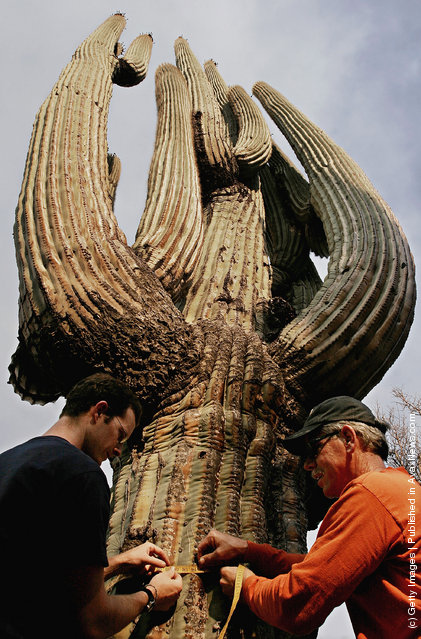
“The saguaro (scientific name Carnegiea gigantea) is a large, tree-sized cactus species in the monotypic genus Carnegiea. It is native to the Sonoran Desert in the U.S. state of Arizona, the Mexican state of Sonora, a small part of Baja California in the San Felipe Desert and an extremely small area of California, U.S. The saguaro blossom is the State Wildflower of Arizona”. – Wikipedia

Photo: Daniel Appel (L), a firefighter with Engine 84 from the Lassen National Forest in California and Mike Hallen, (R), Arizona representative of the National Register of Big Trees, measure the circumference of this Saguaro cactus called the "Grand One," in the Tonto National Forest on July 1, 2005 35 miles north of Phoenix, near Carefree, Arizona. The cactus, estimated to be more than 200 years old, measures a circumference of 7 feet, 10 inches (2.4 meters) and stands 46 feet high (14 meters). The cactus was burned in the Cave Creek Complex fire and may not survive. It was once the largest Saguaro in the world, two others have been found recently that have tied it's measurements. The fire has burned more than 214,000 acres of the Sonoran desert. (Photo by Jeff Topping/Getty Images)
Details
26 Jul 2011 12:27:00
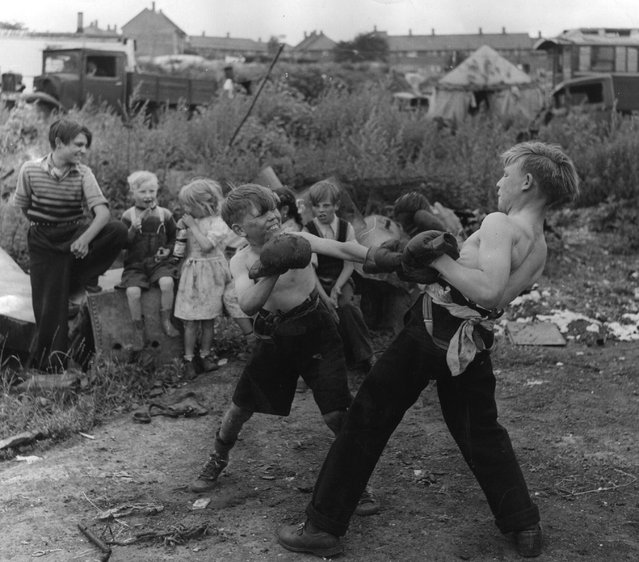
The unromantic gypsies. Children boxing in a gypsy camp in Kent, England on July 1, 1951. Like all boys these gypsy lads like to try their hand at boxing. Encouraged by their friends they fight it out on Corke's Meadow. Few Romanies now live a life of wandering romance. Most are like the three hundred squatters of Corke's Meadow, Kent, which is part of a “gypsy problem” that involves about 100,000 today. Of those about 25,000 can be rightly called gypsies, the rest are Mumpers and Posh-rats and Hobos. Corke's Meadow has both kinds. “Picture Post” cameraman Bert Hardy photographs the Corke's Meadow gypsies in their encampment. (Photo by Hulton-Deutsch Collection/Corbis via Getty Images)

The unromantic gypsies. Children boxing in a gypsy camp in Kent, England on July 1, 1951. Like all boys these gypsy lads like to try their hand at boxing. Encouraged by their friends they fight it out on Corke's Meadow. Few Romanies now live a life of wandering romance. Most are like the three hundred squatters of Corke's Meadow, Kent, which is part of a “gypsy problem” that involves about 100,000 today. Of those about 25,000 can be rightly called gypsies, the rest are Mumpers and Posh-rats and Hobos. Corke's Meadow has both kinds. “Picture Post” cameraman Bert Hardy photographs the Corke's Meadow gypsies in their encampment. (Photo by Hulton-Deutsch Collection/Corbis via Getty Images)
Details
12 Mar 2017 00:01:00
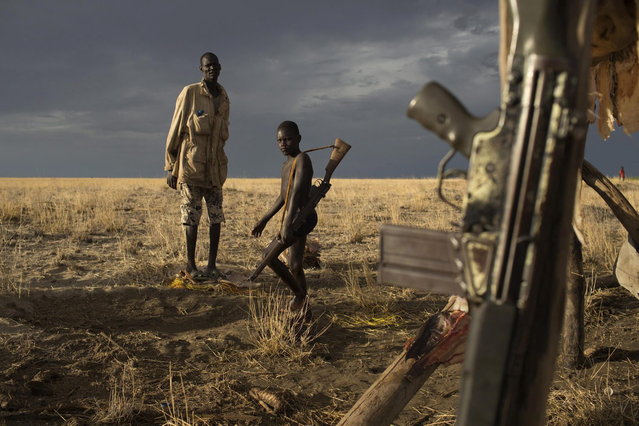
A Turkana man and a boy carrying a gun look on as a G3 battle rifle hangs from a structure used to dry fish at a fishing camp on the shores of Lake Turkana, some kilometres from Todonyang near the Kenya-Ethiopia border in northwestern Kenya October 12, 2013. (Photo by Siegfried Modola/Reuters)

A Turkana man and a boy carrying a gun look on as a G3 battle rifle hangs from a structure used to dry fish at a fishing camp on the shores of Lake Turkana, some kilometres from Todonyang near the Kenya-Ethiopia border in northwestern Kenya October 12, 2013The Turkana are traditionally nomadic pastoralists, but they have seen the pasture that they need to feed their herds suffer from recurring droughts and many have turned to fishing. However, Lake Turkana is overfished, and scarcity of food and pastureland is fuelling long-standing conflict with Ethiopian indigenous Dhaasanac, who have seen grazing grounds squeezed by large-scale government agricultural schemes in southern Ethiopia. The Dhaasanac now venture ever deeper into Kenyan territory in search of fish and grass, clashing with neighbours. Fighting between the communities has a long history, but the conflict has become ever more fatal as automatic weapons from other regional conflicts seep into the area. While the Turkana region is short of basics like grass and ground-water, it contains other resources including oil reserves and massive, newly discovered underground aquifers. (Photo by Siegfried Modola/Reuters)
Details
05 Dec 2013 12:08:00
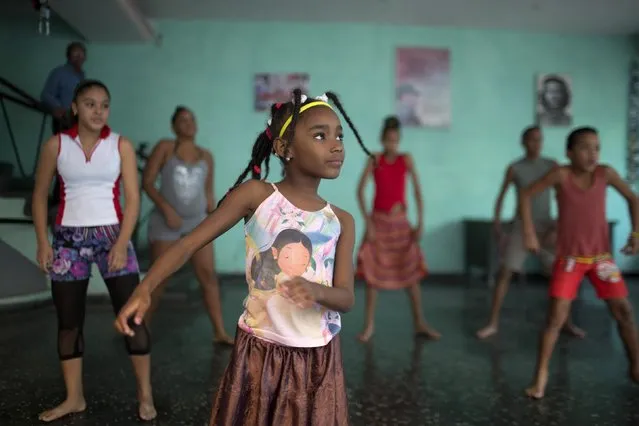
Sakia Corona, 8, (C) takes part in a rehearsal of the Contemporary Haitian Dance in a communal center in downtown Havana January 30, 2015. (Photo by Alexandre Meneghini/Reuters)

Sakia Corona, 8, (C) takes part in a rehearsal of the Contemporary Haitian Dance in a communal center in downtown Havana January 30, 2015. Nearly 25 people, from the Haitian Contemporary Dance Company Petit Fey or Small Leaf, in Haitian Creole, rehearse a play called Papa Guede for future presentations in Havana. (Photo by Alexandre Meneghini/Reuters)
Details
02 Feb 2015 10:04:00
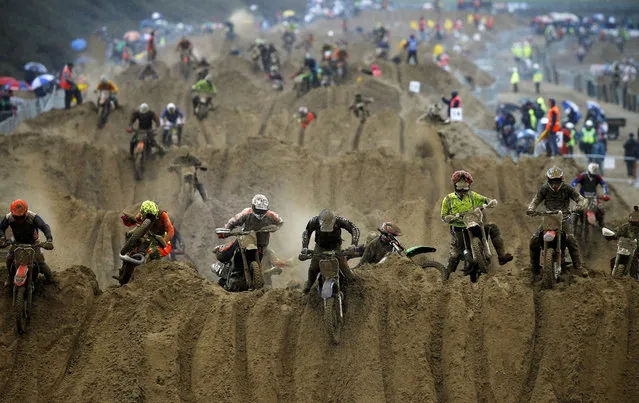
RHL Beach Race At Weston

If you love dirt bikes and live in England, then there is no doubt that you’ve heard about RHL Weston Beach Race that takes place in Weston-super-Mare in Somerset. In the beginning, this race was organized by a few avid bikers sponsored by local businessmen. However, after a while, this event has gained traction, and now as many as one hundred thousand people come to take part in this race. In order to accommodate all the contestants, a whole beach in converted into one gigantic race track. The noise created by such a mass of dirt bikes can be heard for miles; however, this is a small price to pay for all the fun the people are having.
Details
27 Feb 2015 03:35:00
The Songkran festival

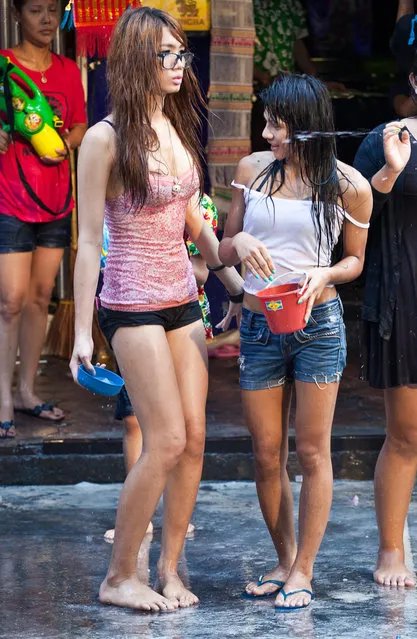
“The Songkran festival is celebrated in Thailand as the traditional New Year's Day from 13 to 15 April. It coincides with the New Year of many calendars of South and Southeast Asia. The most obvious celebration of Songkran is the throwing of water upon others. Thais roam the streets with containers of water or water guns. In addition, many Thais will have small bowls of beige colored talc sold cheaply and mixed with water which is then smeared on the faces and bodies of random passerbys as a blessing for the new year” – Wikipedia. (Photo by Seua Yai)
Details
23 Oct 2013 12:00:00
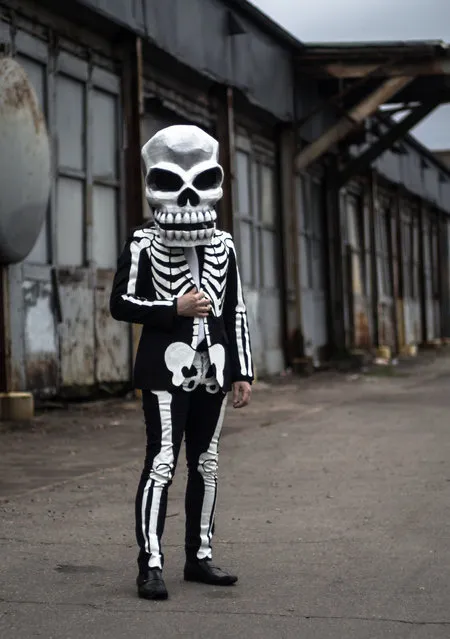
“The Skeleton Krewe 2013 – Manning”. (Kevin O'Mara)

“The Skeleton Krewe was founded in 1999 by Christopher Kirsch. Inspired by the early days of Carnival before tractors and floats replaced walking processions, the Krewe has become one of New Orleans' premier marching clubs. The Krewe began actively marching as a small group of friends, but has grown to 40 active members”. – The Skeleton Krewe. Photo: “The Skeleton Krewe 2013 – Manning”. (Photo by Kevin O'Mara)
Details
29 Oct 2013 11:56:00
Berndnaut Smilde Creater Clouds

Dutch artist Berndnaut Smilde is interested in the ephemeral -- impermanent states of being which he documents through photographs. For Nimbus II, he used a smoke machine, combined with moisture and dramatic lighting to create a hovering indoor cloud in the empty setting of a sixteenth-century chapel in Hoorn, a small town in Holland. “I imagined walking into a museum hall with just empty walls. The place even looked deserted. On the one hand I wanted to create an ominous situation. You could see the cloud as a sign of misfortune. You could also read it as an element out of the Dutch landscape paintings in a physical form in a classical museum hall.”
Details
25 Dec 2012 12:31:00