Loading...
Done
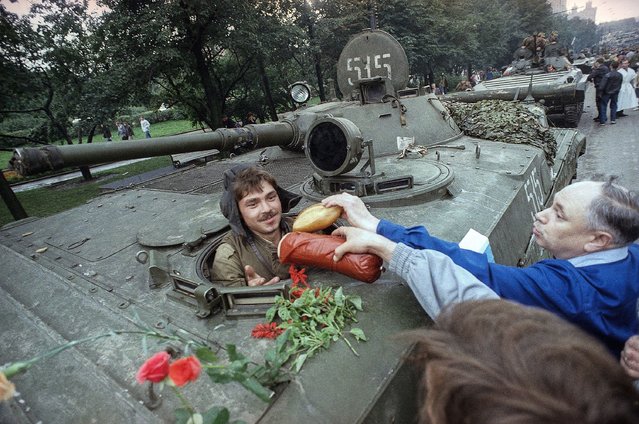
In this Wednesday, August 21, 1991 file photo, appreciative muscovites hand bread, sausages and flowers to a Soviet tank's driver who helped stop the failed hardline coup in Moscow, Russia. When a group of top Communist officials ousted Soviet leader Mikhail Gorbachev 30 years ago and flooded Moscow with tanks, the world held its breath, fearing a rollback on liberal reforms and a return to the Cold War confrontation. But the August 1991 coup collapsed in just three days, precipitating the breakup of the Soviet Union that plotters said they were trying to prevent. (Photo by Czarek Sokolowski/AP Photo/File)

In this Wednesday, August 21, 1991 file photo, appreciative muscovites hand bread, sausages and flowers to a Soviet tank's driver who helped stop the failed hardline coup in Moscow, Russia. When a group of top Communist officials ousted Soviet leader Mikhail Gorbachev 30 years ago and flooded Moscow with tanks, the world held its breath, fearing a rollback on liberal reforms and a return to the Cold War confrontation. But the August 1991 coup collapsed in just three days, precipitating the breakup of the Soviet Union that plotters said they were trying to prevent. (Photo by Czarek Sokolowski/AP Photo/File)
Details
23 Aug 2021 03:45:00
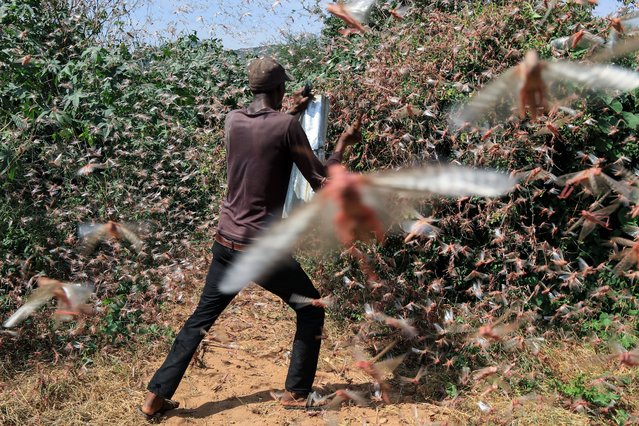
A man uses iron sheet to make noises, as a way of trying to disperse desert locusts that had invaded their farms during the second wave invasion in Kakongo village, in Nuu-Mwingi East, in Kitui, Kenya, 06 February 2021. The second wave invasion of the desert locusts in the country comes at a time where most famers are expecting to harvest their farm produce in the country. According to the United Nations Food and Agriculture Organization (FAO), on 04 February, warned numerous immature desert locust swarms persist in southern Ethiopia and Kenya. Some of the swarms are in community areas and therefore cannot be treated. In Kenya, immature swarms continue to spread westwards across northern and central counties where there are currently about 20 small swarms present, mostly about 50 hectares in size, it said. (Photo by Daniel Irungu/EPA/EFE)

A man uses iron sheet to make noises, as a way of trying to disperse desert locusts that had invaded their farms during the second wave invasion in Kakongo village, in Nuu-Mwingi East, in Kitui, Kenya, 06 February 2021. The second wave invasion of the desert locusts in the country comes at a time where most famers are expecting to harvest their farm produce in the country. (Photo by Daniel Irungu/EPA/EFE)
Details
25 Feb 2021 08:17:00
Nature – first prize, stories. Pandemic Pigeons – A Love Story. The photographer’s daughter, Merel, cowers after Dollie flies past and perches on the balcony before entering the house in Vlaardingen in the Netherlands on 6 April 2020. “She’s still frightened when Dollie suddenly lands on the balcony railing. I hide my smile behind the camera, as I try to comfort her by saying they won’t hurt you. “I thought he was going to attack me”, she replies. As the nesting pigeons keep coming back to our place, slowly my girls have started to appreciate them – perhaps not as much as I do, but it’s a start”. (Photo by Jasper Doest/World Press Photo 2021)

Nature – first prize, stories. Pandemic Pigeons – A Love Story. The photographer’s daughter, Merel, cowers after Dollie flies past and perches on the balcony before entering the house in Vlaardingen in the Netherlands on 6 April 2020. “She’s still frightened when Dollie suddenly lands on the balcony railing. I hide my smile behind the camera, as I try to comfort her by saying they won’t hurt you. “I thought he was going to attack me”, she replies. As the nesting pigeons keep coming back to our place, slowly my girls have started to appreciate them – perhaps not as much as I do, but it’s a start”. (Photo by Jasper Doest/World Press Photo 2021)
Details
17 Apr 2021 09:30:00
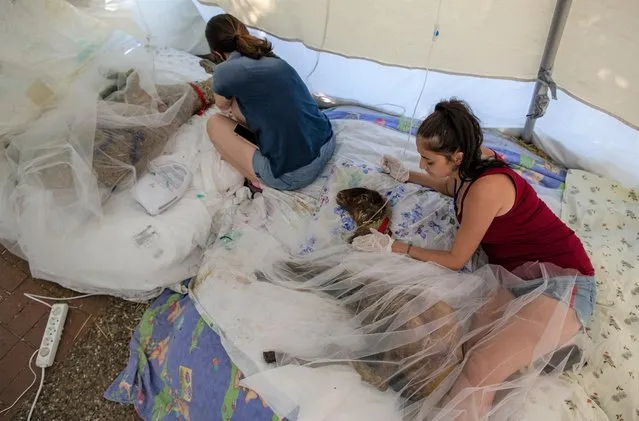
Volunteers care for burned sheeps in a field hospital established by HAYTAP (The Federation of the Animals Rights in Turkey) for animals after a wildfire at the Manavgat district of Antalya, Turkey, 09 August 2021. It is not known how many wild animals living in the forest died in the fires, but about 33,000 farm animals perished. About 30 veterinarians and hundreds of volunteers work around the clock at the field hospital. Sheep, covered in mosquito nets to protect their wounds from flies, lay there in the shade trying to recover, and various animals such as cats, dogs, owls, and cows have been treated or are still being treated there. (Photo by Erdem Sahin/EPA/EFE)

Volunteers care for burned sheeps in a field hospital established by HAYTAP (The Federation of the Animals Rights in Turkey) for animals after a wildfire at the Manavgat district of Antalya, Turkey, 09 August 2021. It is not known how many wild animals living in the forest died in the fires, but about 33,000 farm animals perished. About 30 veterinarians and hundreds of volunteers work around the clock at the field hospital. Sheep, covered in mosquito nets to protect their wounds from flies, lay there in the shade trying to recover, and various animals such as cats, dogs, owls, and cows have been treated or are still being treated there. (Photo by Erdem Sahin/EPA/EFE)
Details
27 Aug 2021 08:30:00
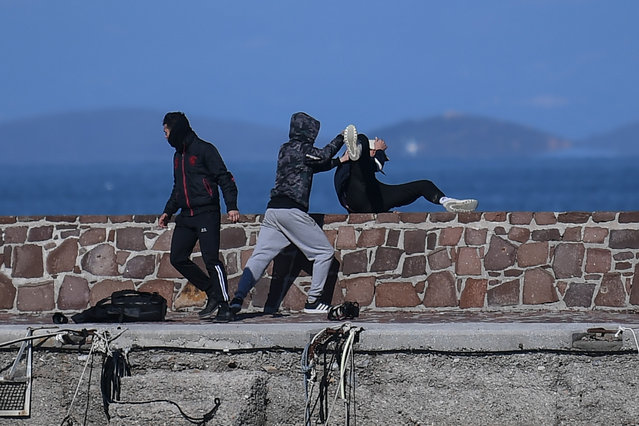
A journalist (R) is attacked by residents who are trying to prevent migrants from disembarking on the Greek island of Lesbos, on March 1, 2020. The United Nation called on March 1 for calm and urged states to refrain from “excessive” force, as thousands of migrants have flooded to Turkey's border with Greece in a bid to enter the EU. A massive influx of migrants swelled along the border over the weekend after Turkey's President Recep Tayyip Erdogan threatened to open its frontier to Europe as tensions mount over its deepening conflict in Syria. (Photo by AFP Photo/Stringer)

A journalist (R) is attacked by residents who are trying to prevent migrants from disembarking on the Greek island of Lesbos, on March 1, 2020. The United Nation called on March 1 for calm and urged states to refrain from “excessive” force, as thousands of migrants have flooded to Turkey's border with Greece in a bid to enter the EU. A massive influx of migrants swelled along the border over the weekend after Turkey's President Recep Tayyip Erdogan threatened to open its frontier to Europe as tensions mount over its deepening conflict in Syria. (Photo by AFP Photo/Stringer)
Details
03 Mar 2020 00:07:00
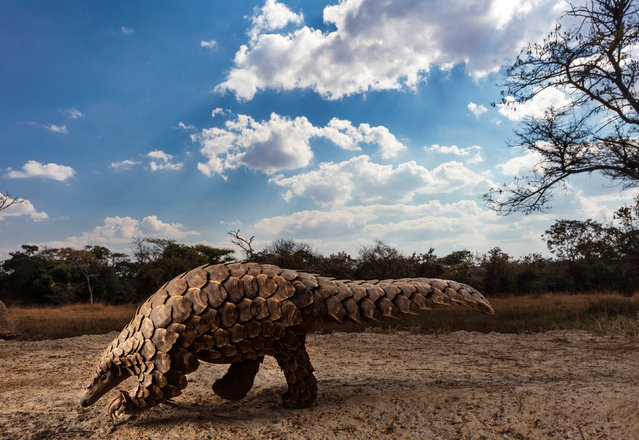
Pangolins in Crisis: Brent Stirton, South Africa; 1st place, Natural world and wildlife. “Pangolins are the world’s most illegally trafficked mammals, with an estimated one million trafficked to Asia in the last 10 years. Their scales are used in traditional Chinese and Vietnamese medicine, and their meat is sold as a high-priced delicacy. As a result, pangolins are listed as critically endangered and anyone who trades or consumes them is breaking the law. This body of work exposes the trade, while exploring aspects of illegality and celebrating the people who are trying to save these animals”. (Photo by Brent Stirton/Sony World Photography Awards 2020)

Pangolins in Crisis: Brent Stirton, South Africa; 1st place, Natural world and wildlife. “Pangolins are the world’s most illegally trafficked mammals, with an estimated one million trafficked to Asia in the last 10 years. Their scales are used in traditional Chinese and Vietnamese medicine, and their meat is sold as a high-priced delicacy. As a result, pangolins are listed as critically endangered and anyone who trades or consumes them is breaking the law. This body of work exposes the trade, while exploring aspects of illegality and celebrating the people who are trying to save these animals”. (Photo by Brent Stirton/Sony World Photography Awards 2020)
Details
11 Jun 2020 00:05:00
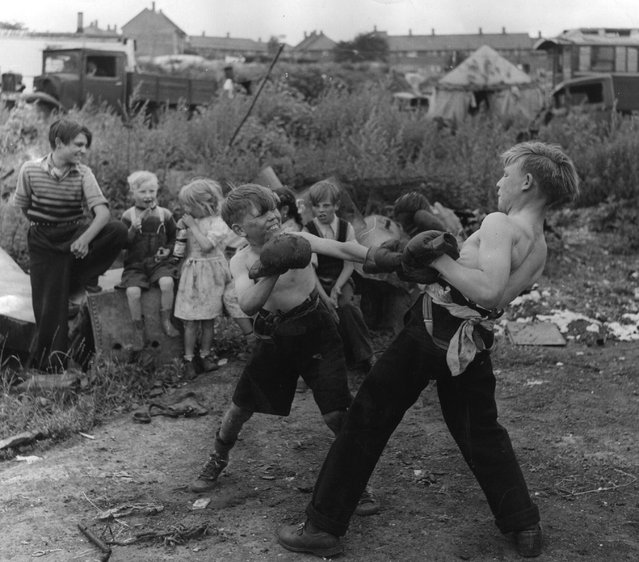
The unromantic gypsies. Children boxing in a gypsy camp in Kent, England on July 1, 1951. Like all boys these gypsy lads like to try their hand at boxing. Encouraged by their friends they fight it out on Corke's Meadow. Few Romanies now live a life of wandering romance. Most are like the three hundred squatters of Corke's Meadow, Kent, which is part of a “gypsy problem” that involves about 100,000 today. Of those about 25,000 can be rightly called gypsies, the rest are Mumpers and Posh-rats and Hobos. Corke's Meadow has both kinds. “Picture Post” cameraman Bert Hardy photographs the Corke's Meadow gypsies in their encampment. (Photo by Hulton-Deutsch Collection/Corbis via Getty Images)

The unromantic gypsies. Children boxing in a gypsy camp in Kent, England on July 1, 1951. Like all boys these gypsy lads like to try their hand at boxing. Encouraged by their friends they fight it out on Corke's Meadow. Few Romanies now live a life of wandering romance. Most are like the three hundred squatters of Corke's Meadow, Kent, which is part of a “gypsy problem” that involves about 100,000 today. Of those about 25,000 can be rightly called gypsies, the rest are Mumpers and Posh-rats and Hobos. Corke's Meadow has both kinds. “Picture Post” cameraman Bert Hardy photographs the Corke's Meadow gypsies in their encampment. (Photo by Hulton-Deutsch Collection/Corbis via Getty Images)
Details
12 Mar 2017 00:01:00
Two women enjoy drinks outside a pub in the soho area of central London on November 4, 2020, on the eve of a second novel coronavirus COVID-19 lockdown in an effort to combat soaring infections. English pubs call last orders at the bar for a month on Wednesday evening, as the country effectively shuts down from November 5, for the second time this year to try to cut coronavirus cases. Prime Minister Boris Johnson insisted that the lockdown for England would end “automatically” in four weeks, as he tried to placate party critics over the spiralling economic fallout. (Photo by Stephen Lock/i-Images)

Two women enjoy drinks outside a pub in the soho area of central London on November 4, 2020, on the eve of a second novel coronavirus COVID-19 lockdown in an effort to combat soaring infections. English pubs call last orders at the bar for a month on Wednesday evening, as the country effectively shuts down from November 5, for the second time this year to try to cut coronavirus cases. Prime Minister Boris Johnson insisted that the lockdown for England would end “automatically” in four weeks, as he tried to placate party critics over the spiralling economic fallout. (Photo by Stephen Lock/i-Images)
Details
06 Nov 2020 00:07:00