Loading...
Done
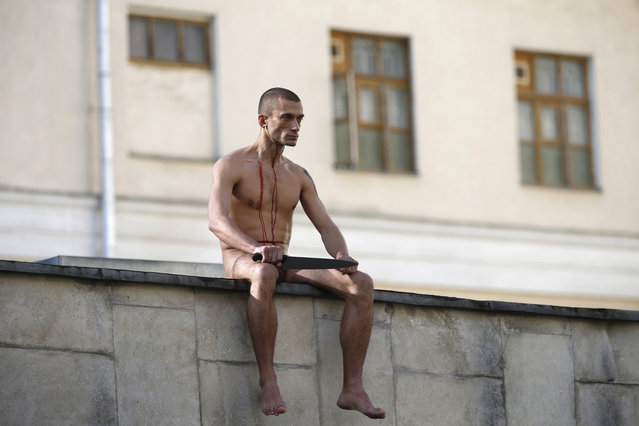
Artist Pyotr Pavlensky sits on the wall enclosing the Serbsky State Scientific Center for Social and Forensic Psychiatry after he cut off a part of his earlobe during his protest action titled “Segregation” in Moscow October 19, 2014. (Photo by Maxim Zmeyev/Reuters)

Artist Pyotr Pavlensky sits on the wall enclosing the Serbsky State Scientific Center for Social and Forensic Psychiatry after he cut off a part of his earlobe during his protest action titled “Segregation” in Moscow October 19, 2014. Pavlensky protested against the usage of forensic psychiatry for politically motivated purposes. He cut off his earlobe to demonstrate how authorities could “cut off” an unwanted individual from society by using psychiatric and medical diagnosis to forcefully send a person to a penitentiary hospital, according to Pavlensky. (Photo by Maxim Zmeyev/Reuters)
Details
21 Oct 2014 12:10:00
Concept Design Home Reversible Destiny Lofts MITAKA: In Memory Of Helen Keller By Reversible Destiny Foundation and Shusaku Arakawa

“The Reversible Destiny Lofts – Mitaka (In Memory of Helen Keller) is a nine-unit multiple dwelling. It was first completed example of procedural architecture put to residential use. These lofts reflexively articulate the residents’ operative tendencies and coordinating skills essential to and determinative of human thought and behavior; which means to say, the lofts manage, by virtue of how they are constructed, to reveal to their residents the ins and outs of what makes a person, in this case the resident. This is the same set of tendencies and skills to which Arakawa and Madeline Gins gave diagrammatic form in their decades-long research project The Mechanism of Meaning”. – Wikipedia

Photo: The exterior of the concept design home “Reversible Destiny Lofts MITAKA: In Memory of Helen Keller” is seen on October 27, 2005 in Tokyo, Japan. (Photo by Koichi Kamoshida/Getty Images)
Details
30 Nov 2011 11:58:00
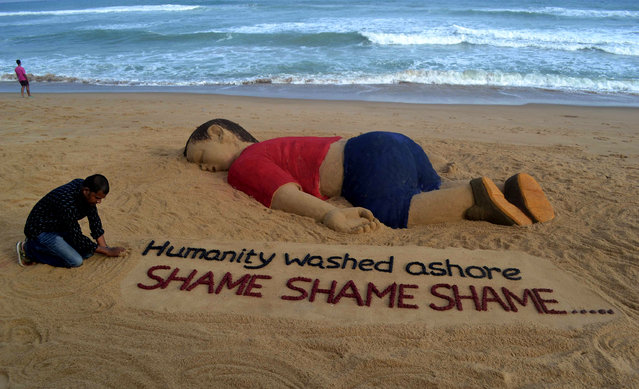
Indian artist Sudarsan Pattnaik works on a sand sculpture depicting drowned Syrian boy Aylan Kurdi at Puri beach, some 65 kilometers away from Bhubaneswar, on September 4, 2015. Charities helping refugees saw a surge in donations on September 4 across Europe as people shocked by the heart-rending images of a drowned Syrian boy on a Turkish beach dug deep to help out. (Photo by Asit Kumar/AFP Photo)

Indian artist Sudarsan Pattnaik works on a sand sculpture depicting drowned Syrian boy Aylan Kurdi at Puri beach, some 65 kilometers away from Bhubaneswar, on September 4, 2015. Charities helping refugees saw a surge in donations on September 4 across Europe as people shocked by the heart-rending images of a drowned Syrian boy on a Turkish beach dug deep to help out. The photos of the lifeless body of three-year-old Aylan Kurdi, lying on a beach in Bodrum, Turkey, have triggered a wave of emotion across the continent, despite deep divisions among European governments on how to deal with the crisis. (Photo by Asit Kumar/AFP Photo)
Details
05 Sep 2015 12:59:00
Mangalitsa The Hairy Pig

When you look at the picture of a furry pig that resembles a sheep from a distance, you may think that this may be the result of the work of some crazy scientist that tinkered with the pig’s genome. However, in this case, this is not true. Mangalica is a natural breed of pigs, which were bred in Europe for their lard. This breed of pigs is very unique, since the only other breed of pigs which had a long coat was Loncolnshire Curly Coat, which is now extinct. In the past, these pigs were quite popular, since they were able to produce a lot of lard. However, when the demand for pig lard dwindled, the population of these pigs rapidly decreased, making it a “rare breed”.
Details
01 Dec 2014 13:42:00
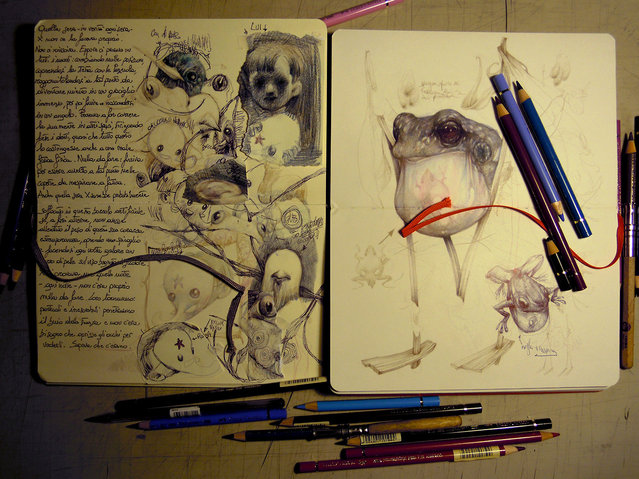
Pencil Artist Marco Mazzoni

Italian pencil artist Marco Mazzoni‘s work goes far beyond technical perfection. His representation of historical healing women is enigmatic and sublime. Often leaving the eyes blank or covered with an abundance of birds, butterflies and flowers, he gives the impression of a deeper inward focused sight, as well as obscuring the identity of the individual. Many female healers in the past – both medicine woman and midwives – were brutally persecuted by religion, some even burnt as witches… Mazzoni’s work captures their deep connection with nature and their innate power and femininity with delicacy and beautiful detail.
Details
24 Mar 2015 09:33:00
Afghanistan: Dogs of War Part 2

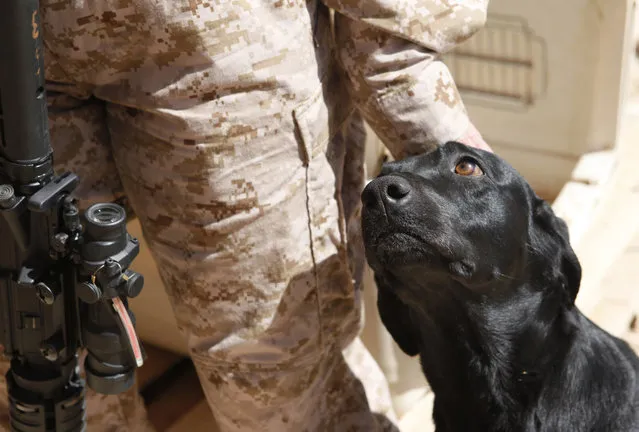
Throughout the course of the long war in Afghanistan, Coalition troops have relied on thousands of military working dogs to help keep them safe, and make their jobs easier. The dogs are trained to detect explosives, to find illegal drugs, to search for missing comrades, or target enemy combatants. Not only are they active on the front lines, but behind the lines they serve as therapy dogs, service dogs, and loyal companions. They also share the same risks as the ground troops, suffering injuries and sometimes death on the battlefields. Gathered here are images of these dogs and their handlers in Afghanistan and back home, from over the past several years, part of the ongoing series here on Afghanistan.
Details
05 Jun 2014 21:10:00
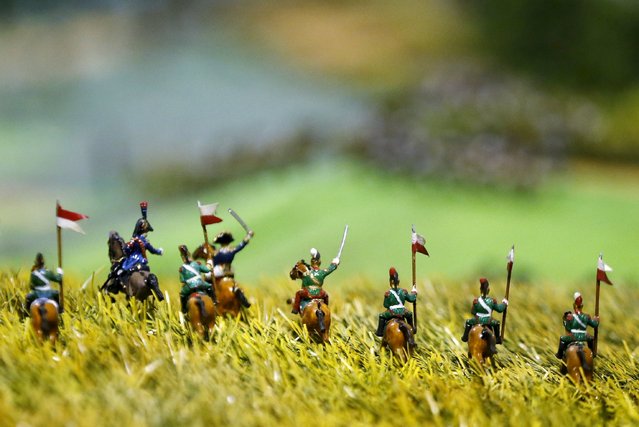
Figurines representing French Brigade of Lancers are seen on a 40-square-metre miniature model of the June 18, 1815 Waterloo battlefield, in Diest, Belgium, in this picture taken on April 29, 2015. (Photo by Francois Lenoir/Reuters)

Figurines representing French Brigade of Lancers are seen on a 40-square-metre miniature model of the June 18, 1815 Waterloo battlefield, in Diest, Belgium, in this picture taken on April 29, 2015. Waterloo enthusiast Willy Smout said he spent 40,000 hours and around 150,000 euros over the past 40 years, to recreate the battlefield as closely as possible in a purpose-built room in his house. (Photo by Francois Lenoir/Reuters)
Details
06 May 2015 13:42:00
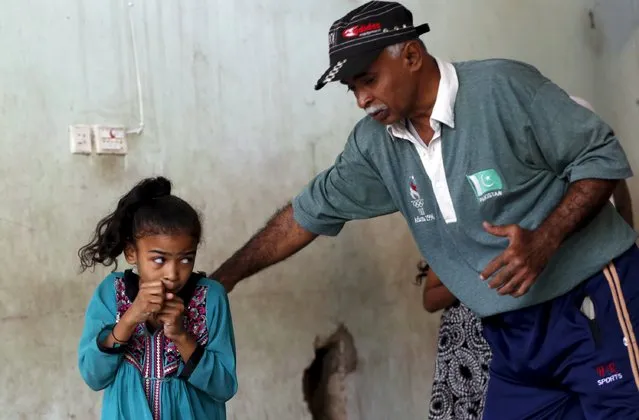
Arisha, 9, takes instructions from coach Younus Qambrani during an exercise session at the first women's boxing coaching camp in Karachi, Pakistan February 19, 2016. (Photo by Akhtar Soomro/Reuters)

Arisha, 9, takes instructions from coach Younus Qambrani during an exercise session at the first women's boxing coaching camp in Karachi, Pakistan February 19, 2016. For the past six months about a dozen girls, aged 8 to 17, have gone to the Pak Shine Boxing Club after school to practice their jabs, hooks and upper cuts. (Photo by Akhtar Soomro/Reuters)
Details
01 Mar 2016 09:46:00