Loading...
Done
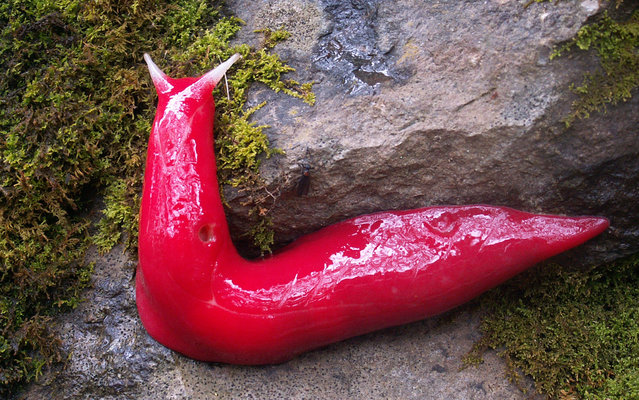
It would seem to be something you'd see only in a cartoon or at a Phish concert, but according to park rangers in New South Wales, Australia, dozens of giant, fluorescent pink slugs have been popping up on a mountaintop there. (Photo by Michael Murphy/AFP Photo/NSW Environment Office)

It would seem to be something you'd see only in a cartoon or at a Phish concert, but according to park rangers in New South Wales, Australia, dozens of giant, fluorescent pink slugs have been popping up on a mountaintop there. The eight-inch creatures have been spotted only on Mount Kaputar, a 5,000-foot peak in the Nandewar Range in northern New South Wales. Scientists believe the eye-catching organisms are survivors from an era when Australia was home to rainforests. A series of volcanoes, millions of years of erosion and other geological changes “have carved a dramatic landscape at Mount Kaputar”, the park service wrote on its Facebook page, and unique arid conditions spared the slugs from extinction. (Photo by Michael Murphy/AFP Photo/NSW Environment Office)
Details
01 Jun 2013 14:09:00
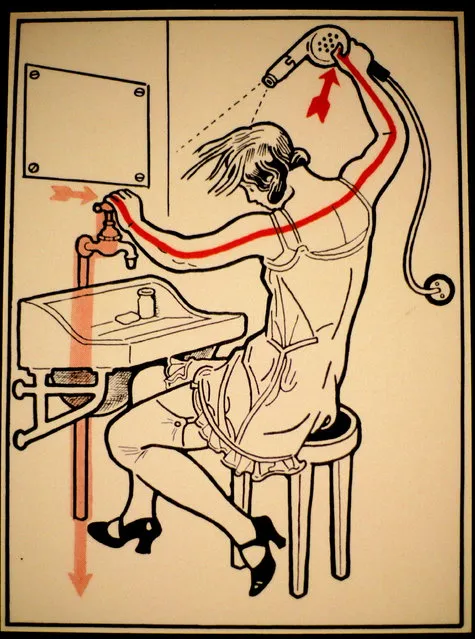
The book “Elektroschutz in 132 Bildern” (Electrical Protection in 132 Pictures) was published in Vienna in the early 1900s by a Viennese physician named Stefan Jellinek (1878-1968, a founder of the Electro-Pathological Museum). The pictures are nice and direct and unambiguous; they teach, graphically, that the surest way to kill yourself with electricity is to form a complete path from source (usually the bright red arrow) to ground (the screened back, pink arrow). Arrowheads provide the path for current flow. (Photo by The Vienna Technical Museum)

The book “Elektroschutz in 132 Bildern” (Electrical Protection in 132 Pictures) was published in Vienna in the early 1900s by a Viennese physician named Stefan Jellinek (1878-1968, a founder of the Electro-Pathological Museum). The pictures are nice and direct and unambiguous; they teach, graphically, that the surest way to kill yourself with electricity is to form a complete path from source (usually the bright red arrow) to ground (the screened back, pink arrow). Arrowheads provide the path for current flow. (Photo by The Vienna Technical Museum)
Details
11 Aug 2014 11:10:00
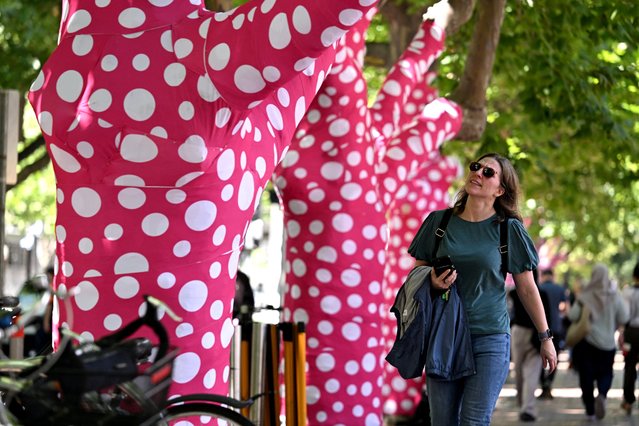
A woman looks at some of the 60 plane trees wrapped in a pink-and-white polka-dot design developed especially for Melbourne by Japanese contemporary artist Yayoi Kusama titled “Ascension of Polka Dots on the Trees”, in Melbourne on November 27, 2024. The National Gallery of Victoria’s (NGV) world-premiere blockbuster exhibition Yayoi Kusama will be on display from 15 December 2024 to 21 April 2025. (Photo by William West/AFP Photo)

A woman looks at some of the 60 plane trees wrapped in a pink-and-white polka-dot design developed especially for Melbourne by Japanese contemporary artist Yayoi Kusama titled “Ascension of Polka Dots on the Trees”, in Melbourne on November 27, 2024. The National Gallery of Victoria’s (NGV) world-premiere blockbuster exhibition Yayoi Kusama will be on display from 15 December 2024 to 21 April 2025. (Photo by William West/AFP Photo)
Details
23 Jan 2025 05:10:00


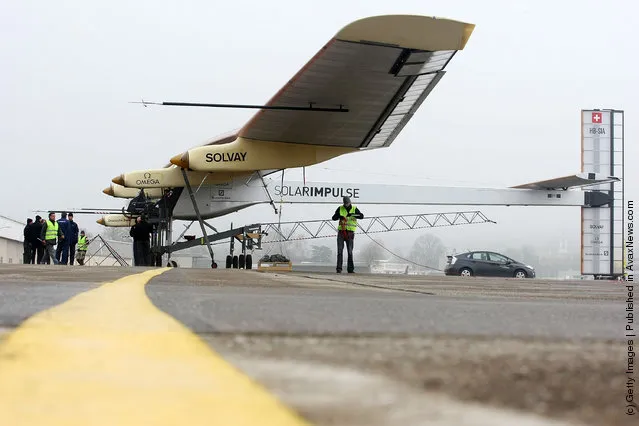
“Solar Impulse is a European long-range solar powered plane project being undertaken by Bertrand Piccard and André Borschberg. The project eventually hopes to succeed in the first circling of the earth with a piloted fixed-wing aircraft using only solar power. The first aircraft, bearing the Swiss aircraft registration code of HB-SIA, is a single-seater, capable of taking off under its own power, and intended to remain airborne up to 36 hours. This aircraft first flew an entire diurnal solar cycle, including nearly 9 hours of night flying, in a 26-hour flight on 7–8 July 2010”. – Wikipedia


Photo: Workers prepare the Solar Impulse airplane HB-SIA for a first runway test on November 19, 2009 in Dubendorf, Switzerland. Solar Impulse chairman Bertrand Piccard, psychatrist and aeronaut, who made the first non-stop round-the-world balloon flight, and CEO and former fighter pilot Andrй Borschberg plan a round-the-world flight, driven only by solar energy, for 2012. (Photo by Johannes Simon/Getty Images)
Details
16 May 2011 08:13:00
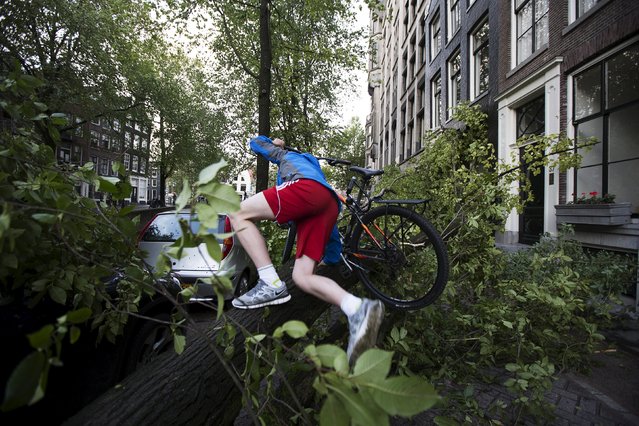
A cyclist climbs over a tree fallen atop a car after a heavy storm in Amsterdam, the Netherlands, July 25, 2015. One person was killed as the most severe July storm ever recorded in the Netherlands swept across the country on Saturday, delaying flights and disrupting road and rail traffic. (Photo by Cris Toala Olivares/Reuters)

A cyclist climbs over a tree fallen atop a car after a heavy storm in Amsterdam, the Netherlands, July 25, 2015. One person was killed as the most severe July storm ever recorded in the Netherlands swept across the country on Saturday, delaying flights and disrupting road and rail traffic. Dozens of flights were delayed at Amsterdam's Schiphol Airport and authorities warned travellers not to take to the road as gale-force winds and rain lashed the country, prompting the meteorological service to issue a “Code Red” warning. (Photo by Cris Toala Olivares/Reuters)
Details
26 Jul 2015 11:05:00
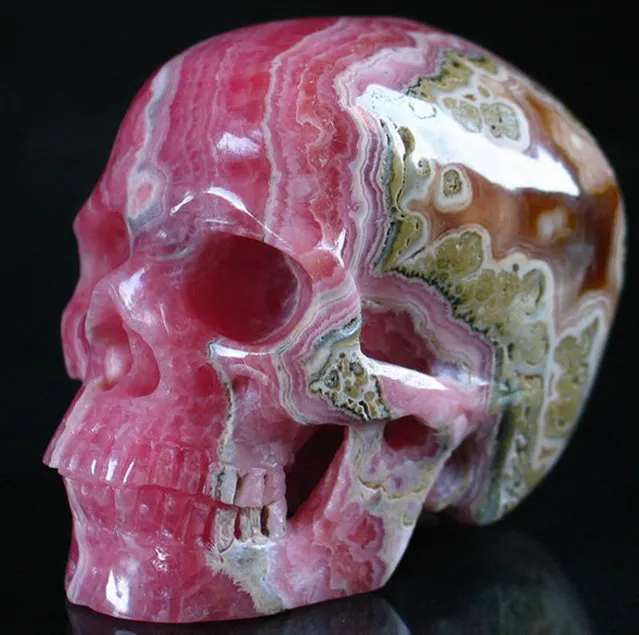
Rhodochrosite - The Mineral And Gemstone Kingdom

Rhodochrosite is a manganese carbonate mineral with chemical composition MnCO3. In its (rare) pure form, it is typically a rose-red color, but impure specimens can be shades of pink to pale brown. It streaks white, and its Mohs hardness varies between 3.5 and 4. Its specific gravity is between 3.5 and 3.7. It crystallizes in the trigonal system, and cleaves with rhombohedral carbonate cleavage in three directions.
Details
30 Sep 2014 10:25:00
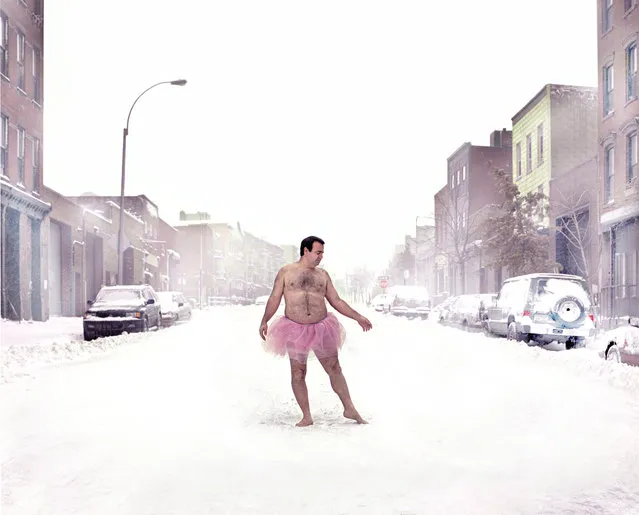
Bob Carey By The Tutu Project

You don't often see a man walking around a field of cows wearing a pink tutu. Needless to say, we were intrigued by Bob Carey and the shirtless photos of him gallivanting around in a costume often worn by little girls. We sensed there was a good story behind this alter-ego ballerina, but we didn't expect it would be this heartwarming.
Details
12 Jun 2013 07:26:00
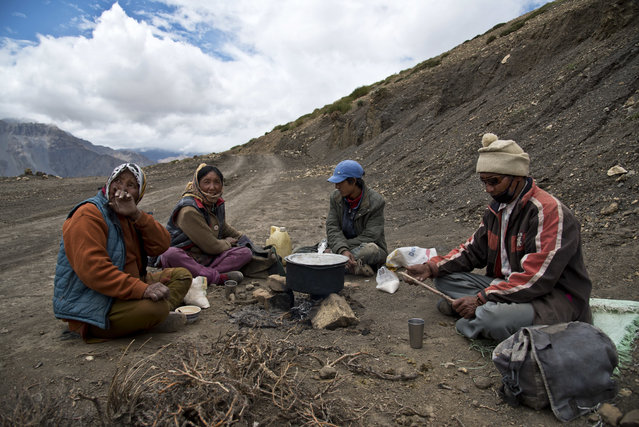
In this August 17, 2016, photo, from left to right, Chhering Chodom, 60, Tashi Yangzom, 50, Lobsang Chhering, 27, and Dorje Tandup, 58, drink milk tea on the side of the road. For centuries, the sleepy valley nestled in the Indian Himalayas remained a hidden Buddhist enclave forbidden to outsiders. Enduring the harsh year-round conditions of the high mountain desert, the people of Spiti Valley lived by a simple communal code – share the Earth's bounty, be hospitable to neighbors, and eschew greed and temptation at all turns. That's all starting to change, for better or worse. Since India began allowing its own citizens as well as outsiders to visit the valley in the early 1990s, tourism and trade have boomed. And the marks of modernization, such as solar panels, asphalt roads and concrete buildings, have begun to appear around some of the villages that dot the remote landscape at altitudes above 4,000 meters (13,000 feet). (Photo by Thomas Cytrynowicz/AP Photo)

In this August 17, 2016, photo, from left to right, Chhering Chodom, 60, Tashi Yangzom, 50, Lobsang Chhering, 27, and Dorje Tandup, 58, drink milk tea on the side of the road. For centuries, the sleepy valley nestled in the Indian Himalayas remained a hidden Buddhist enclave forbidden to outsiders. Enduring the harsh year-round conditions of the high mountain desert, the people of Spiti Valley lived by a simple communal code – share the Earth's bounty, be hospitable to neighbors, and eschew greed and temptation at all turns. That's all starting to change, for better or worse. (Photo by Thomas Cytrynowicz/AP Photo)
Details
15 Sep 2016 09:22:00