American actress Raquel Welch on a balcony overlooking a street in London, 1970. (Photo by Evening Standard). P.S. All pictures are presented in high resolution.
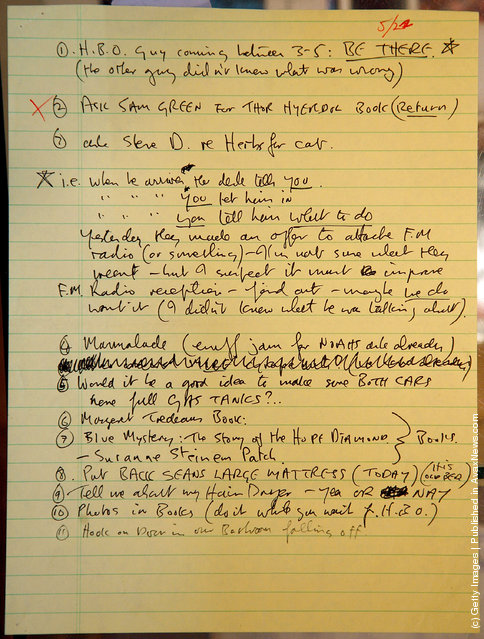
A to-do list written by John Lennon on display at the GOTTA HAVE IT! Rock & Roll Pop Culture Auction Press Preview at the Gotta Have It! store on November 30, 2011 in New York City. (Photo by Andy Kropa/Getty Images)
A group of youngsters dressed as ghouls and zombies for Halloween parade in downtown Lisbon, Portugal, Friday, October 31, 2014. (Photo by Francisco Seco/AP Photo)
Aenne Schwarz as a “daughter” and Anna Sophie Krenn on Thursday, September 8, 2017, during the photoprobe of “Paradies flood / Lost symphony / Part one of the klimatrilogie” in the Akademietheater in Vienna, Austria. The piece premiered on September 9, 2017. (Photo by Georg Hochmuth/APA)
Soap Bubble Structures by Kym Cox. Bubbles optimise space and minimise their surface area for a given volume of air. This phenomenon makes them a useful tool in many areas of research, in particular, materials science and “packing” – how things fit together. Bubble walls drain under gravity, thin at the top, thick at the bottom, which interferes with travelling lightwaves to create bands of colour. Black spots show the wall is too thin for interference colours, indicating the bubble is about to burst. (Photo by Kym Cox/2019 Science Photographer of the Year/RPS)
Inês Carvalho (C), accompanied by her sister and cousin, is helped by her aunt to dress up at Alfama neighborhood in Lisbon on June 12, 2014. Carvalho, 18, is one of the revelers from the Alfama march and every Saint Anthony's day, Lisbon's protector, she parades with several other typical neighborhoods of the city. (Photo by Patricia De Melo Moreira/AFP Photo)
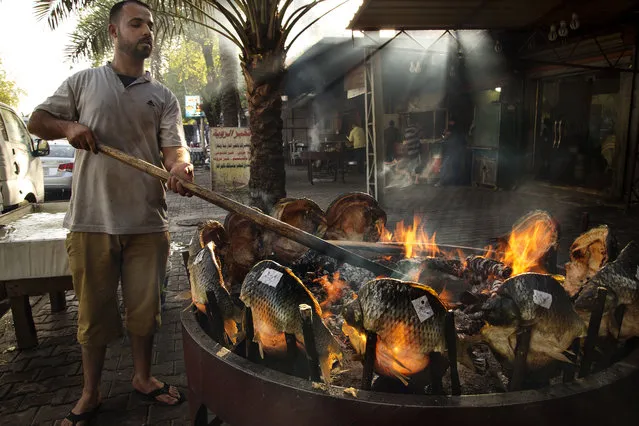
An Iraqi man cooks traditional Masgouf fish on a barbecue for sale in the Karada market July 02, 2014. Masgouf, one of the national dishes of Iraq is a grilled carp seasoned with olive oil, rock salt, tamarind and ground turmeric. (Photo by Scott Nelson for the Washington Post)
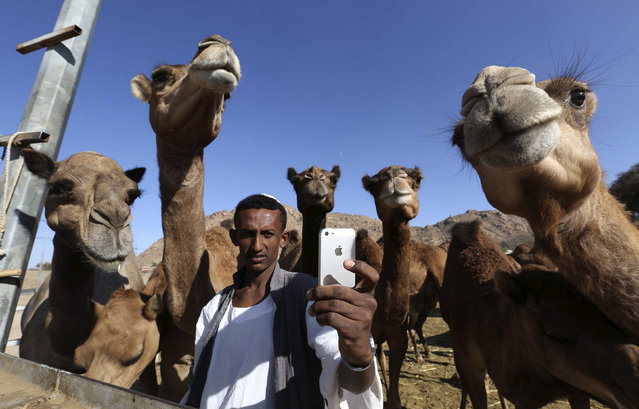
A man takes a “selfie” with camels at a farm in Taif November 1, 2014. Saudi Arabia said late on Wednesday it had detected six new cases of the deadly Middle East Respiratory Syndrome (MERS) in 24 hours, the biggest daily jump for months with officials blaming lax hospital procedures. Scientists are not sure of the origin of the virus, but several studies have linked it to camels and some experts think it is being passed to humans through close physical contact or through the consumption of camel meat or camel milk. (Photo by Mohamed Alhwaity/Reuters)