Loading...
Done
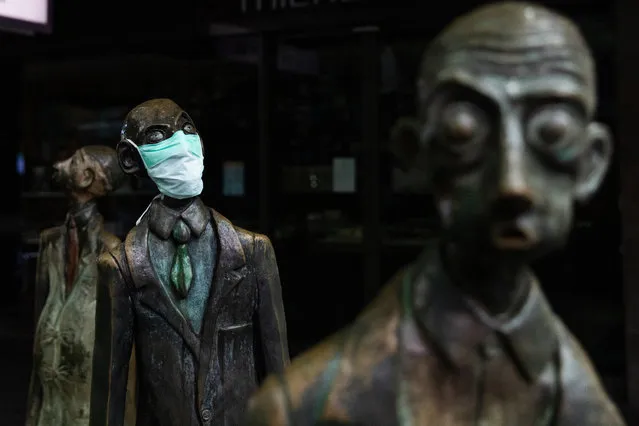
A face mask is placed on one of the 'Three business men who brought lunch' statues on Swanston street on March 29, 2020 in Melbourne, Australia. All international arrivals into Australia from midnight on Saturday will be placed into mandatory quarantine in hotels for 14 days as the Federal Government increases restrictions to stop the spread of COVID-19. All libraries, museums, galleries, beauty salons, tattoo parlours, shopping centre food courts, auctions, open houses, amusement parks, arcades, indoor and outdoor play centres, swimming pools are closed and indoor exercise activities are now banned. This is in addition to the closure of bars, pubs and nightclubs which came into effect on Monday. Restaurants and cafes are restricted to providing takeaway only. Weddings will now be restricted to five people including the couple while funerals are limited to 10 mourners. All Australians are now expected to stay at home except for essential outings such as work, grocery shopping and medical appointments. Exercising outdoors alone is still permitted. Australia now has more than 3,600 confirmed cases of COVID-19 while the death toll now stands at 16. (Photo by Asanka Ratnayake/Getty Images)

A face mask is placed on one of the 'Three business men who brought lunch' statues on Swanston street on March 29, 2020 in Melbourne, Australia. All international arrivals into Australia from midnight on Saturday will be placed into mandatory quarantine in hotels for 14 days as the Federal Government increases restrictions to stop the spread of COVID-19. (Photo by Asanka Ratnayake/Getty Images)
Details
31 Mar 2020 00:07:00
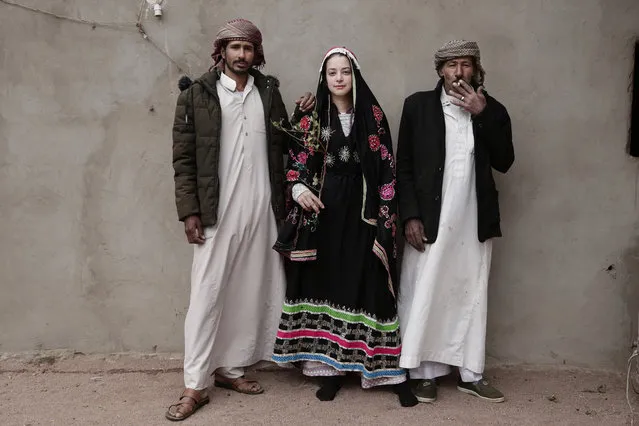
In this March 31, 2019 photo, an Egyptian student borrows a Bedouin wedding dress to pose for a photograph with Bedouin men from the Hamada tribe, in Wadi Sahw, Abu Zenima, in South Sinai, Egypt. Four Bedouin women are for the first time leading tours in Egypt’s Sinai Peninsula, breaking new ground in their deeply conservative community, where women almost never work outside the home or interact with outsiders.  The tourists can only be women, and the tours can’t go overnight. Each day before the sun sets, the group returns to the Hamada’s home village in Wadi Sahu, a narrow desert valley. (Photo by Nariman El-Mofty/AP Photo)

In this March 31, 2019 photo, an Egyptian student borrows a Bedouin wedding dress to pose for a photograph with Bedouin men from the Hamada tribe, in Wadi Sahw, Abu Zenima, in South Sinai, Egypt. Four Bedouin women are for the first time leading tours in Egypt’s Sinai Peninsula, breaking new ground in their deeply conservative community, where women almost never work outside the home or interact with outsiders. The tourists can only be women, and the tours can’t go overnight. Each day before the sun sets, the group returns to the Hamada’s home village in Wadi Sahu, a narrow desert valley. (Photo by Nariman El-Mofty/AP Photo)
Details
11 Apr 2019 00:01:00
In this February 27, 1984, file photo, singer Placido Domingo laughs with members of the Rockettes at New York's Radio City Music Hall. The singer and dancers met while rehearsing for Channel Thirteen's “Gala of Stars 1984”. Nine women in the opera world have told The Associated Press that they were sexually harassed by Domingo, one of the most celebrated and powerful men in opera. The women say the encounters took place over three decades, at venues that included opera companies where he held top managerial positions. (Photo by Steve Friedman/AP Photo/File)

In this February 27, 1984, file photo, singer Placido Domingo laughs with members of the Rockettes at New York's Radio City Music Hall. The singer and dancers met while rehearsing for Channel Thirteen's “Gala of Stars 1984”. Nine women in the opera world have told The Associated Press that they were sexually harassed by Domingo, one of the most celebrated and powerful men in opera. The women say the encounters took place over three decades, at venues that included opera companies where he held top managerial positions. (Photo by Steve Friedman/AP Photo/File)
Details
17 Aug 2019 00:01:00
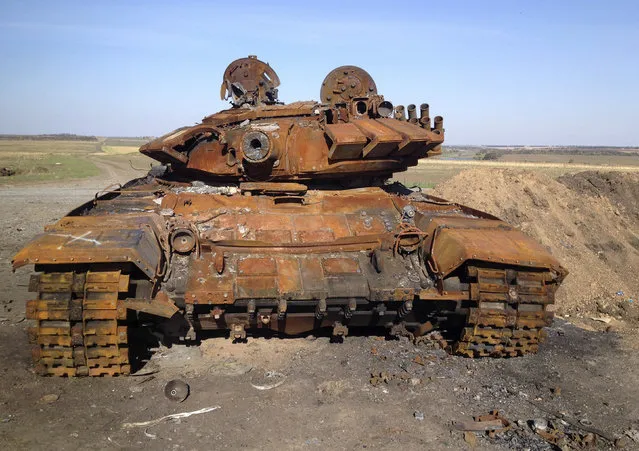
A destroyed T-72 tank, which presumably came from Russia, is seen on a battlefield near separatist-controlled Starobesheve, eastern Ukraine, October 2, 2014.(Photo by Maria Tsvetkova/Reuters)

A destroyed T-72 tank, which presumably came from Russia, is seen on a battlefield near separatist-controlled Starobesheve, eastern Ukraine, October 2, 2014. The burnt-out remains of dozens of tanks and armoured vehicles in fields near the small village of Horbatenko bear witness to the ferocity of a battle that turned the tide of the conflict in eastern Ukraine. Among the debris, Reuters found the blackened carcasses of what military experts have since identified as two Russian army tanks, supporting statements by Kiev and the West that the rebels were backed by troops and equipment sent by Moscow. (Photo by Maria Tsvetkova/Reuters)
Details
24 Oct 2014 12:14:00
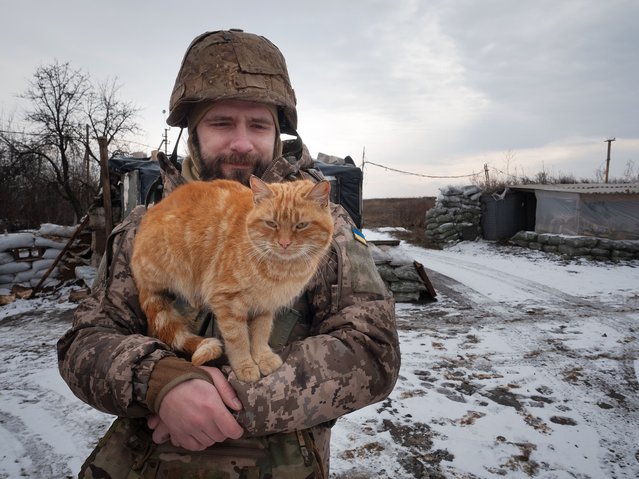
Ukrainian Serviceman Oleksii Hodzenko, aka Godzilla, was a civilian journalist. His father, Sergeant chief Dmytro "Godzilla" Godzenko was killed on March 31, 2016 at 6 a.m. in a mortar attack near the village of Zaitsevo near Horlivka in the Donetsk region. Since then Godzilla "junior" has joined the army, at a frontline position held by Ukraine's 503rd Detached Marine Battalion on February 7, 2022 near Verkhnotoretske, Ukraine. Regional tensions remain high as Russia continues to amass soldiers and military equipment along its border with Ukraine, where large swaths of the Luhansk and Donetsk regions are held by Russian-backed separatists. Russia has also moved roughly 30,000 troops into Belarus, which borders Ukraine to the north. American and European officials say they do not whether Russian President Vladimir Putin has made a decision to invade Ukraine, but have issued a series of warnings about the country's assertive military posture. (Photo by Gaelle Girbes/Getty Images)

Ukrainian Serviceman Oleksii Hodzenko, aka Godzilla, was a civilian journalist. His father, Sergeant chief Dmytro "Godzilla" Godzenko was killed on March 31, 2016 at 6 a.m. in a mortar attack near the village of Zaitsevo near Horlivka in the Donetsk region. Since then Godzilla "junior" has joined the army, at a frontline position held by Ukraine's 503rd Detached Marine Battalion on February 7, 2022 near Verkhnotoretske, Ukraine. Regional tensions remain high as Russia continues to amass soldiers and military equipment along its border with Ukraine, where large swaths of the Luhansk and Donetsk regions are held by Russian-backed separatists. Russia has also moved roughly 30,000 troops into Belarus, which borders Ukraine to the north. American and European officials say they do not whether Russian President Vladimir Putin has made a decision to invade Ukraine, but have issued a series of warnings about the country's assertive military posture. (Photo by Gaelle Girbes/Getty Images)
Details
13 Mar 2022 04:03:00
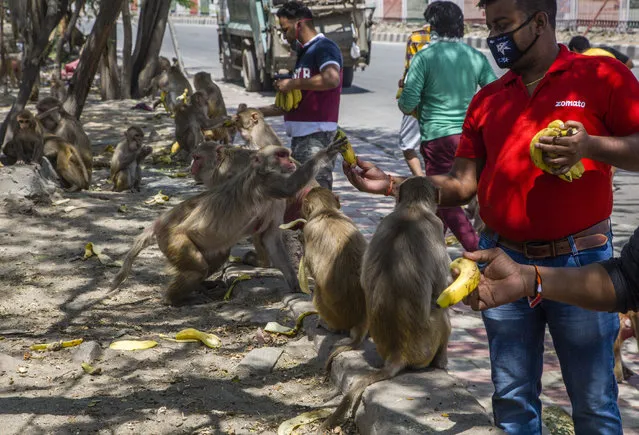
Men give bananas to monkeys gathered on the side of the road as India remains under an unprecedented lockdown over the highly contagious coronavirus (COVID-19) on April 08, 2020 in New Delhi, India. Wild animals, including monkeys, are roaming human settlements in India as people are staying indoors due to the 21-day lockdown. With India's 1.3 billion population and tens of millions of cars off the roads, wildlife is moving towards areas inhabited by humans. Wild animals in many countries have been seen roaming streets. A study says some 60 percent of the new diseases found around the globe every year are zoonotic, meaning they originate in animals and are passed on to humans. COVID-19 is a zoonotic disease that is suspected to have come from the wet markets of Wuhan, China. (Photo by Yawar Nazir/Getty Images)

Men give bananas to monkeys gathered on the side of the road as India remains under an unprecedented lockdown over the highly contagious coronavirus (COVID-19) on April 08, 2020 in New Delhi, India. Wild animals, including monkeys, are roaming human settlements in India as people are staying indoors due to the 21-day lockdown. (Photo by Yawar Nazir/Getty Images)
Details
12 Apr 2020 00:05:00
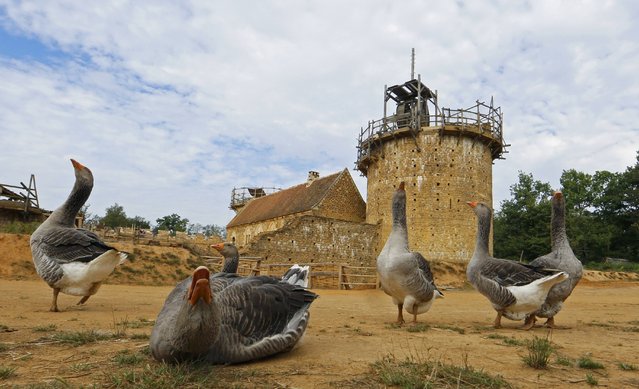
A view of the construction site of the Chateau de Guedelon near Treigny in the Burgundy region of France, September 13, 2016. Blacksmiths, stonemasons and quarry men are hard at work in a Burgundy forest building a 13th-century-style castle using the most basic tools and materials, replicating the methods used hundreds of years ago to better understand them. Forgoing all modern technology, workers use hammers to break stones and forge iron, operate wooden wheels to hoist their materials up to where they are needed, and rely on a quarry for stone, clay and sand as they build up a castle from scratch. Construction on Guedelon Castle in central France began in 1997 after an archaeological survey revealed a medieval fortress hidden inside the walls of nearby Chateau de Saint-Fargeau. Those behind the project hope to answer questions about medieval construction and provide lessons on sustainable building. (Photo by Jacky Naegelen/Reuters)

A view of the construction site of the Chateau de Guedelon near Treigny in the Burgundy region of France, September 13, 2016. Blacksmiths, stonemasons and quarry men are hard at work in a Burgundy forest building a 13th-century-style castle using the most basic tools and materials, replicating the methods used hundreds of years ago to better understand them. (Photo by Jacky Naegelen/Reuters)
Details
15 Sep 2016 09:43:00
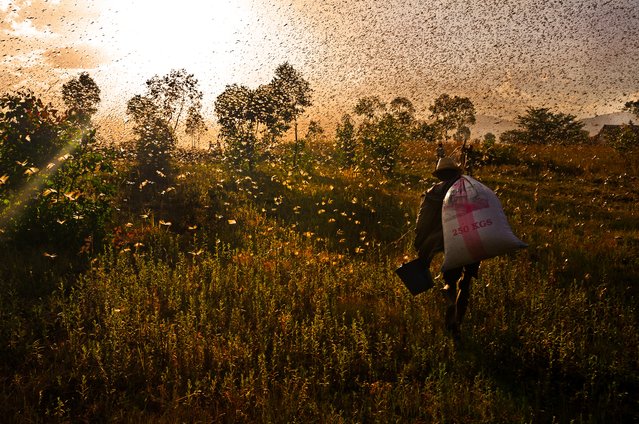
“Locusts & Men”. Oppression, interaction, collaboration. In the life cycle of nature nothing is lost, but the coexistence of different species is sometimes difficult. In Madagascar periodically returns the archaic antagonism between man and the migratory locust, in a circle of life where the two species are looking for space and food for their survival. Photo location: Madagascar, 2013. (Photo and caption by Michele Martinelli/National Geographic Photo Contest)

“Locusts & Men”. Oppression, interaction, collaboration. In the life cycle of nature nothing is lost, but the coexistence of different species is sometimes difficult. In Madagascar periodically returns the archaic antagonism between man and the migratory locust, in a circle of life where the two species are looking for space and food for their survival. At the end of the day a man walks home carrying on his shoulders the heavy bag which contains the locusts captured during the day. The insects provide nutritious meals for the man and his family. Photo location: Madagascar, 2013. (Photo and caption by Michele Martinelli/National Geographic Photo Contest)

ATTENTION! All pictures are presented in high resolution. To see Hi-Res images – just TWICE click on any picture. In other words, click small picture – opens the BIG picture. Click BIG picture – opens VERY BIG picture.
Details
03 Dec 2013 10:59:00