Loading...
Done
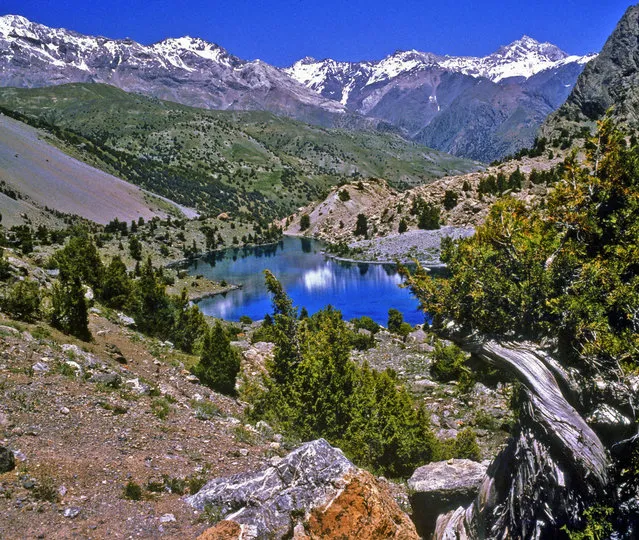
Fann Mountains In Tajikistan

Fann Mountains are part of the western Pamir-Alay mountain system and are located in Tajikistan's Sughd Province between the Zarafshan Range to the north and the Gissar Range to the south (see map of Fann Mountains). In the east-west direction they extend from Fandarya River to Archimaydan River, and the cluster of Marguzor lakes west of Archimaydan is also included in the Fanns.
Details
29 May 2013 11:45:00
Revelers throw colored corn starch into the air as they celebrate the 2015 Holi (Festival of Colors) at the Krishna Temple in Spanish Fork, Utah on Saturday, March 28, 2015. (Photo by Rick Bowmer/AP Photo)

Revelers throw colored corn starch into the air as they celebrate the 2015 Holi (Festival of Colors) at the Krishna Temple in Spanish Fork, Utah on Saturday, March 28, 2015. (Photo by Rick Bowmer/AP Photo)
Details
04 Apr 2015 11:13:00
Bagt Kosgi Ashgabat - Turkmenistan

The "Wedding Palace" (Bagt Kosgi) is located in the southwest of Ashgabat. while the building was designed in a sphere shape surrounded by the eight-corner "Oguzkhan Star" on the corners of the building. There is a map of Turkmenistan on the outer space of the sphere whose radius is 32 meters and it can be seen from far away as the sun reflects off it.
Details
18 May 2014 16:37:00
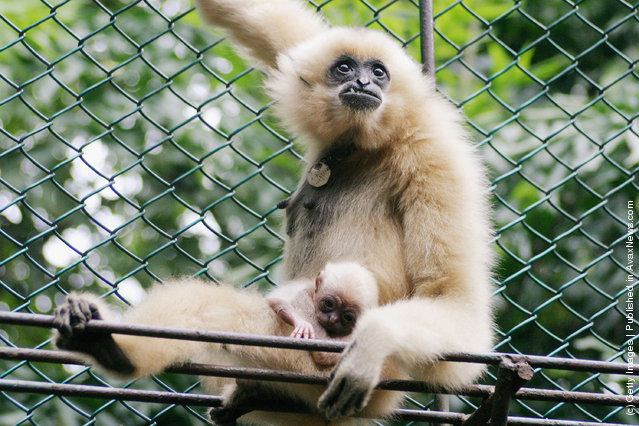
Newborn White-Cheeked Gibbon Nomascus

“Nomascus is the second most speciose genus of gibbons (family Hylobatidae). Originally this genus was a subgenus of Hylobates, and all individuals were considered one species, Hylobates concolor. Species within Nomascus are characterized by 52 chromosomes. Some species are all black, some light with a distinct black tuft of crown fur, and some by distinct, light-colored cheek patches. Nomascus is found from southern China (Yunnan) to southern Vietnam, and also on Hainan Island. One of the genus' species, Nomascus nasutus, has been deemed “the most critically endangered ape species in the world”. All of the species in this genus are endangered or critically endangered”. – Wikipedia

Photo: A newborn White-Cheeked Gibbon clings to its mother in the Nanning Zoo on April 12, 2004 in Nanning, Guangxi province, China. The White-Cheeked Gibbon's natural habitat is Southern China as well as Vietnam and Laos. They are classified as highly endangered and are on the brink of extinction due to poaching and reduction of natural rainforests. (Photo by Getty Images)

Details
12 Aug 2011 11:51:00
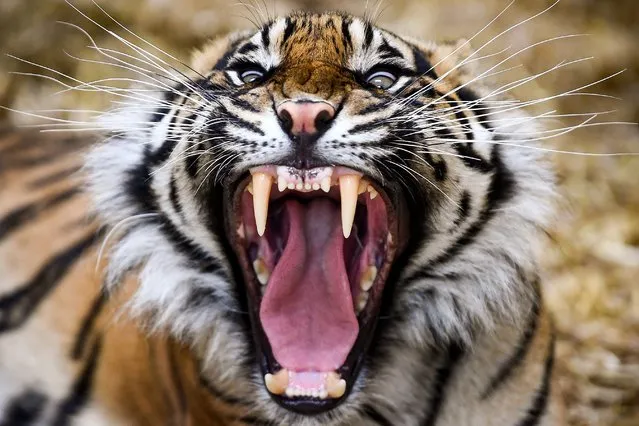
Dharma the Sumatran tiger yawns as members of the public return to Edinburgh Zoo as it opens for the first time following the easing of Scottish Governments lockdown restrictions on June 29, 2020 in Edinburgh, Scotland. Outdoor visitor attractions in Scotland have reopened along with many non-essential retailers after more than three months in lockdown, as Scotland moves into phase 2 of its “route map” for easing coronavirus restrictions. (Photo by Jeff J. Mitchell/Getty Images)

Dharma the Sumatran tiger yawns as members of the public return to Edinburgh Zoo as it opens for the first time following the easing of Scottish Governments lockdown restrictions on June 29, 2020 in Edinburgh, Scotland. Outdoor visitor attractions in Scotland have reopened along with many non-essential retailers after more than three months in lockdown, as Scotland moves into phase 2 of its “route map” for easing coronavirus restrictions. (Photo by Jeff J. Mitchell/Getty Images)
Details
05 Jul 2020 00:01:00
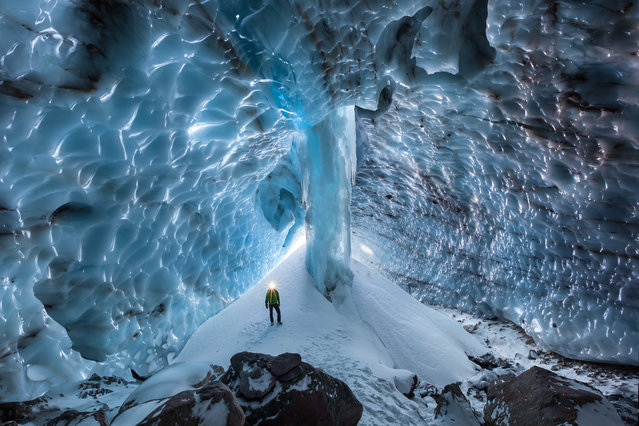
On the western side of Mount Hood lies the longest glacier cave system in the contiguous United States. In 2012, these caves were mapped to a combined length of 7,166.8 feet by cave explorers Brent McGregor and Eddy Cartaya. Currently, the total passage length is hundreds of feet less. Glaciers are frozen rivers; they are always moving and changing. In the past five years, we have seen the caves melt, shrink and collapse in a dramatic way. The caves are formed by water carving away at the ice. (Photo and caption by Josh Hydeman)

On the western side of Mount Hood lies the longest glacier cave system in the contiguous United States. In 2012, these caves were mapped to a combined length of 7,166.8 feet by cave explorers Brent McGregor and Eddy Cartaya. Currently, the total passage length is hundreds of feet less. Glaciers are frozen rivers; they are always moving and changing... (Photo and caption by Josh Hydeman)
Details
22 Mar 2015 11:05:00
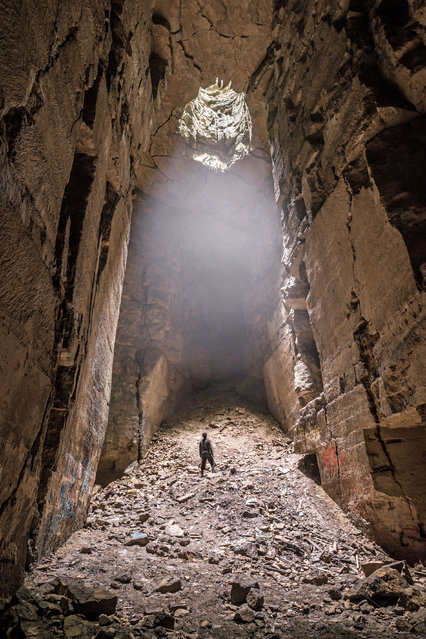
This incredible picture was taken at the Box Freestone Mine, in Wiltshire. Mike revealed that even experienced map readers would struggle to navigate their way around the seemingly endless tunnels that he and his friends visit. (Photo by Mike Deere/Caters News)

A photographer has captured these eerie images showing the scale of some of Britain's deepest darkest wonders. Mike Deere, from Reading, heads to daunting locations such as abandoned mine shafts, miles of sewer tunnels that snake underneath London and even disused cooling towers. Photo: This incredible picture was taken at the Box Freestone Mine, in Wiltshire. Mike revealed that even experienced map readers would struggle to navigate their way around the seemingly endless tunnels that he and his friends visit. (Photo by Mike Deere/Caters News)
Details
02 Jul 2014 10:52:00
Hemispheric color differences on Saturn's moon Rhea are apparent in this false-color view from NASA's Cassini spacecraft in this March 2, 2010 file photo. (Photo by Reuters/NASA/JPL/SSI)

Hemispheric color differences on Saturn's moon Rhea are apparent in this false-color view from NASA's Cassini spacecraft in this March 2, 2010 file photo. (Photo by Reuters/NASA/JPL/SSI)
Details
16 Nov 2015 08:14:00