Loading...
Done
The Lun-class Ekranoplane was used by the Soviet Navy starting in 1987, and wasn't retired until the late 1990s, after the Soviet Union's fall. (Igor113)

“The Lun-class ekranoplan (NATO reporting name Duck) was a ground effect vehicle (GEV) designed by Rostislav Evgenievich Alexeev and used by the Soviet and Russian navies from 1987 until sometime in the late 1990s. It “flew” using the lift generated by the ground effect of its large wings when close to the surface of the water – about four metres or less. Although they might look similar and/or have related technical characteristics, ekranoplans like the Lun are not aircraft, seaplanes, hovercraft, or hydrofoils – ground effect is a separate technology altogether. The International Maritime Organization classifies these vehicles as maritime ships. The name Lun comes from the Russian for harrier”. – Wikipedia (Photo by Igor113)
Details
08 Aug 2014 10:51:00
Revellers ride during the 54th annual brass band festival in the Serbian village of Guca August 7, 2014. Every year Guca is swamped by thousands of people taking part in the celebration of brass band music. (Photo by Marko Djurica/Reuters)

Revellers ride during the 54th annual brass band festival in the Serbian village of Guca August 7, 2014. Every year Guca is swamped by thousands of people taking part in the celebration of brass band music. (Photo by Marko Djurica/Reuters)
Details
10 Aug 2014 10:48:00
President Woodrow Wilson speaks on telephone. Woodrow Wilson was the 28th U.S. President serving from 1913 – 1921. (Photo by Corbis)

President Woodrow Wilson speaks on telephone. Woodrow Wilson was the 28th U.S. President serving from 1913 – 1921. (Photo by Corbis)
Details
18 Mar 2014 09:54:00
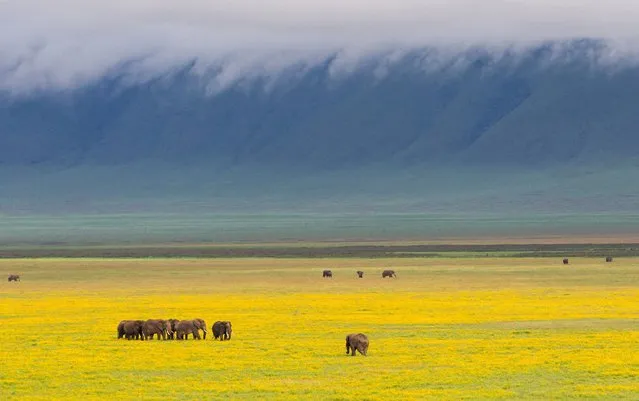
Ngorongoro Crater (Tanzania). At 610m deep and 260 sq km, this is the largest unflooded caldera in the world. A blue-green vision from above it's a haven for engangered wildlife and Maasai livestock. The crater was formed three million years ago when a giant volcano, which could have been as high as Kilimanjaro, exploded and collapsed. The caldera formed the concentric fractures in the crust cracked down to a magma reservoir deep underground. (Photo by John Bryant/Getty Images)

Ngorongoro Crater (Tanzania). At 610m deep and 260 sq km, this is the largest unflooded caldera in the world. A blue-green vision from above it's a haven for engangered wildlife and Maasai livestock. The crater was formed three million years ago when a giant volcano, which could have been as high as Kilimanjaro, exploded and collapsed. The caldera formed the concentric fractures in the crust cracked down to a magma reservoir deep underground. (Photo by John Bryant/Getty Images)
Details
28 Mar 2014 08:08:00
Tanzania, 1964. A touching moment between primatologist and National Geographic grantee Jane Goodall and young chimpanzee Flint at Tanzania's Gombe Stream Reserve. (Photo by Hugo van Lawick

Tanzania, 1964. A touching moment between primatologist and National Geographic grantee Jane Goodall and young chimpanzee Flint at Tanzania's Gombe Stream Reserve. (Photo by Hugo van Lawick via National Geographic)
Details
16 Jan 2013 09:59:00
Commonwealth dance group on the right track with Virgin Trains – Photo call at Glasgow Central Station. (Photo by Daily Record)

Commonwealth dance group on the right track with Virgin Trains – Photo call at Glasgow Central Station. (Photo by Daily Record)
Details
14 Jul 2014 13:09:00
1936:  Lucie Clayton instructs pupils in the art of correct posture by balancing a glass and book on their heads at her finishing school

Lucie Clayton instructs pupils in the art of correct posture by balancing a glass and book on their heads at her finishing school in Old Cavendish Street, London. (Photo by William Vanderson/Fox Photos/Getty Images). 25th November 1936
Details
06 Sep 2011 12:06:00
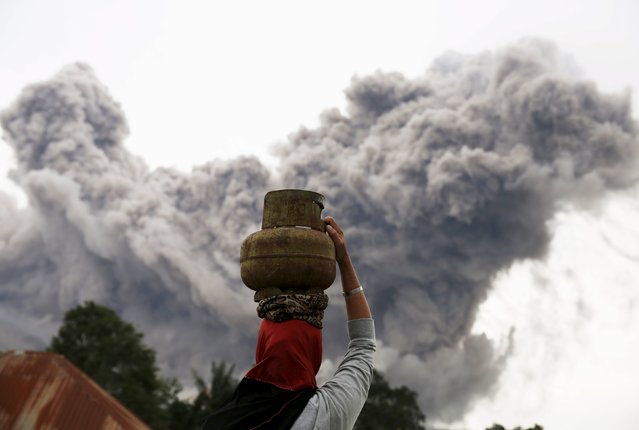
A resident carries a gas canister as an ash cloud hovers above during an eruption of Mount Sinabung volcano at Tiga Serangkai village in Karo Regency, North Sumatra province, Indonesia June 24, 2015. More than 10,000 people from 12 villages, who are living around the slopes of Mount Sinabung, left their homes and moved to refugee camps, local media reported. (Photo by Reuters/Beawiharta)

A resident carries a gas canister as an ash cloud hovers above during an eruption of Mount Sinabung volcano at Tiga Serangkai village in Karo Regency, North Sumatra province, Indonesia June 24, 2015. More than 10,000 people from 12 villages, who are living around the slopes of Mount Sinabung, left their homes and moved to refugee camps, local media reported. (Photo by Reuters/Beawiharta)
Details
27 Jun 2015 13:30:00