Loading...
Done
Polish artist Agnieszka Pilat poses with the artwork of her robot painting dogs – Basia Spot and Bunny Spot – who have become artists painting on canvases with their paws, at the launch of the National Gallery of Victoria (NGV) Triennial 2023 in Melbourne on April 5, 2023. Pilat works with the Boston Dynamics dogs, training them to paint autonomously through AI technology individually and collaboratively, and will be part of more than 100 local and international artists, designers and collectives presenting at the exhibition opening in December. (Photo by William West/AFP Photo)

Polish artist Agnieszka Pilat poses with the artwork of her robot painting dogs – Basia Spot and Bunny Spot – who have become artists painting on canvases with their paws, at the launch of the National Gallery of Victoria (NGV) Triennial 2023 in Melbourne on April 5, 2023. Pilat works with the Boston Dynamics dogs, training them to paint autonomously through AI technology individually and collaboratively, and will be part of more than 100 local and international artists, designers and collectives presenting at the exhibition opening in December. (Photo by William West/AFP Photo)
Details
25 May 2023 03:14:00
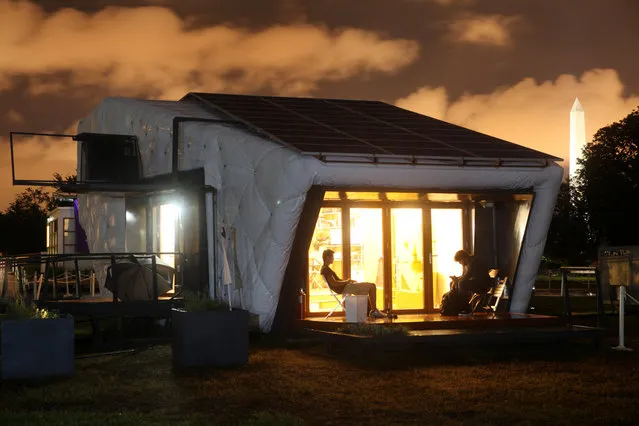
CHIP House Powered By Solar Energy

CHIP is a prefab, net-zero solar-powered house designed and built by a student-run team from two Southern California schools: Southern California Institute of Architecture (SCI-Arc) and California Institute of Technology (Caltech). The house is the team's entry for the U.S. Department of Energy Solar Decathlon 2011 competition.
Details
13 Dec 2012 11:35:00


A model showcases lingerie during a lingerie show on International Women's Day at a shopping mall on March 8, 2011 in Qingdao, Shandong Province of China. The official theme of International Women's Day 2011 is “Equal access to education, training and science and technology: Pathway to decent work for women”. (Photo by ChinaFotoPress/Getty Images). QINGDAO, CHINA – MARCH 08 2011
Details
10 Mar 2011 12:24:00
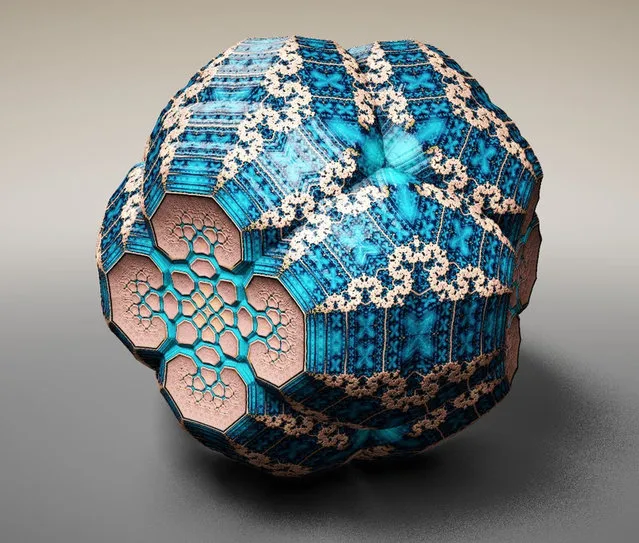
Organic Geometry By Tom Beddard

Edinburgh-based physicist-turned-web-designer Tom Beddard was inspired by geometry to create these virtual Fabergé fractals – made up of self-repeating patterns, so that structures within the object resemble the whole. “Within a 3D fractal, there is infinite detail”, says Beddard, 37. “The closer you zoom in, the more structure is revealed”. Beddard rendered the fractals using WebGL, a technology used to animate 3D scenes in a browser.
Details
25 Jul 2014 12:14:00
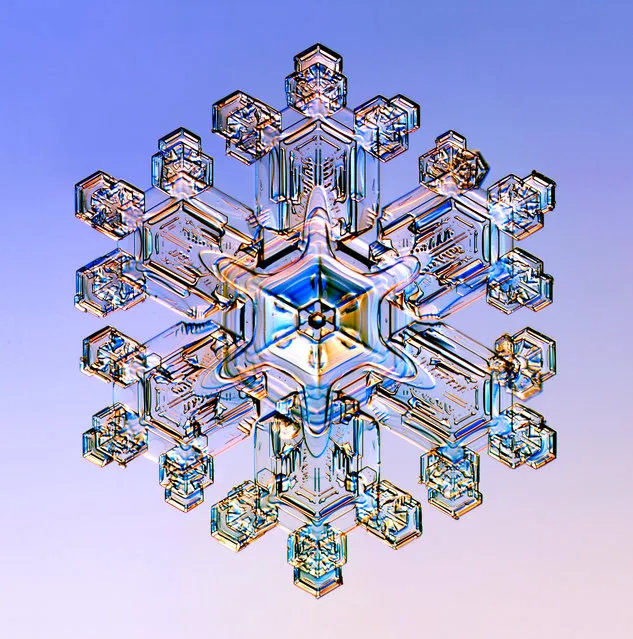
Nikon Small World Photomicrography Competition 2012. Honorable Mention. “Snow crystal, illuminated with colored lights (5x)”. (Photo by Dr. Kenneth Libbrecht, California Institute of Technology (Caltech), Department of Physics, Pasadena, California, USA)

Most people know Nikon as a purveyor of pro and consumer-grade digital cameras. But the company's expertise with optics bleeds over into related markets – it's one of the science community's major suppliers of microscopes. And each year the company asks the community to send it some of their favorite images of tiny objects. A panel of scientists and journalists have chosen the best of this past year's submissions, which Nikon has placed on its Small World site.

Photo: Honorable Mention. “Snow crystal, illuminated with colored lights (5x)”. (Photo by Dr. Kenneth Libbrecht, California Institute of Technology (Caltech), Department of Physics, Pasadena, California, USA)
Details
25 Oct 2012 13:49:00


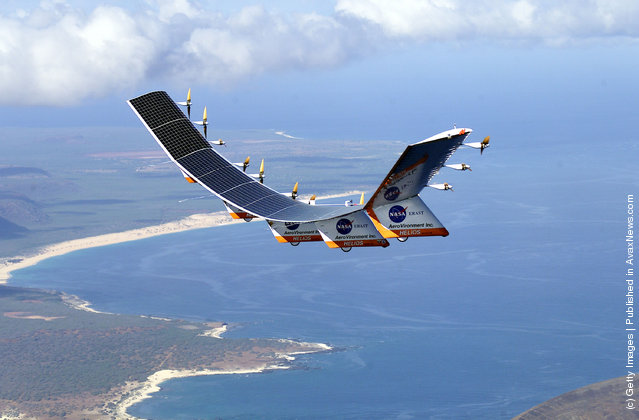
“NASA's Pathfinder, Pathfinder Plus, Centurion and Helios Prototype were an evolutionary series of solar- and fuel-cell-system-powered unmanned aerial vehicles. AeroVironment, Inc. developed the vehicles under NASA's Environmental Research Aircraft and Sensor Technology (ERAST) program. They were built to develop the technologies that would allow long-term, high-altitude aircraft to serve as “atmospheric satellites”, to perform atmospheric research tasks as well as serve as communications platforms”. – Wikipedia

Photo: The solar-electric Helios Prototype flying wing is flies over the Hawaiian islands of Niihau and Lehua during the first solar-powered test flight July 14, 2001 from the U.S. Navy's Pacific Missile Range Facility on Kauai, HI. The 18-hour flight was a functional checkout of the aircraft's systems and performance in preparation for an attempt to reach sustained flight at 100,000 feet altitude later in the summer. (Photo Courtesy of NASA/Getty Images)

Details
14 Jul 2011 09:24:00
Plaster cast moulds of victims of the Mount Vesuvius eruption lie on a display table in a laboratory at Pompeii October 13, 2015. An expert team made up of archaeologists, radiologists, orthodontists and anthropologists began on September 2015 to use CAT scan technology (computerised axial tomography) to peer inside the plaster cast moulds of Pompeii's victims, in a study that has added more detail to previous findings. (Photo by Alessandro Bianchi/Reuters)

Plaster cast moulds of victims of the Mount Vesuvius eruption lie on a display table in a laboratory at Pompeii October 13, 2015. An expert team made up of archaeologists, radiologists, orthodontists and anthropologists began on September 2015 to use CAT scan technology (computerised axial tomography) to peer inside the plaster cast moulds of Pompeii's victims, in a study that has added more detail to previous findings. A 16-layer scan had to be used in order to penetrate the hardened plaster but the results showed up impressive skeletal remains and near perfect teeth. (Photo by Alessandro Bianchi/Reuters)
Details
22 Oct 2015 08:02:00
In this Wednesday, July 23, 2014 file photo, Omaha photographer Lane Hickenbottom photographs the night sky in a pasture near Callaway, Neb. With no moon in the sky, the Milky Way was visible to the naked eye. More than one-third of the world’s population can no longer see the Milky Way because of man-made lights, according to a scientific paper by Light Pollution Science and Technology Institute's Fabio Falchi and his team members, published on Friday, June 10, 2016. (Photo by Travis Heying/The Wichita Eagle via AP Photo)

In this Wednesday, July 23, 2014 file photo, Omaha photographer Lane Hickenbottom photographs the night sky in a pasture near Callaway, Neb. With no moon in the sky, the Milky Way was visible to the naked eye. More than one-third of the world’s population can no longer see the Milky Way because of man-made lights, according to a scientific paper by Light Pollution Science and Technology Institute's Fabio Falchi and his team members, published on Friday, June 10, 2016. (Photo by Travis Heying/The Wichita Eagle via AP Photo)
Details
11 Jun 2016 12:37:00