Loading...
Done
High Glitz by Susan Anderson

Child beauty pageants are a billion-dollar industry in the U.S. While some critics see the pageants as an exploitation of innocents, others—particularly pageant parents—view the competitions as a way for a young talent to enter the entertainment industry.
Details
07 Nov 2016 23:55:00
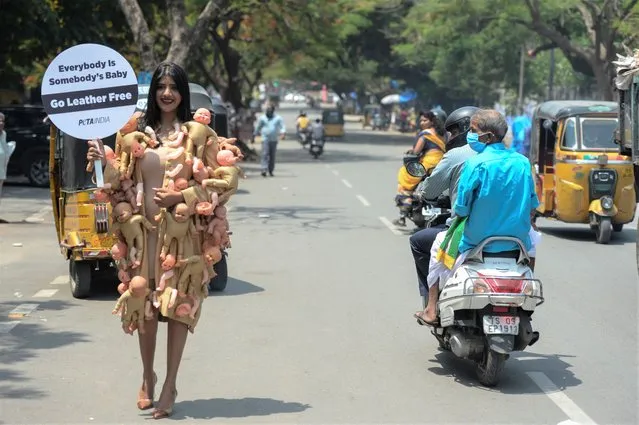
An activist of People for the Ethical Treatment of Animals (PETA) stands along a road wearing a coat with baby dolls to raise awareness about the leather industry, in Hyderabad on May 6, 2022. (Photo by Noah Seelam/AFP Photo)

An activist of People for the Ethical Treatment of Animals (PETA) stands along a road wearing a coat with baby dolls to raise awareness about the leather industry, in Hyderabad, India on May 6, 2022. (Photo by Noah Seelam/AFP Photo)
Details
07 May 2022 05:32:00


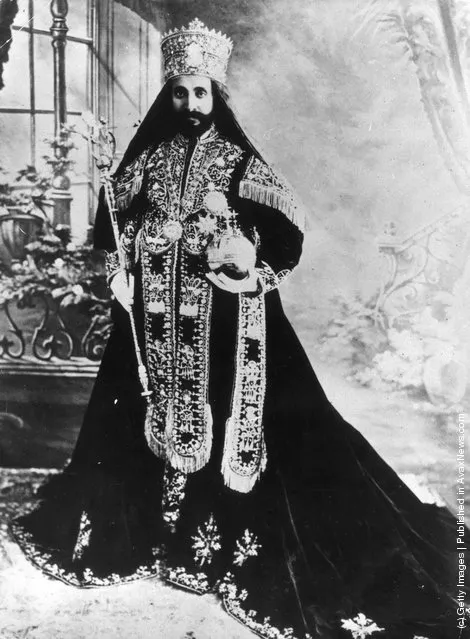
“Haile Selassie I (23 July 1892 – 27 August 1975), born Tafari Makonnen, was Ethiopia's regent from 1916 to 1930 and Emperor of Ethiopia from 1930 to 1974. The heir to a dynasty that traced its origins to the 13th century, and from there by tradition back to King Solomon and Queen Makeda, Empress of Axum, known in the Abrahamic tradition as the Queen of Sheba. Haile Selassie is a defining figure in both Ethiopian and African history.

Haile Selassie is revered as the returned Messiah of the Bible, God incarnate, among the Rastafari movement, the number of followers of which is estimated between 200,000 and 800,000. Begun in Jamaica in the 1930s, the Rastafari movement perceives Haile Selassie as a messianic figure who will lead a future golden age of eternal peace, righteousness, and prosperity. He himself remained an Ethiopian Orthodox Christian throughout his life”. – Wikipedia

Photo: Negusa Negasti, Emperor of Ethiopia Haile Selassie I, known as “Lord of Lords”, “The Conquering Lion of the tribe of Judah”, “Light of the world”, “Elect of God”, in full ceremonial regalia following his coronation. (Photo by Hulton Archive/Getty Images)

Details
21 Jun 2011 11:04:00
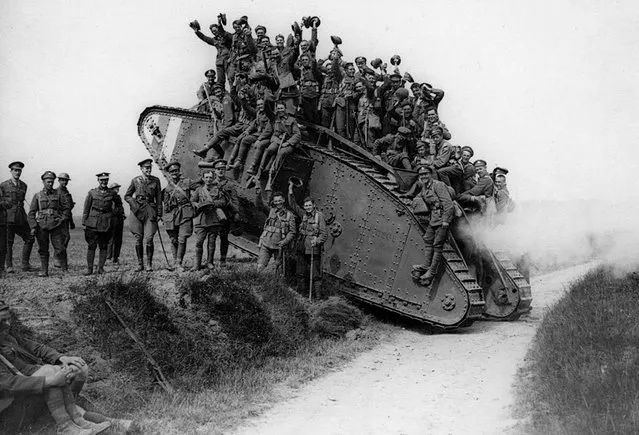
These black-and-white photos are taken from the new book “Armoured Warfare in the First World War 1916 – 1918” by Anthony Tucker-Jones and published by Pen & Sword Military. “Interestingly the British, French and Germans took completely different approaches with varying results”. The British military produced “Little Willie” in Autumn 1915 weighing 18 tonnes, which had a crew of two plus four gunners. “Inspired by a tracked artillery tractor “Little Willie” was referred to as a water tank – hence the name tank – to ensure secrecy”, said Anthony. “This led to the strange looking Mark I with its peculiar rhomboid shape, designed to cross trenches with guns in sponsons on either side. The Germans saw the tank as unchivalrous and were slow to grasp its utility. They favoured the Stormtrooper (specialist soldiers used to infiltrate enemy trenches) and artillery, not the tank”, said Anthony. “However, they didn’t hesitate to make use of captured British tanks. Although the tank helped secure victory and German soldiers dubbed it “Germany’s Downfall” the country was ultimately brought to its knees by the Allies blockade”. Here: British troops hitch a ride on a Mark IV after the massed tank fleet spearheading attack at Cambrai on November 20, 1917. (Photo by Anthony Tucker-Jones/Mediadrumworld.com)

These black-and-white photos are taken from the new book “Armoured Warfare in the First World War 1916 – 1918” by Anthony Tucker-Jones and published by Pen & Sword Military. Here: British troops hitch a ride on a Mark IV after the massed tank fleet spearheading attack at Cambrai on November 20, 1917. (Photo by Anthony Tucker-Jones/Mediadrumworld.com)
Details
23 Feb 2017 00:02:00
A mannequin wearing a face mask stands at the entrance of a women's clothing store in La Paz, Bolivia, Monday, June 1, 2020. After more than two months of quarantine to curb the spread of the new coronavirus the government authorized the restart of public transport and several industrial and commercial activities. (Photo by Juan Karita/AP Photo)

A mannequin wearing a face mask stands at the entrance of a women's clothing store in La Paz, Bolivia, Monday, June 1, 2020. After more than two months of quarantine to curb the spread of the new coronavirus the government authorized the restart of public transport and several industrial and commercial activities. (Photo by Juan Karita/AP Photo)
Details
03 Jul 2020 00:03:00
Industrial Sector, Tokai, Japan. (Photo by Benjamin Grant/Digital Globe/Caters News)

This series of pictures shot by satellite, show the man-made world as astronauts see it. Artist Benjamin Grant uses Google Earth to find the most compelling satellite images of human civilization. The stunning pictures of sprawling metropolises and vast reservoirs are sometimes unidentifiable until zoomed in. In order to find an extraordinary picture in the practically endless supply of satellite data, Benjamin focuses on the themes of current events or environmental issues. Here: Industrial Sector, Tokai, Japan. (Photo by Benjamin Grant/Digital Globe/Caters News)
Details
04 Feb 2015 12:21:00
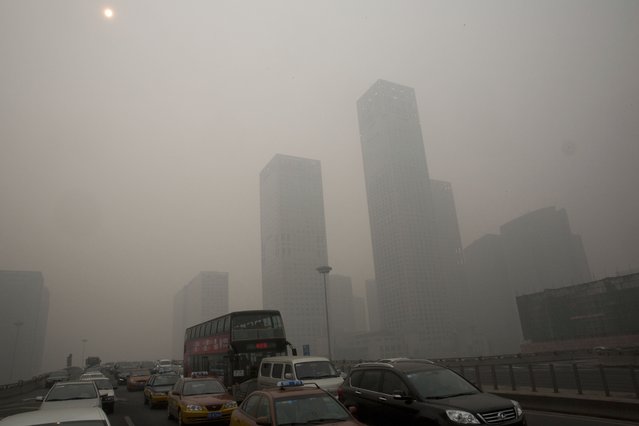
Vehicles clog a highway during a hazy day in Beijing, China, Wednesday, February 26, 2014. Beijing remained cloaked in hazardous white pollution hiding much of its skyline Wednesday, despite the announced closures or production cuts at 147 of the city's industrial plants. (Photo by Ng Han Guan/AP Photo)

Vehicles clog a highway during a hazy day in Beijing, China, Wednesday, February 26, 2014. Beijing remained cloaked in hazardous white pollution hiding much of its skyline Wednesday, despite the announced closures or production cuts at 147 of the city's industrial plants. (Photo by Ng Han Guan/AP Photo)
Details
27 Feb 2014 07:37:00
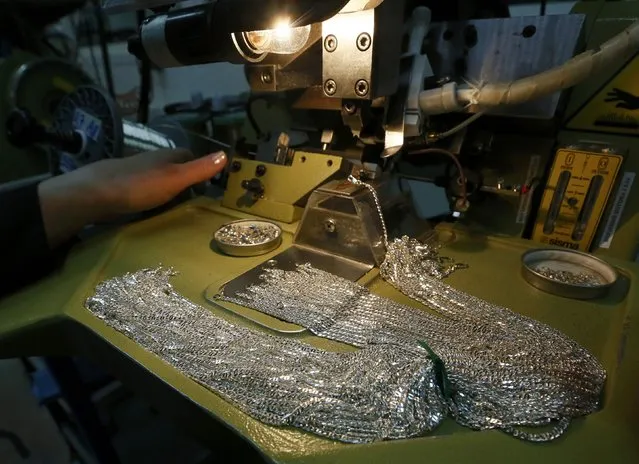
An employee operates a machine while attaching a lock to a silver chain at the jewelry department of the Krastsvetmet non-ferrous metals plant, one of the world's largest producers in the precious metals industry, in the Siberian city of Krasnoyarsk, Russia, December 14, 2016. (Photo by Ilya Naymushin/Reuters)

An employee operates a machine while attaching a lock to a silver chain at the jewelry department of the Krastsvetmet non-ferrous metals plant, one of the world's largest producers in the precious metals industry, in the Siberian city of Krasnoyarsk, Russia, December 14, 2016. (Photo by Ilya Naymushin/Reuters)
Details
17 Dec 2016 07:46:00