Loading...
Done
Revellers enjoy a night out in central Liverpool, northwest England, on December 30, 2020 before hightened Tier 3 restrictions closing hospitality venues, and bars indoor and outdoor socialising between households are imposed in the city amid surging cases of the novel coronavirus. Tighter coronavirus restrictions will be extended across England from on December 30 the British government announced, with a new Covid-19 variant blamed for a rapid surge in cases. Liverpool enters Tier 3, which closes hospitality venues, and bars indoor and outdoor socialising between households with the highest Tier 4 rules, which require all non-essential shops, hairdressers as well as leisure and entertainment venues to close, will now apply to more than 44 million people. (Photo by Oli Scarff/AFP Photo)

Revellers enjoy a night out in central Liverpool, northwest England, on December 30, 2020 before hightened Tier 3 restrictions closing hospitality venues, and bars indoor and outdoor socialising between households are imposed in the city amid surging cases of the novel coronavirus. (Photo by Oli Scarff/AFP Photo)
Details
01 Mar 2021 08:47:00
Ruins of a building are seen in the old village of Belchite, in northern Spain, November 13, 2016. (Photo by Andrea Comas/Reuters)

Ruins of a building are seen in the old village of Belchite, in northern Spain, November 13, 2016. Almost 80 years ago Tomas Ortin fled under the cover of night from his home in the small town of Belchite on Spain's northern plains to escape with hundreds of others from one of the bloodiest battles of the country's civil war. At 94 years old, Ortin now lives just across the road from Belchite, which has lain in ruins since Republican forces attacked it, a symbol of the destruction caused by the 1936-1939 war in which an estimated 500,000 people died. (Photo by Andrea Comas/Reuters)
Details
30 Nov 2016 12:31:00
Cassette Tape Art By Benoit Jammes

So I'm a 33 year old graphic designer, and I live in Paris, France
This work on cassette tapes is entirely handmade, with a bit of work but so nostalgia... It so happened that I found a bunch of old cassettes at home; seeing them brought me back, in thought, to an earlier time, the 80s, and to me as a kid. In any case, I could not play them any more so resurrecting them sounded like a good idea...it was sound, it became visual! And I am pretty sure they are more happy now than in a shoebox :-)
I think people from my generation relate to this work because many enjoy the funny side of it, the references. They are happy to see that these old cassette tapes managed to start a new life!

Signed and numbered prints are available for sale.

Benoit Jammes

Details
11 Apr 2013 11:06:00


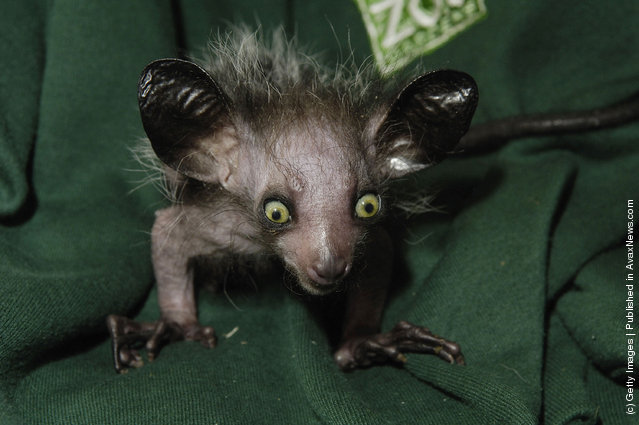
“The aye-aye (Daubentonia madagascariensis) is a lemur, a strepsirrhine primate native to Madagascar that combines rodent-like teeth and a special thin middle finger to fill the same ecological niche as a woodpecker. It is the world's largest nocturnal primate, and is characterized by its unusual method of finding food; it taps on trees to find grubs, then gnaws holes in the wood and inserts its narrow middle finger to pull the grubs out. The only other animal species known to find food in this way is the striped possum. From an ecological point of view the aye-aye fills the niche of a woodpecker as it is capable of penetrating wood to extract the invertebrates within”. – Wikipedia

Photo: In this handout image from Bristol Zoo is seen the first captive bred aye-aye in the UK named “Kintana” (meaning star in Malagasy) April 15, 2005 at Bristol Zoo Gardens, England. The zoo announced today only the second baby aye-aye to be hand-reared in the world (the first was in Jersey Zoo) and has now made his first public appearance since his birth on 11 February 2005. (Photo by Rob Cousins/Bristol Zoo via Getty Images)
Details
13 Apr 2011 13:33:00
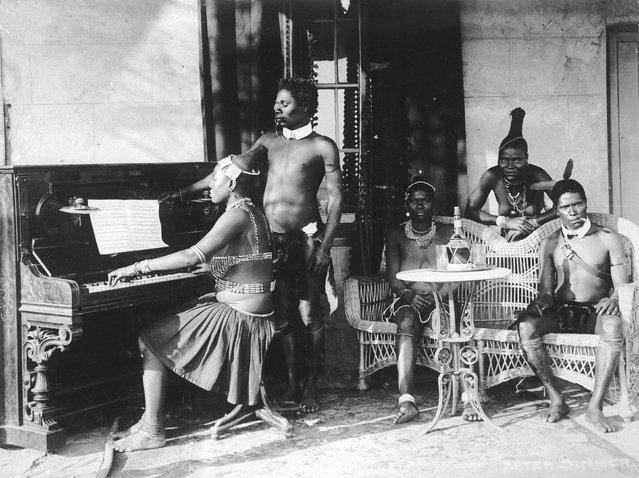
circa 1925:  A Zulu woman playing the piano while a group of others sit and listen.  (Photo by General Photographic Agency/Getty Images)

“The Zulu are the largest South African ethnic group, with an estimated 10–11 million people living mainly in the province of KwaZulu-Natal. Small numbers also live in Zimbabwe, Zambia, and Mozambique. Their language, Zulu, is a Bantu language; more specifically, part of the Nguni subgroup. The Zulu Kingdom played a major role in South African history during the 19th and 20th centuries. Under apartheid, Zulu people were classed as third-class citizens and suffered from state-sanctioned discrimination. They remain today the most numerous ethnic group in South Africa, and now have equal rights along with all other citizens”. – Wikipedia.

Photo: A Zulu woman playing the piano while a group of others sit and listen (to put it briefly, Englishmen scoff over Zulu). South Africa, circa 1925. (Photo by General Photographic Agency)

Details
03 Feb 2014 09:40:00
A boy sits in a canoe in front of a shed built on a raft in the Makoko fishing community on the Lagos Lagoon, Nigeria February 29, 2016. Makoko, a vast slum of houses on stilts in a Lagos lagoon, now boasts a new school – pyramid-shaped, floating and capable of withstanding the waterways' extreme weather, it is a beacon of hope for the nearly 100,000 Nigerians who live there.  (Photo by Akintunde Akinleye/Reuters)

A boy sits in a canoe in front of a shed built on a raft in the Makoko fishing community on the Lagos Lagoon, Nigeria February 29, 2016. In Makoko, a sprawling slum of Nigeria's megacity Lagos, a floating school capable of holding up to a hundred pupils has since November brought free education to the waterways known as the Venice of Lagos. It offers the chance of social mobility for youngsters who, like most of the city's 21 million inhabitants, lack a reliable electricity and water supply and whose water-based way of life is threatened by climate change as well as rapid urbanisation. (Photo by Akintunde Akinleye/Reuters)
Details
05 Mar 2016 12:01:00
Cool rider Ace on the back on the motorbike, on January 12, 2015, in Surabaya, Indonesia. A pair of dogs enjoy a bit of bark-and-ride – as they weave through Indonesiaís traffic on the back of a motorcycle. Wearing red-framed sunglasses and a helmet the two golden retrievers happily sandwich their owner on the fast bike. (Photo by Jefta Images/Barcroft Media/ABACAPress)

Cool rider Ace on the back on the motorbike, on January 12, 2015, in Surabaya, Indonesia. A pair of dogs enjoy a bit of bark-and-ride – as they weave through Indonesiaís traffic on the back of a motorcycle. Wearing red-framed sunglasses and a helmet the two golden retrievers happily sandwich their owner on the fast bike. Unsurprisingly, the sight of the docile dogs hitching a fast ride in Surabaya, Indonesia, attracts a lot of attention from onlookers. Ace and Armani have been riding since they were just a few months old and now at the age of three the pair jump onto the bike whenever they think their owner is heading out. (Photo by Jefta Images/Barcroft Media/ABACAPress)
Details
29 Jan 2015 11:28:00
The carriages have decayed over time, on February 27, 2015, in Purwakarta, Indonesia. Dozens of trains are stacked on top of each other in what looks like a post-apocalyptic world. The old electric trains that travelled in and out of Jakarta, Indonesia, are weathered and decayed over time. The trains were used everyday since the 1980s and carried thousands of people to work. (Photo by HKV/Barcroft Media)

The carriages have decayed over time, on February 27, 2015, in Purwakarta, Indonesia. Dozens of trains are stacked on top of each other in what looks like a post-apocalyptic world. The old electric trains that travelled in and out of Jakarta, Indonesia, are weathered and decayed over time. The trains were used everyday since the 1980s and carried thousands of people to work. Now the carriages, which were once the lifeblood of public transport in the south-Asian city, have been left to rust among shrubbery. (Photo by HKV/Barcroft Media)
Details
21 Apr 2015 11:13:00