Loading...
Done


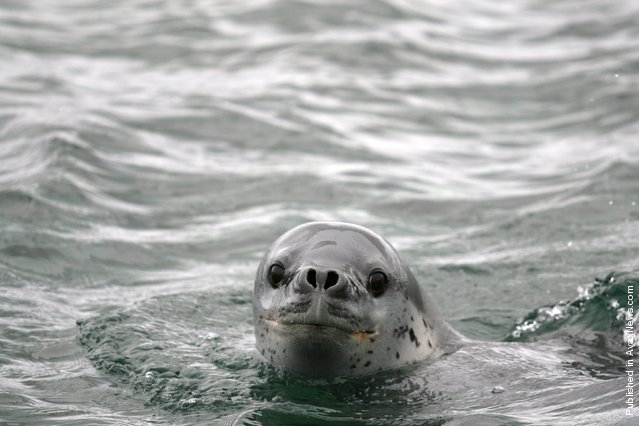
“The leopard seal (Hydrurga leptonyx), also referred to as the sea leopard, is the second largest species of seal in the Antarctic (after the southern elephant seal). It is most common in the southern hemisphere along the coast of Antarctica and on most sub-Antarctic islands, but can also be found on the coasts of southern Australia, Tasmania, South Africa, New Zealand, Lord Howe Island, Tierra del Fuego, the Cook Islands, and the Atlantic coast of South America. It can live twenty-six years, possibly more. Orcas and large sharks are the only natural predators of leopard seals”. – Wikipedia

Photo by: Gilad Rom; Source: Flickr
Details
13 Nov 2011 11:24:00
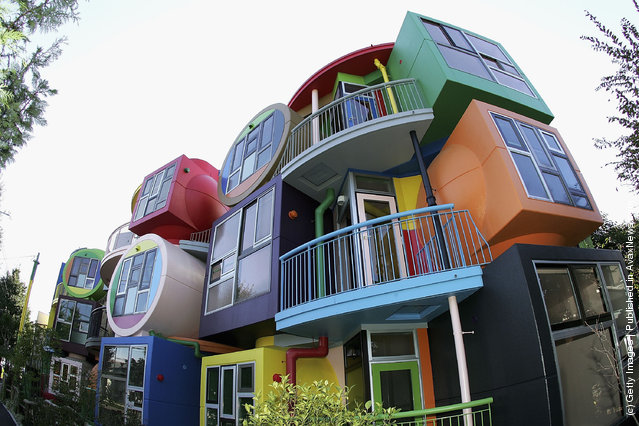
Concept Design Home Reversible Destiny Lofts MITAKA: In Memory Of Helen Keller By Reversible Destiny Foundation and Shusaku Arakawa

“The Reversible Destiny Lofts – Mitaka (In Memory of Helen Keller) is a nine-unit multiple dwelling. It was first completed example of procedural architecture put to residential use. These lofts reflexively articulate the residents’ operative tendencies and coordinating skills essential to and determinative of human thought and behavior; which means to say, the lofts manage, by virtue of how they are constructed, to reveal to their residents the ins and outs of what makes a person, in this case the resident. This is the same set of tendencies and skills to which Arakawa and Madeline Gins gave diagrammatic form in their decades-long research project The Mechanism of Meaning”. – Wikipedia

Photo: The exterior of the concept design home “Reversible Destiny Lofts MITAKA: In Memory of Helen Keller” is seen on October 27, 2005 in Tokyo, Japan. (Photo by Koichi Kamoshida/Getty Images)
Details
30 Nov 2011 11:58:00
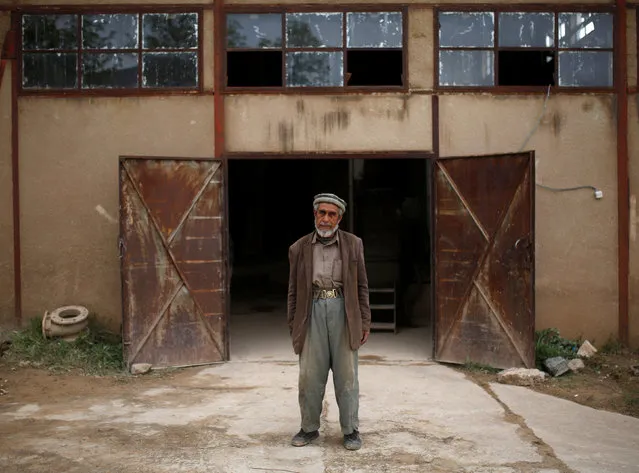
A worker at the Jabal Saraj cement factory poses for a photograph in Jabal Saraj, north of Kabul, Afghanistan April 19, 2016. (Photo by Ahmad Masood/Reuters)

A worker at the Jabal Saraj cement factory poses for a photograph in Jabal Saraj, north of Kabul, Afghanistan April 19, 2016. In an area desperately short of industry and jobs, local workers hope that the relaunch of the plant in Jabal Saraj, built by Czech engineers in 1957 and closed down by the Taliban in 1995, can show that Afghanistan's shattered industry can climb back to its feet after decades of war and destruction. But the outdated state-owned plant some 75 kilometres outside Kabul also shows how far it has to go before that promise can be achieved and there are serious questions over whether it has a viable future unless a new, modern facility is built to replace it. (Photo by Ahmad Masood/Reuters)
Details
31 May 2016 11:29:00
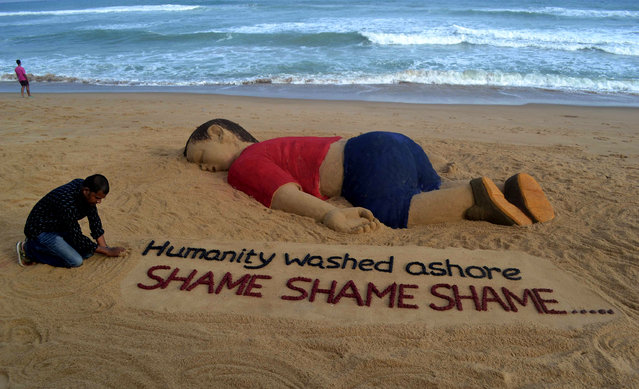
Indian artist Sudarsan Pattnaik works on a sand sculpture depicting drowned Syrian boy Aylan Kurdi at Puri beach, some 65 kilometers away from Bhubaneswar, on September 4, 2015. Charities helping refugees saw a surge in donations on September 4 across Europe as people shocked by the heart-rending images of a drowned Syrian boy on a Turkish beach dug deep to help out. (Photo by Asit Kumar/AFP Photo)

Indian artist Sudarsan Pattnaik works on a sand sculpture depicting drowned Syrian boy Aylan Kurdi at Puri beach, some 65 kilometers away from Bhubaneswar, on September 4, 2015. Charities helping refugees saw a surge in donations on September 4 across Europe as people shocked by the heart-rending images of a drowned Syrian boy on a Turkish beach dug deep to help out. The photos of the lifeless body of three-year-old Aylan Kurdi, lying on a beach in Bodrum, Turkey, have triggered a wave of emotion across the continent, despite deep divisions among European governments on how to deal with the crisis. (Photo by Asit Kumar/AFP Photo)
Details
05 Sep 2015 12:59:00
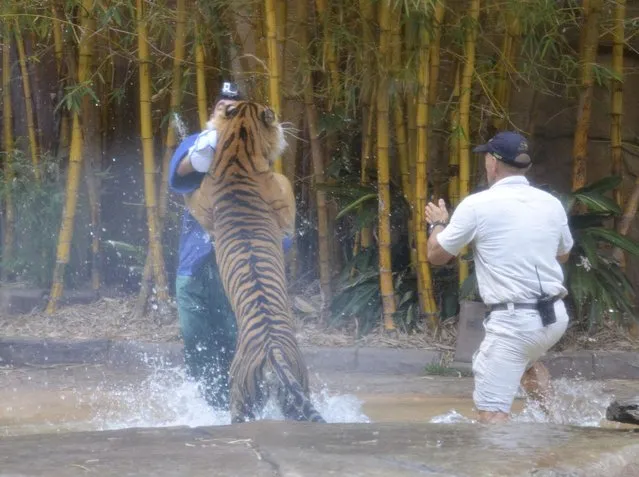
In this photo taken Tuesday, Nov. 26, 2013 and made available Thursday, November 28, a Sumatran tiger leaps on Australia Zoo handler Dave Styles, left, as an unidentified man comes to Styles' aid in an enclosure at the zoo at Sunshine Coast, Australia. Styles who suffered puncture wounds to his head and shoulder was rescued by fellow workers at the zoo. He is recovering following surgery after being airlifted to a hospital. (Photo by Johanna Schehl/AP Photo)

In this photo taken Tuesday, November 26, 2013 and made available Thursday, November 28, a Sumatran tiger leaps on Australia Zoo handler Dave Styles, left, as an unidentified man comes to Styles' aid in an enclosure at the zoo at Sunshine Coast, Australia. Styles who suffered puncture wounds to his head and shoulder was rescued by fellow workers at the zoo. He is recovering following surgery after being airlifted to a hospital. (Photo by Johanna Schehl/AP Photo)
Details
29 Nov 2013 08:58:00
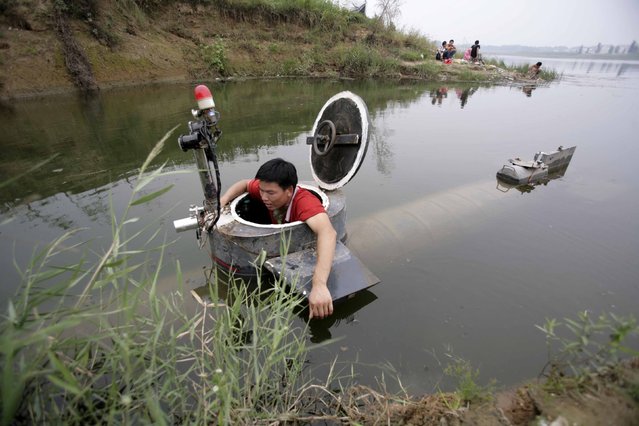
Tao Xiangli gets out of his homemade submarine after operating it in a lake on the outskirts of Beijing September 3, 2009. Amateur inventor Tao, 34,  made a fully functional submarine, which has a periscope, depth control tanks, electric motors, manometer, and two propellers, from old oil barrels and tools which he bought at a second-hand market. He took 2 years to invent and test the submarine which costs 30,000 yuan ($4,385). (Photo by Christina Hu/Reuters)

Tao Xiangli gets out of his homemade submarine after operating it in a lake on the outskirts of Beijing September 3, 2009. Amateur inventor Tao, 34, made a fully functional submarine, which has a periscope, depth control tanks, electric motors, manometer, and two propellers, from old oil barrels and tools which he bought at a second-hand market. He took 2 years to invent and test the submarine which costs 30,000 yuan ($4,385). (Photo by Christina Hu/Reuters)
Details
05 May 2013 12:06:00
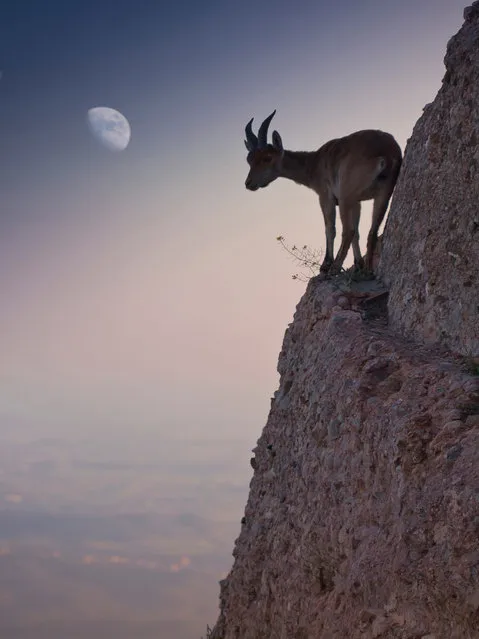
“For a bouquet of flowers”. Photographs made ​​in the last hours of the day. A goat is directed by a dangerous way to eat a small bouquet of flowers. Location: España, Barcelona, Montserrat. (Photo and caption by Renato Lopez Baldo/National Geographic Traveler Photo Contest)

“For a bouquet of flowers”. Photographs made ​​in the last hours of the day. A goat is directed by a dangerous way to eat a small bouquet of flowers. Location: España, Barcelona, Montserrat. (Photo and caption by Renato Lopez Baldo/National Geographic Traveler Photo Contest)

ATTENTION! All pictures are presented in high resolution. To see Hi-Res images – just TWICE click on any picture. In other words, click small picture – opens the BIG picture. Click BIG picture – opens VERY BIG picture.
Details
25 Jun 2013 12:51:00
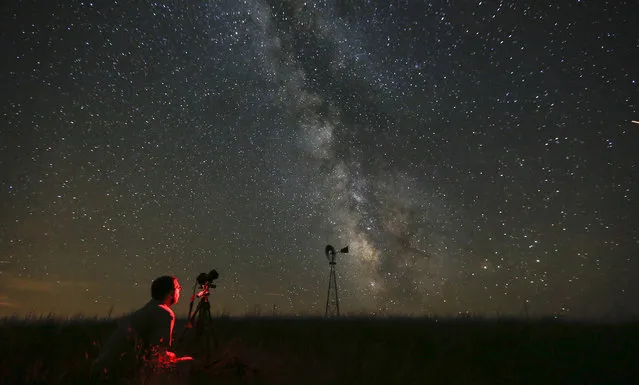
In this Wednesday, July 23, 2014 file photo, Omaha photographer Lane Hickenbottom photographs the night sky in a pasture near Callaway, Neb. With no moon in the sky, the Milky Way was visible to the naked eye. More than one-third of the world’s population can no longer see the Milky Way because of man-made lights, according to a scientific paper by Light Pollution Science and Technology Institute's Fabio Falchi and his team members, published on Friday, June 10, 2016. (Photo by Travis Heying/The Wichita Eagle via AP Photo)

In this Wednesday, July 23, 2014 file photo, Omaha photographer Lane Hickenbottom photographs the night sky in a pasture near Callaway, Neb. With no moon in the sky, the Milky Way was visible to the naked eye. More than one-third of the world’s population can no longer see the Milky Way because of man-made lights, according to a scientific paper by Light Pollution Science and Technology Institute's Fabio Falchi and his team members, published on Friday, June 10, 2016. (Photo by Travis Heying/The Wichita Eagle via AP Photo)
Details
11 Jun 2016 12:37:00