Loading...
Done
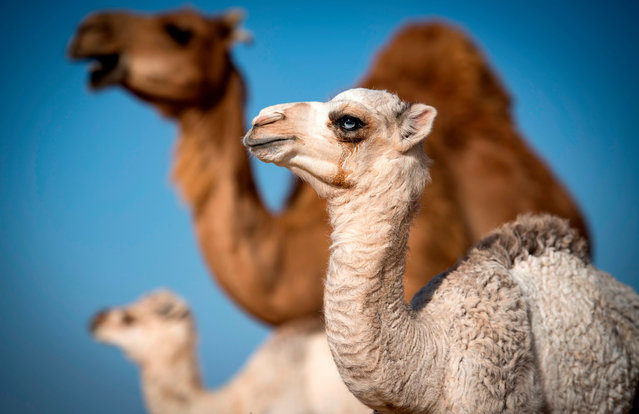
A camel calf is seen among a herd in the desert near Dakhla in Morocco-administered Western Sahara, on October 13, 2019. In the Oued Eddahab desert in Western Sahara, Habiboullah Dlimi raises dairy and racing camels just like his ancestors used to, but with a little help from modern technology. While his animals roam free and are milked traditionally, by hand, at dawn and dusk, they are watched over by hired herders and Dlimi follows GPS coordinates across the desert in a 4X4 vehicle to reach them. (Photo by Fadel Senna/AFP Photo)

A camel calf is seen among a herd in the desert near Dakhla in Morocco-administered Western Sahara, on October 13, 2019. In the Oued Eddahab desert in Western Sahara, Habiboullah Dlimi raises dairy and racing camels just like his ancestors used to, but with a little help from modern technology. While his animals roam free and are milked traditionally, by hand, at dawn and dusk, they are watched over by hired herders and Dlimi follows GPS coordinates across the desert in a 4X4 vehicle to reach them. (Photo by Fadel Senna/AFP Photo)
Details
24 Nov 2019 00:03:00
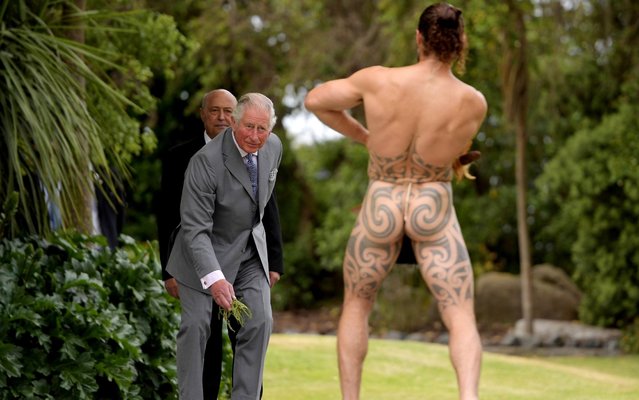
A Maori warrior prepares to challenge Prince Charles during his welcome to Takanhanga Marae in Kaikoura, New Zealand November 23, 2019. (Photo by Tracey Nearmy/Reuters)

A Maori warrior prepares to challenge Prince Charles during his welcome to Takanhanga Marae in Kaikoura, New Zealand November 23, 2019. (Photo by Tracey Nearmy/Reuters)
Details
25 Nov 2019 00:05:00
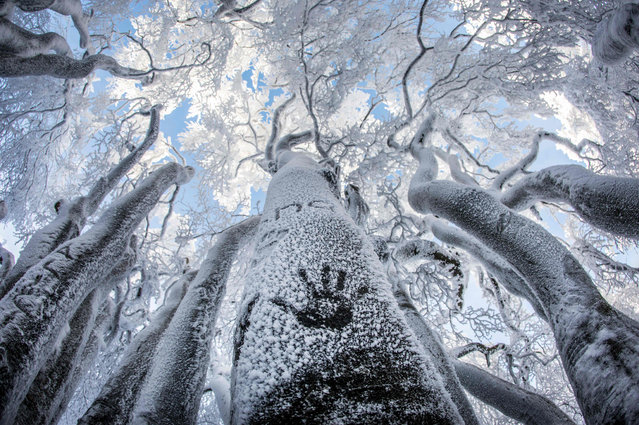
A walker has left a handprint on a snow- covered tree trunk on Grosser Feldberg mountain in the Taunus mountain range, Germany, 16 January 2017. (Photo by Frank Rumpenhorst/DPA)

A walker has left a handprint on a snow- covered tree trunk on Grosser Feldberg mountain in the Taunus mountain range, Germany, 16 January 2017. (Photo by Frank Rumpenhorst/DPA)
Details
18 Jan 2017 07:39:00
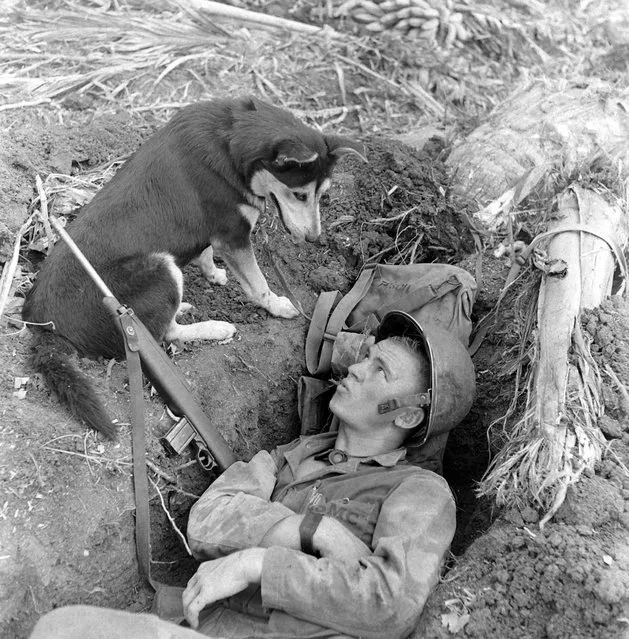
View of an American marine as he lies in a foxhole and whistles at a husky, one of the scouting dogs used during the landing on Guam, August 1944. (Photo by W. Eugene Smith/Time & Life Pictures/Getty Images)

View of an American marine as he lies in a foxhole and whistles at a husky, one of the scouting dogs used during the landing on Guam, August 1944. (Photo by W. Eugene Smith/Time & Life Pictures/Getty Images)
Details
25 Feb 2017 00:04:00
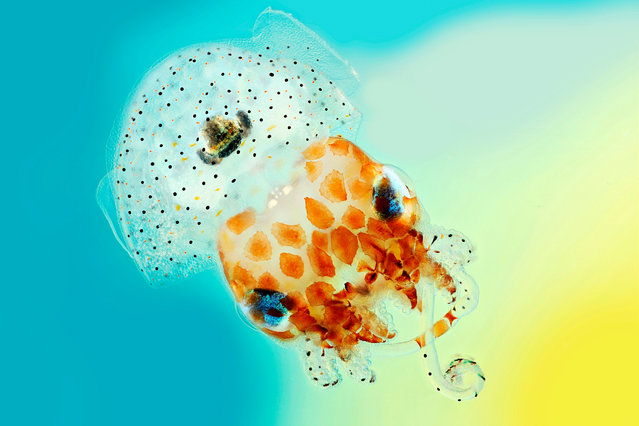
With its huge eyes, comical name and diminutive size, Mark R. Smith’s image of a baby Hawaiian bobtail squid can’t help but raise a smile. A curiously endearing creature, the cephalopod is just 1.5cm across, its mantle cavity bearing more than a passing resemblance to a rather natty shower cap. But it is also a beautiful example of symbiosis – nature’s version of “I’ll scratch your back if you scratch mine” – for on the underside of the squid is a light organ which houses bioluminescent bacteria. The squid offers the bacteria protection and food, while the bacteria emit a glow – a handy trait that the squid uses to offset its silhouette, helping it to evade predators in the depths below. Mark R. Smith’s entry combines several images of a Hawaiian bobtail squid with different focus lengths to create a final picture with greater depth of field than normal. (Photo by Mark R. Smith/Wellcome Images/Macroscopic Solutions)

With its huge eyes, comical name and diminutive size, Mark R. Smith’s image of a baby Hawaiian bobtail squid can’t help but raise a smile. A curiously endearing creature, the cephalopod is just 1.5cm across, its mantle cavity bearing more than a passing resemblance to a rather natty shower cap. But it is also a beautiful example of symbiosis – nature’s version of “I’ll scratch your back if you scratch mine” – for on the underside of the squid is a light organ which houses bioluminescent bacteria. The squid offers the bacteria protection and food, while the bacteria emit a glow – a handy trait that the squid uses to offset its silhouette, helping it to evade predators in the depths below. Mark R. Smith’s entry combines several images of a Hawaiian bobtail squid with different focus lengths to create a final picture with greater depth of field than normal. (Photo by Mark R. Smith/Wellcome Images/Macroscopic Solutions)
Details
08 Mar 2017 00:05:00
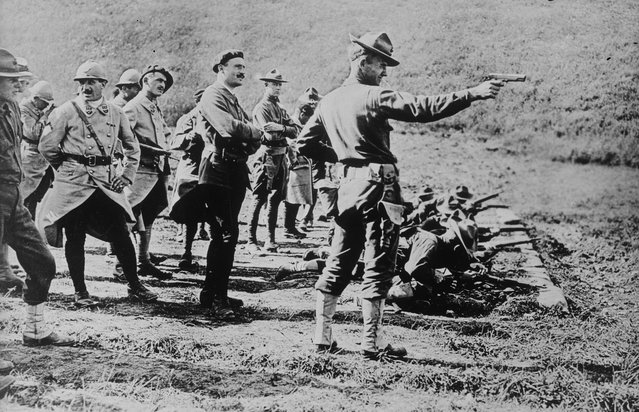
A U.S. Marine leads training on a shooting range in France in an undated photo taken during the First World War. (Photo by Reuters/Courtesy Library of Congress)

A U.S. Marine leads training on a shooting range in France in an undated photo taken during the First World War. (Photo by Reuters/Courtesy Library of Congress)
Details
10 Apr 2017 08:55:00
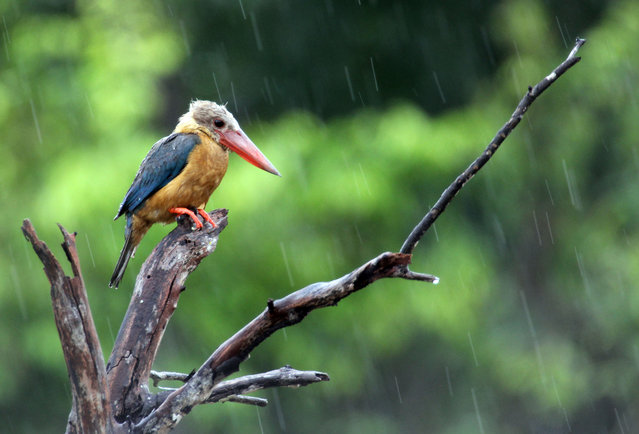
Stork-billed kingfisher during rain in Bintan, Indonesia. The tree species is sparsely distributed in the tropical Indian subcontinent and south-east Asia, from India to Indonesia. (Photo by Sijori Images/Barcroft Images)

A stork-billed kingfisher (Pelargopsis capensis) is seen perched on a tree during monsoon rain on July 25, 2016 in Bintan, Indonesia. The stork-billed kingfisher is a tree species which is widely but sparsely distributed in the tropical Indian subcontinent and Southeast Asia, from India to Indonesia. This kingfisher is resident throughout its range. It is very large, measuring 35 to 38 cm (14 to 15 in) in length. The adult has a green back, blue wings and tail, and grey head. (Photo by Sijori Images/Barcroft Images)
Details
27 May 2017 07:47:00
Britain's Emma Raducanu hits a return against Sloane Stephens of the US during their women's singles match on day two of the Australian Open tennis tournament in Melbourne on January 18, 2022. (Photo by James Gourley/Reuters)

Britain's Emma Raducanu hits a return against Sloane Stephens of the US during their women's singles match on day two of the Australian Open tennis tournament in Melbourne on January 18, 2022. (Photo by James Gourley/Reuters)
Details
24 Jan 2022 04:57:00