Loading...
Done
A farmer arranges vegetable at a greenhouse on January 29, 2021 in Hukou County, Jiangxi Province of China. (Photo by Zhang Yu/VCG via Getty Images)

A farmer arranges vegetable at a greenhouse on January 29, 2021 in Hukou County, Jiangxi Province of China. (Photo by Zhang Yu/VCG via Getty Images)
Details
08 Feb 2021 09:21:00
Sarah Bui poses for photographer, Brian Le around blossoming cherry trees, near the Tidal Basin on Thursday March 23, 2017 in Washington, DC. (Photo by Matt McClain/The Washington Post)

Sarah Bui poses for photographer, Brian Le around blossoming cherry trees, near the Tidal Basin on Thursday March 23, 2017 in Washington, DC. (Photo by Matt McClain/The Washington Post)
Details
25 Mar 2017 08:17:00
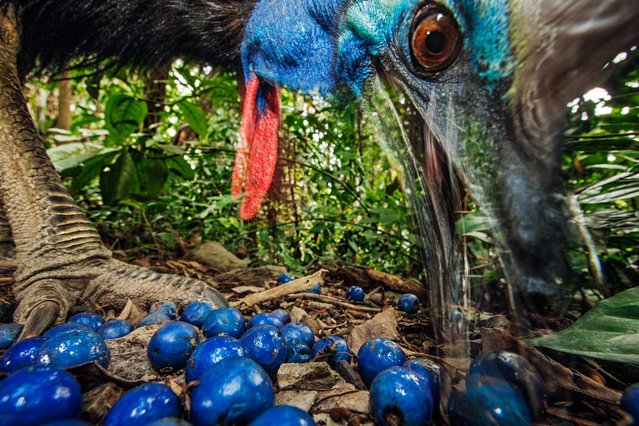
“Cassowaries are large, flightless birds related to emus and (more distantly) to ostriches, rheas, and kiwis”, writes Olivia Judson in the September issue of National Geographic magazine. (Photo by Christian Ziegler/National Geographic)

“Cassowaries are large, flightless birds related to emus and (more distantly) to ostriches, rheas, and kiwis”, writes Olivia Judson in the September issue of National Geographic magazine. How large? People-size: Adult males stand well over five foot five and top 110 pounds. Females are even taller, and can weigh more than 160 pounds. Dangerous when roused, they’re shy and peaceable when left alone. But even birds this big and tough are prey to habitat loss. The dense New Guinea and Australia rain forests where they live have dwindled. Today cassowaries might number 1,500 to 2,000. And because they help shape those same forests – by moving seeds from one place to another – “if they vanish”, Judson writes, “the structure of the forest would gradually change” too. (Photo by Christian Ziegler/National Geographic)
Details
06 Jan 2014 12:21:00
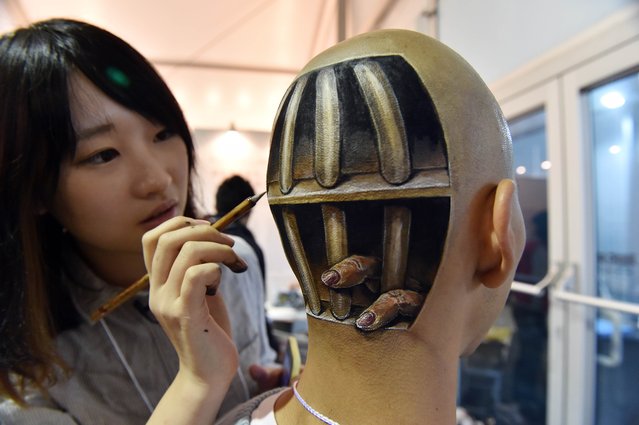
This picture taken on November 1, 2014 shows Japanese body-painting artist Hikaru Cho (L) adding the finishing touches to a body painting of fingers sticking out from prison cell bars on the head of Ryonosuke Tanaka during “Tokyo Designers Week” in Tokyo. Cho, 21, was born to Chinese parents in Japan and burst onto Tokyo's art scene when she entered the city's Musashino Art University in 2012. (Photo by Yoshikazu Tsuno/AFP Photo)

This picture taken on November 1, 2014 shows Japanese body-painting artist Hikaru Cho (L) adding the finishing touches to a body painting of fingers sticking out from prison cell bars on the head of Ryonosuke Tanaka during “Tokyo Designers Week” in Tokyo. Cho, 21, was born to Chinese parents in Japan and burst onto Tokyo's art scene when she entered the city's Musashino Art University in 2012. Cho's ultimate ambition is to paint an entire – and naked – body. (Photo by Yoshikazu Tsuno/AFP Photo)
Details
08 Nov 2014 12:59:00
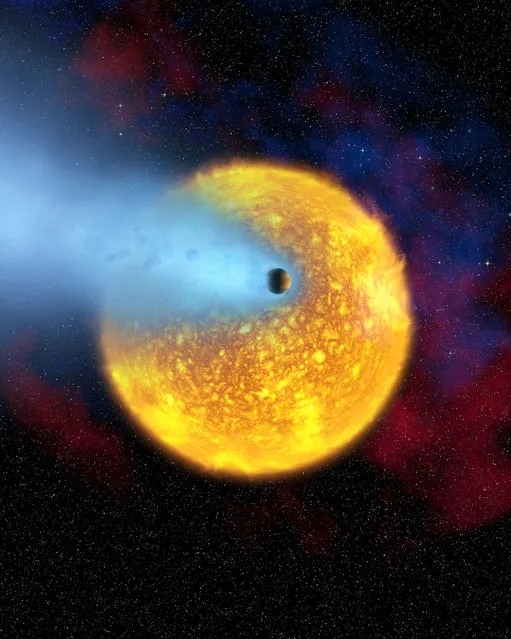
Dramatic changes spotted in HD 189733b exoplanet atmosphere

This artist's rendering illustrates the evaporation of HD 189733b's atmosphere in response to a powerful eruption from its host star. NASA's Hubble Space Telescope detected the escaping gases and NASA's Swift satellite caught the stellar flare. (Credit: NASA's Goddard Space Flight Center)
Details
29 Jun 2012 09:45:00
An Afghan National Army (ANA) soldier assigned to the Mobile Strike Force Kandak fires a RPG-7 rocket-propelled grenade launcher during a live-fire exercise supervised by the Marines with the Mobile Strike Force Advisor Team on Camp Shorabak, Helmand province, Afghanistan, May 20, 2013. The Marines with the Mobile Strike Force Advisor Team instructed and mentored their ANA counterparts on how to properly utilize their weapons systems. (Photo by SSgt Ezekiel R. Kitandwe/RCT 7)

An Afghan National Army (ANA) soldier assigned to the Mobile Strike Force Kandak fires a RPG-7 rocket-propelled grenade launcher during a live-fire exercise supervised by the Marines with the Mobile Strike Force Advisor Team on Camp Shorabak, Helmand province, Afghanistan, May 20, 2013. The Marines with the Mobile Strike Force Advisor Team instructed and mentored their ANA counterparts on how to properly utilize their weapons systems. (Photo by SSgt Ezekiel R. Kitandwe/RCT 7)
Details
07 Apr 2014 12:34:00
Participants hang from ropes as they learn how to use safety gears at an experience centre for construction safety training in Beijing, September 5, 2014. The centre which opened in June 2014 was established to educate workers about construction safety. According to the centre, about 1,000 construction workers undergo 3-hour classes which comprises of 33 modules every month. (Photo by Kim Kyung-Hoon/Reuters)

Participants hang from ropes as they learn how to use safety gears at an experience centre for construction safety training in Beijing, September 5, 2014. The centre which opened in June 2014 was established to educate workers about construction safety. According to the centre, about 1,000 construction workers undergo 3-hour classes which comprises of 33 modules every month. (Photo by Kim Kyung-Hoon/Reuters)
Details
06 Sep 2014 11:46:00


“Snowflake (c. 1964 – November 24, 2003) was an albino gorilla. He was the only known albino gorilla so far, and the most popular resident of the Barcelona Zoo in Catalonia, Spain. Originally named Nfumu Ngui in Fang language ("white gorilla") by his captor, he was then nicknamed Floquet de Neu (Catalan for little snowflake) by his keeper Jordi Sabater Pi. On his arrival to Barcelona where he was given an official reception by the then Mayor of Barcelona, Josep Maria de Porcioles, in November 1966, he was called Blancanieves (“Snow White”) in the newspaper Tele/Exprés. But he became famous with the name given to him by Sabater when National Geographic Magazine featured him on the main page in March 1967, with the English name Snowflake. This name spread among the press (Stern, Life, Paris-Match) and was later translated to Spanish as Copito de Nieve. Sabater himself called the gorilla Floquet or Copi, and in the later years Nfumu. The asteroid 95962 Copito, discovered by Catalan astronomer J. Manteca, is named in his honour”.

Details
07 Mar 2011 15:50:00