Loading...
Done
A man carries a block of ice left behind by a hailstorm in Sao Paulo, Brazil, on May 19, 2014. (Photo by Nelson Antoine/AP Photo)

A man carries a block of ice left behind by a hailstorm in Sao Paulo, Brazil, on May 19, 2014. After the severe overnight hailstorm a layer of hailstones as deep as 20 centimeters covered streets and parks, drawing people to make snowmen and play in the ice, an unusual scene to the city. (Photo by Nelson Antoine/AP Photo)
Details
20 May 2014 10:34:00
This strange coral-looking specimen is actually a mushroom. The photo, “Beautiful Destroyer”, was taken in the Panamanian tropical rainforest where the mushroom produces nitrogen, an element vital to soil health. (Photo by Sarah A. Batterman)

This strange coral-looking specimen is actually a mushroom. The photo, “Beautiful Destroyer”, was taken in the Panamanian tropical rainforest where the mushroom produces nitrogen, an element vital to soil health. (Photo by Sarah A. Batterman)
Details
13 Aug 2014 09:49:00
A model presents a creation by Maltese hairstylist Marielle Calleja of Prive at the Malta Fashion Awards 2015 at the Marsa Shipbuilding warehouse in Marsa, outside Valletta in Malta, May 16, 2015. (Photo by Darrin Zammit Lupi/Reuters)

A model presents a creation by Maltese hairstylist Marielle Calleja of Prive at the Malta Fashion Awards 2015 at the Marsa Shipbuilding warehouse in Marsa, outside Valletta in Malta, May 16, 2015. (Photo by Darrin Zammit Lupi/Reuters)
Details
18 May 2015 12:39:00
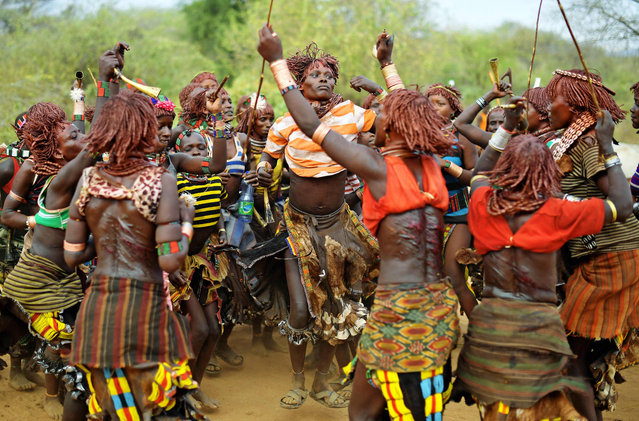
Hamar women dance before a bull jumping ceremony in Ethiopia's southern Omo Valley region near Turmi on September 19, 2016. The Hamar are a Nilotic ethnic group in Ethiopia. The construction of the Gibe III dam, the third largest hydroelectric plant in Africa, and large areas of very “thirsty” cotton and sugar plantations and factories along the Omo river are impacting heavily on the lives of tribes living in the Omo Valley who depend on the river for their survival and way of life. Human rights groups fear for the future of the tribes if they are forced to scatter, give up traditional ways through loss of land or ability to keep cattle as globalisation and development increases. (Photo by Carl De Souza/AFP Photo)

Hamar women dance before a bull jumping ceremony in Ethiopia's southern Omo Valley region near Turmi on September 19, 2016. The Hamar are a Nilotic ethnic group in Ethiopia. The construction of the Gibe III dam, the third largest hydroelectric plant in Africa, and large areas of very “thirsty” cotton and sugar plantations and factories along the Omo river are impacting heavily on the lives of tribes living in the Omo Valley who depend on the river for their survival and way of life. (Photo by Carl De Souza/AFP Photo)
Details
02 Oct 2016 08:45:00
Three Palestinian women sit on a beachfront as a wave comes rushing by in Gaza City on November 17, 2016. (Photo by Mohammed Abed/AFP Photo)

Three Palestinian women sit on a beachfront as a wave comes rushing by in Gaza City on November 17, 2016. (Photo by Mohammed Abed/AFP Photo)
Details
18 Nov 2016 11:11:00
Kaw-Claa, a Tlingit native woman in full potlatch dancing costume, 1906. (Photo by Case & Draper/Buyenlarge/Getty Images)

Kaw-Claa, a Tlingit native woman in full potlatch dancing costume, 1906. (Photo by Case & Draper/Buyenlarge/Getty Images)
Details
11 Jan 2017 14:42:00
A wax figure of President William Howard Taft is seated in the front seat with his detached head in the back after it was  purchased from an auction of the Hall of Presidents Museum, which closed in November, in Gettysburg, Pennsylvania, U.S. January 14, 2017. (Photo by Mark Makela/Reuters)

A wax figure of President William Howard Taft is seated in the front seat with his detached head in the back after it was purchased from an auction of the Hall of Presidents Museum, which closed in November, in Gettysburg, Pennsylvania, U.S. January 14, 2017. (Photo by Mark Makela/Reuters)
Details
16 Jan 2017 09:58:00
Heads of love dolls are seen on the shelf on March 9, 2017 in Tokyo, Japan. Japan's oldest and largest “love doll” maker Orient Industry, has been producing silicone love dolls since 1977, and has seen there is a trend for intimate relationships with silicone dolls in Japan. The Orient Industry's factory produces approximately 500 life size hand-made per year, and one doll, costs up to 600,000JPY (approx. 6,000 USD), takes four to five weeks to be finished. Originally, the company was marketing love dolls for disabled people, and the company continues to support the community by providing discounts and consulting their sexual urges. (Photo by Taro Karibe/Getty Images)

Heads of love dolls are seen on the shelf on March 9, 2017 in Tokyo, Japan. Japan's oldest and largest “love doll” maker Orient Industry, has been producing silicone love dolls since 1977, and has seen there is a trend for intimate relationships with silicone dolls in Japan. (Photo by Taro Karibe/Getty Images)
Details
18 Mar 2017 10:32:00