Loading...
Done
A high-kicking Parisian can-can dancer

A high-kicking Parisian can-can dancer. (Photo by Hulton Archive/Getty Images). 1895
Details
13 Sep 2011 12:42:00
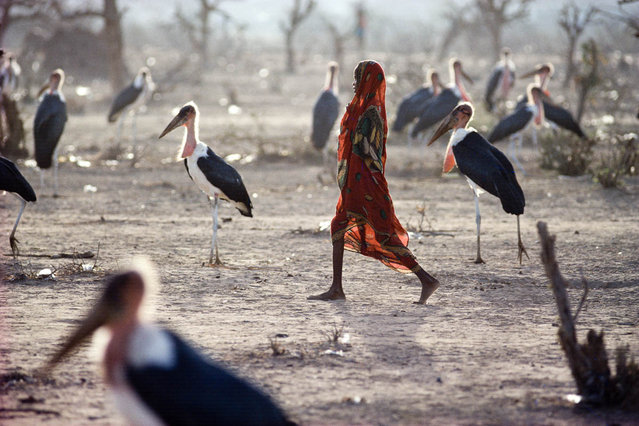
North Kenya, Liboi.  A young Somali refugee crosses a field filled with marabous storks in July 1992. (Jean-Claude Coutausse)

North Kenya, Liboi. A young Somali refugee crosses a field filled with marabous storks in July 1992. (Photo by Jean-Claude Coutausse)
Details
08 Nov 2012 09:58:00
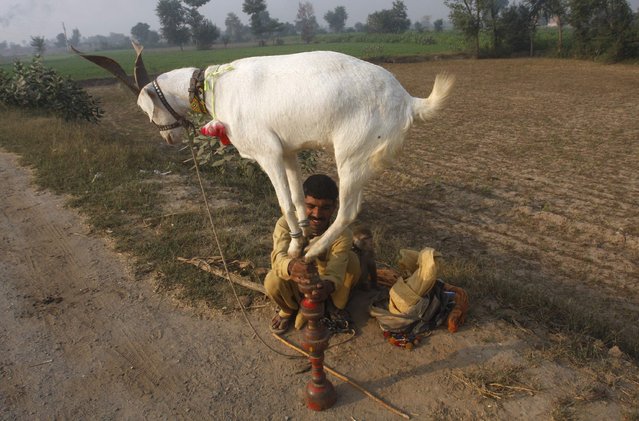
The goats are known to be good climbers, but this one is taking the climbing thing to a whole new level. It clambered on the tip of its owner’s stick, as a part of the roadside performance for a quick coin, on the outskirts of Faisalabad, Pakistan, November 5, 2012. (Photo by Fayyaz Hussain/Reuters)


The goats are known to be good climbers, but this one is taking the climbing thing to a whole new level. It clambered on the tip of its owner’s stick, as a part of the roadside performance for a quick coin, on the outskirts of Faisalabad, Pakistan, November 5, 2012. (Photo by Fayyaz Hussain/Reuters)
Details
10 Nov 2012 11:31:00
General view of the monument to memory of soldiers who liberated the city of Knin, in Knin, Croatia November 10, 2014. (Photo by Antonio Bronic/Reuters)

General view of the monument to memory of soldiers who liberated the city of Knin – in Knin, Croatia on November 10, 2014. Across the former Yugoslavia stand giant monuments to a state that no longer exists, once visited and celebrated during public holidays such as Republic Day on November 29, marking the creation of socialist Yugoslavia. Many are now neglected or ignored, aging symbols of a joint state forged during World War Two but torn apart by nationalism half a century later. Republic Day is no longer marked in any of the seven independent states that emerged from its ashes. (Photo by Antonio Bronic/Reuters)
Details
01 Dec 2014 14:00:00
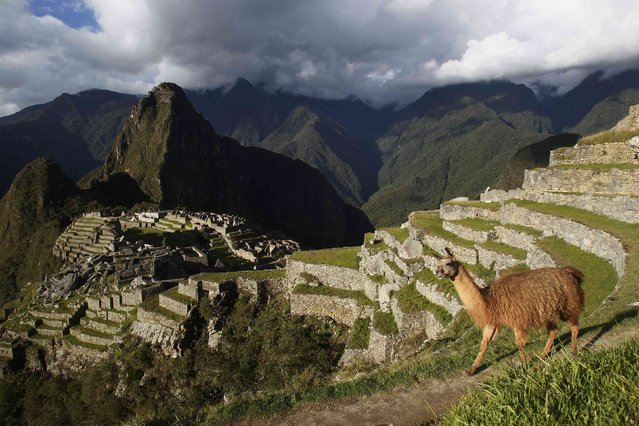
An alpaca is seen near the Inca citadel of Machu Picchu in Cusco December 2, 2014. Machu Picchu, a UNESCO World Heritage Site, is Peru's top tourist attraction, with the government limiting tourists to 2,500 per day due to safety reasons and concerns over the preservation of the ruins. (Photo by Enrique Castro-Mendivil/Reuters)

An alpaca is seen near the Inca citadel of Machu Picchu in Cusco December 2, 2014. Machu Picchu, a UNESCO World Heritage Site, is Peru's top tourist attraction, with the government limiting tourists to 2,500 per day due to safety reasons and concerns over the preservation of the ruins. (Photo by Enrique Castro-Mendivil/Reuters)
Details
04 Dec 2014 11:24:00
In this picture taken on December 13, 2017, a woman commutes on a street on a cold day in Baoding. As temperatures dipped below freezing in a northern Chinese village, a group of parka-clad women tried to stay warm as they played mahjong around a small gas stove in a grocery store. (Photo by Fred Dufour/AFP Photo)

In this picture taken on December 13, 2017, a woman commutes on a street on a cold day in Baoding. As temperatures dipped below freezing in a northern Chinese village, a group of parka-clad women tried to stay warm as they played mahjong around a small gas stove in a grocery store. (Photo by Fred Dufour/AFP Photo)
Details
22 Dec 2017 07:52:00
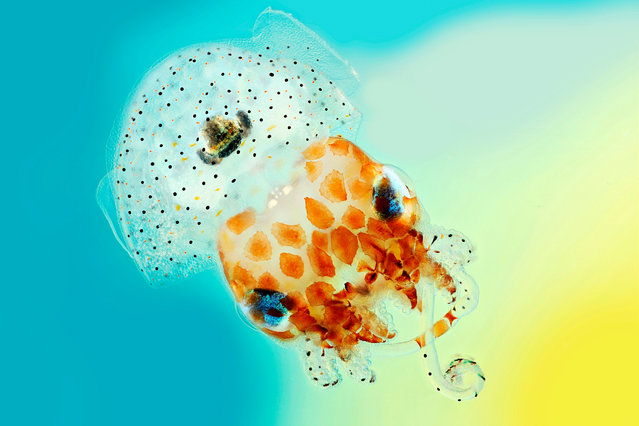
With its huge eyes, comical name and diminutive size, Mark R. Smith’s image of a baby Hawaiian bobtail squid can’t help but raise a smile. A curiously endearing creature, the cephalopod is just 1.5cm across, its mantle cavity bearing more than a passing resemblance to a rather natty shower cap. But it is also a beautiful example of symbiosis – nature’s version of “I’ll scratch your back if you scratch mine” – for on the underside of the squid is a light organ which houses bioluminescent bacteria. The squid offers the bacteria protection and food, while the bacteria emit a glow – a handy trait that the squid uses to offset its silhouette, helping it to evade predators in the depths below. Mark R. Smith’s entry combines several images of a Hawaiian bobtail squid with different focus lengths to create a final picture with greater depth of field than normal. (Photo by Mark R. Smith/Wellcome Images/Macroscopic Solutions)

With its huge eyes, comical name and diminutive size, Mark R. Smith’s image of a baby Hawaiian bobtail squid can’t help but raise a smile. A curiously endearing creature, the cephalopod is just 1.5cm across, its mantle cavity bearing more than a passing resemblance to a rather natty shower cap. But it is also a beautiful example of symbiosis – nature’s version of “I’ll scratch your back if you scratch mine” – for on the underside of the squid is a light organ which houses bioluminescent bacteria. The squid offers the bacteria protection and food, while the bacteria emit a glow – a handy trait that the squid uses to offset its silhouette, helping it to evade predators in the depths below. Mark R. Smith’s entry combines several images of a Hawaiian bobtail squid with different focus lengths to create a final picture with greater depth of field than normal. (Photo by Mark R. Smith/Wellcome Images/Macroscopic Solutions)
Details
08 Mar 2017 00:05:00
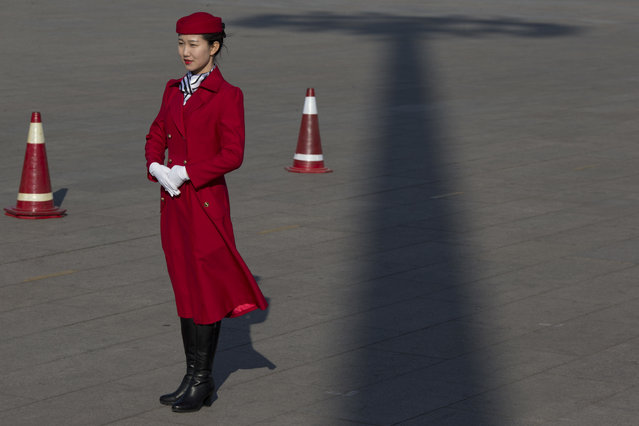
In this photo taken Wednesday, March 8, 2017, a hospitality staff member pose for photos near the shadow of a tall light pole near the Great Hall of the People where a plenary session of the National People's Congress is held in Beijing, China. (Photo by Ng Han Guan/AP Photo)

In this photo taken Wednesday, March 8, 2017, a hospitality staff member pose for photos near the shadow of a tall light pole near the Great Hall of the People where a plenary session of the National People's Congress is held in Beijing, China. (Photo by Ng Han Guan/AP Photo)
Details
14 Mar 2017 00:00:00