Loading...
Done
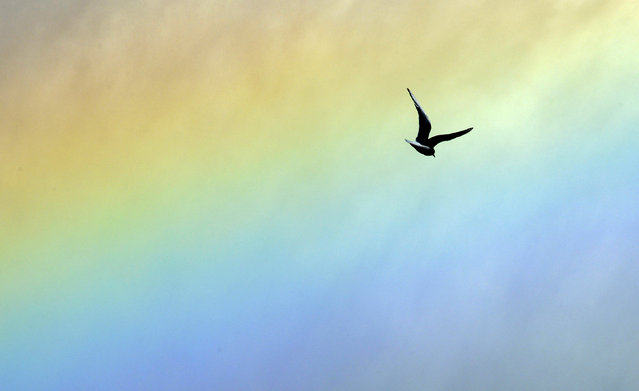
A seagull flies through a rainbow near the Savannah River and the open spillway at Thurmond Dam in Clarks Hill, SC, Monday, January 4, 2016. (Photo by Michael Holahan/Augusta Chronicle via AP Photo)

A seagull flies through a rainbow near the Savannah River and the open spillway at Thurmond Dam in Clarks Hill, SC, Monday, January 4, 2016. (Photo by Michael Holahan/Augusta Chronicle via AP Photo)
Details
28 Apr 2016 12:25:00
Some wave over the rainbow – a splash of colour is captured in spray over the sea wall at Totland Bay on the Isle of Wight off the south coast of England on February 16, 2022. (Photo by Jamie Russell/Bournemouth News)

Some wave over the rainbow – a splash of colour is captured in spray over the sea wall at Totland Bay on the Isle of Wight off the south coast of England on February 16, 2022. (Photo by Jamie Russell/Bournemouth News)
Details
12 Apr 2022 05:57:00
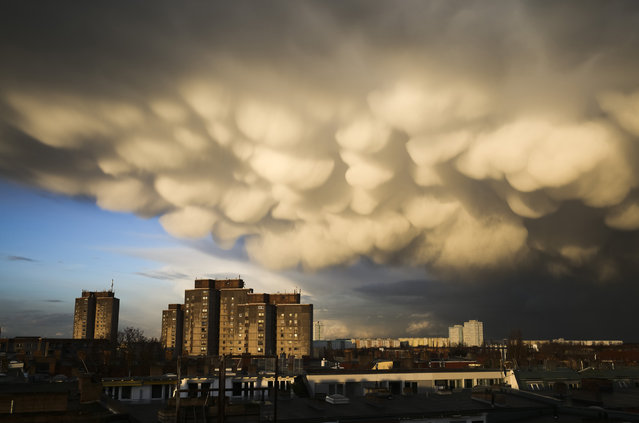
Clouds cover the sky over the Ernst-Taehlmann-Park housing estate after a thunderstorm in Berlin, Germany, Thursday, March 11, 2021. (Photo by Markus Schreiber/AP Photo)

Clouds cover the sky over the Ernst-Taehlmann-Park housing estate after a thunderstorm in Berlin, Germany, Thursday, March 11, 2021. (Photo by Markus Schreiber/AP Photo)
Details
14 Jul 2021 09:41:00
A lenticular cloud is seen during sunrise from Gokmen Aerospace Training Center (GUHEM) in Bursa, Turkiye on January 19, 2023. (Photo by Halit Mirahmetoglu/Anadolu Agency via Getty Images)

A lenticular cloud is seen during sunrise from Gokmen Aerospace Training Center (GUHEM) in Bursa, Turkiye on January 19, 2023. (Photo by Halit Mirahmetoglu/Anadolu Agency via Getty Images)
Details
12 Sep 2023 03:27:00
Multiple lightning strikes are seen in this 66 image composite taken over 1.5 hours during a monsoon in Bangkok, Thailand which took place overnight from October 29th to October 30th, 2024. The monsoon season in Bangkok normally lasts from July to October, making this one of the year's last major storms to hit the Thai capital. (Photo by Adryel Talamantes/ZUMA Press Wire/Rex Features/Shutterstock)

Multiple lightning strikes are seen in this 66 image composite taken over 1.5 hours during a monsoon in Bangkok, Thailand which took place overnight from October 29th to October 30th, 2024. The monsoon season in Bangkok normally lasts from July to October, making this one of the year's last major storms to hit the Thai capital. (Photo by Adryel Talamantes/ZUMA Press Wire/Rex Features/Shutterstock)
Details
12 Aug 2025 03:26:00


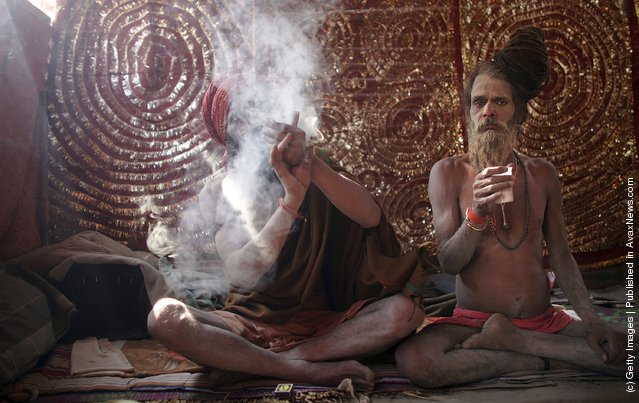
“Kumbh Mela is a mass Hindu pilgrimage in which Hindus gather at the Ganges river. The normal Kumbh Mela is celebrated every 3 years, the Ardh (half) Kumbh Mela is celebrated every six years at Haridwar and Prayag, the Purna (complete) Kumbh takes place every twelve years, at four places (Prayag (Allahabad), Haridwar, Ujjain, and Nashik). The Maha (great) Kumbh Mela which comes after 12 “Purna Kumbh Melas”, or 144 years, is held at Allahabad.

The last Ardh Kumbh Mela was held over a period of 45 days beginning in January 2007, more than 70 million Hindu pilgrims took part in the Ardh Kumbh Mela at Prayag, and on January 15, the most auspicious day of the festival of Makar Sankranti, more than 5 million participated. The previous Maha Kumbh Mela, held in 2001, was attended by around 60 million people, making it at the time the largest gathering anywhere in the world in recorded history”. – Wikipedia

Photo: Sadhus (holy men) smoke at their camp near the ritual site at Sangam, the confluence of the Ganges, Yamuna and mythical Saraswati rivers during the Ardh Kumbh Mela festival (Half Pitcher festival) January 18, 2007 in Allahabad, India. Millions of Hindu pilgrims have flocked to the largest religious gathering in the world which lasts for 45 days in northern India. The festival commemorates the mythical conflict between gods and demons over a pitcher filled with the “nectar of immortality”. Devotees believe that taking a holy dip in the Ganges at this time washes away their sins and paves the path to salvation. (Photo by Mario Tama/Getty Images)
Details
30 Jun 2011 10:27:00
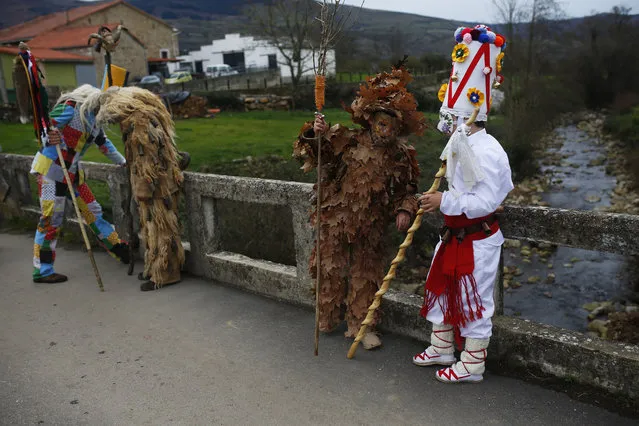
People dressed in costumes have a break while marching during the Vijanera Festival, in the small village of Silio, northern Spain, Sunday, January 3, 2016. The Vijanera masquerade, of pre-Roman origin, is the first carnival of the year in Europe symbolizing the triumph of good over evil and involving the participation of crowds of residents wearing different masks, animal skins and brightly coloured clothing with its own complex function and symbolism and becoming the living example of the survival of archaic cults to nature. (Photo by Francisco Seco/AP Photo)

People dressed in costumes have a break while marching during the Vijanera Festival, in the small village of Silio, northern Spain, Sunday, January 3, 2016. The Vijanera masquerade, of pre-Roman origin, is the first carnival of the year in Europe symbolizing the triumph of good over evil and involving the participation of crowds of residents wearing different masks, animal skins and brightly coloured clothing with its own complex function and symbolism and becoming the living example of the survival of archaic cults to nature. (Photo by Francisco Seco/AP Photo)
Details
04 Jan 2016 10:17:00
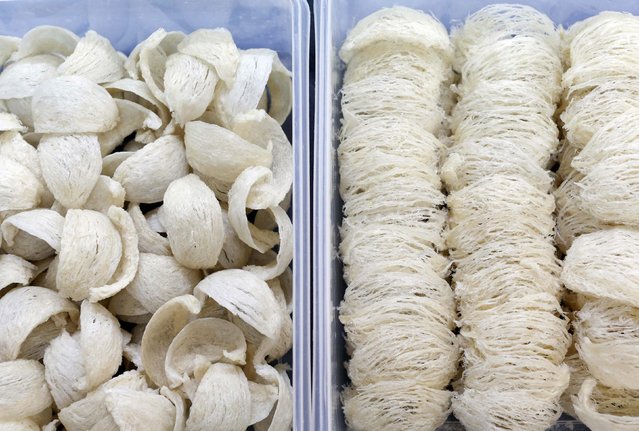
Two styles of cleaned bird's nest, Yan Zhan (L) and Su Zhan (R) await repacking at a processing plant in Kuala Lumpur, February 17, 2015. Prized in China for is alleged health benefits for hundreds of years, nests made from swiftlets' saliva are being mixed into coffee and cereal as the Southeast Asian producers of the delicacy seek to broaden its appeal, and their profit margins. (Photo by Olivia Harris/Reuters)

Two styles of cleaned bird's nest, Yan Zhan (L) and Su Zhan (R) await repacking at a processing plant in Kuala Lumpur, February 17, 2015. Prized in China for is alleged health benefits for hundreds of years, nests made from swiftlets' saliva are being mixed into coffee and cereal as the Southeast Asian producers of the delicacy seek to broaden its appeal, and their profit margins. The nests are among the world's most expensive foods, selling for up to $2,500 a kg and the swiftlets that weave them are indigenous to Indonesia, Malaysia, Thailand and Vietnam. (Photo by Olivia Harris/Reuters)
Details
24 Feb 2015 13:57:00