Loading...
Done
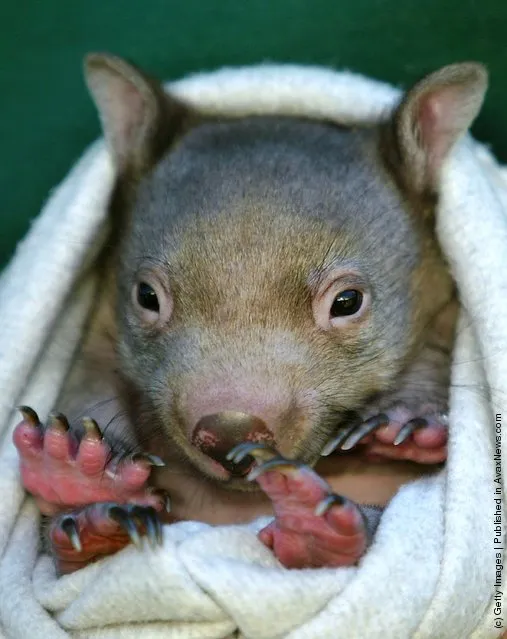
A baby Common Wombat

“Wombats are Australian marsupials; they are short-legged, muscular quadrupeds, approximately 1 metre (39 in) in length with a short, stubby tail. They are adaptable in their habitat tolerances, and are found in forested, mountainous, and heathland areas of south-eastern Australia, including Tasmania, as well as an isolated patch of about 300 ha in Epping Forest National Park in central Queensland”. – Wikipedia

Photo: “Abdul”, a baby Common Wombat, is one of the marsupials on show during the spring baby boom at Taronga Zoo September 1, 2005 in Sydney, Australia. “Abdul” was orphaned when his mother was killed by a car. (Photo by Mark Nolan/Getty Images)
Details
20 Aug 2011 11:23:00
A baby Chimpanzee plays in its enclosure at Taronga Zoo

A baby Chimpanzee plays in its enclosure at Taronga Zoo July 14, 2006 in Sydney, Australia. (Photo by Ian Waldie/Getty Images)
Details
08 Oct 2011 13:22:00
1928: A fruit importer's lorry at Covent Garden, London, with its driver's cabin in the shape of an apple

A fruit importer's lorry at Covent Garden, London, with its driver's cabin in the shape of an apple. (Photo by Harold Clements/London Express/Getty Images). October 1928
Details
21 Oct 2011 10:24:00
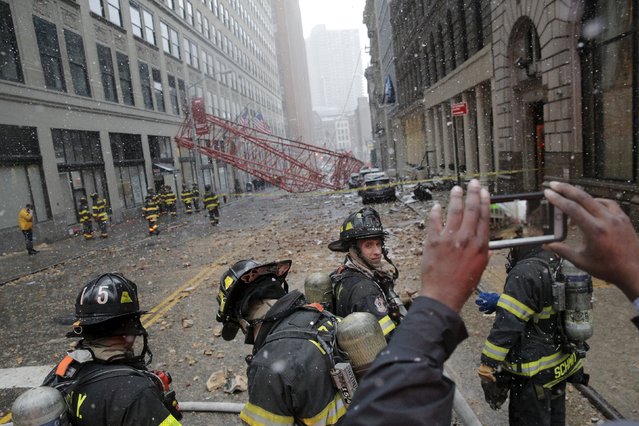
Emergency responders respond to the scene of a 565-foot-tall crane that toppled and flipped upside down, stretching along nearly two city blocks in downtown Manhattan in New York, February 5, 2016. (Photo by Brendan McDermid/Reuters)

Emergency responders respond to the scene of a 565-foot-tall crane that toppled and flipped upside down, stretching along nearly two city blocks in downtown Manhattan in New York, February 5, 2016. The massive construction crane collapsed in lower Manhattan during a swirling snowstorm on Friday, killing one person and crushing a line of parked cars in the first accident of its kind in New York City since 2008. (Photo by Brendan McDermid/Reuters)
Details
06 Feb 2016 13:22:00
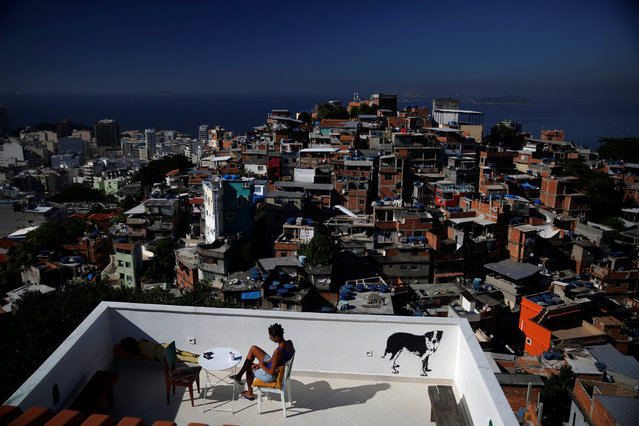
A woman sits on a terrace at Tiki hostel in Cantagalo favela, in Rio de Janeiro, Brazil, April 16, 2016. (Photo by Pilar Olivares/Reuters)

A woman sits on a terrace at Tiki hostel in Cantagalo favela, in Rio de Janeiro, Brazil, April 16, 2016. Hostels in a few of Rio's more than 1,000 slums serve not only as a cheap housing alternative for the more adventurous among the estimated 500,000 foreign tourists expected to arrive for the Olympics in August. The establishments also open up the rich culture of the city's shantytowns for travellers, giving them a glimpse into once “no-go” areas where about one-fifth of Rio's population lives. (Photo by Pilar Olivares/Reuters)
Details
04 May 2016 12:18:00
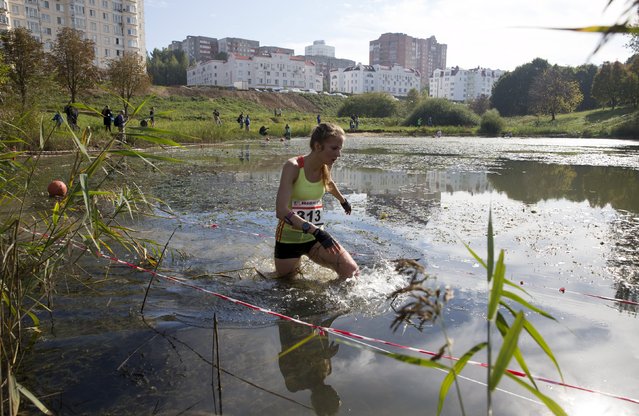
A woman takes part in a “Brave Run” competition in Minsk October 4, 2015. (Photo by Vasily Fedosenko/Reuters)

A woman takes part in a “Brave Run” competition in Minsk October 4, 2015. (Photo by Vasily Fedosenko/Reuters)
Details
06 Oct 2015 08:08:00


For a long time the laws of Canada have explicitly banned gambling in any form. This may be the reason why the country does not have so many gambling establishments as the USA - but their quality surely makes up for the quantity. The first Canadian casino was opened in Dawson City, Yukon, in 1972 - it was the first one after gambling has been banned in the country in 1892. The Diamond Tooth Gertie's Gambling Casino did not operate for long, though. The first permanent commercial casino was opened in 1989, and it was the first of many - there are currently 75 casinos operating on Canadian soil.
Details
16 Sep 2014 12:19:00
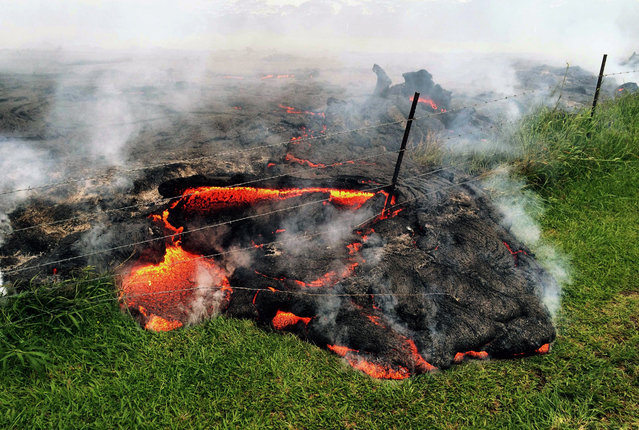
This October 25, 2014 photo provided by the U.S. Geological Survey shows lava flow advancing across the pasture between the Pahoa cemetery and Apa'a Street, engulfing a barbed wire fence, near the town of Pahoa on the Big Island of Hawaii. (Photo by AP Photo/U.S. Geological Survey)

This October 25, 2014 photo provided by the U.S. Geological Survey shows lava flow advancing across the pasture between the Pahoa cemetery and Apa'a Street, engulfing a barbed wire fence, near the town of Pahoa on the Big Island of Hawaii. Dozens of residents in this rural area of Hawaii were placed on alert as flowing lava continued to advance. Authorities on Sunday, October 26, 2014 said lava had advanced about 250 yards since Saturday morning and was moving at the rate of about 10 to 15 yards an hour, consistent with its advancement in recent days. The flow front passed through a predominantly Buddhist cemetery, covering grave sites in the mostly rural region of Puna, and was roughly a half-mile from Pahoa Village Road, the main street of Pahoa. (Photo by AP Photo/U.S. Geological Survey)
Details
27 Oct 2014 11:47:00