Loading...
Done
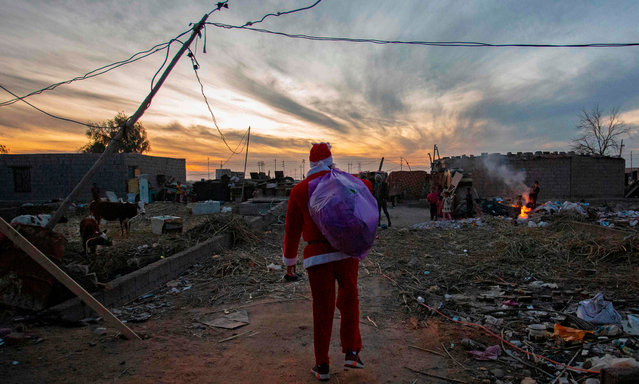
A man dressed as Santa Claus arrives to distribute toys on children living in an impoverished neighbourhood in Iraq's southern city of Basra on December 26, 2020. (Photo by Hussein Faleh/AFP Photo)

A man dressed as Santa Claus arrives to distribute toys on children living in an impoverished neighbourhood in Iraq's southern city of Basra on December 26, 2020. (Photo by Hussein Faleh/AFP Photo)
Details
09 Jan 2021 00:05:00
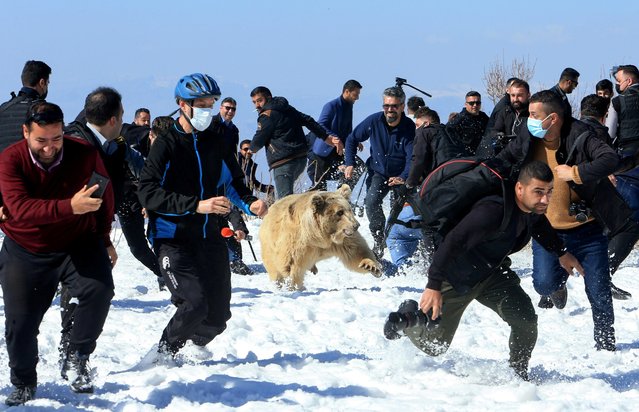
People and security members run away as Kurdish animal rights activists release a bear into the wild after rescuing bears from captivity in people homes, in Dohuk, Iraq on February 11, 2021. (Photo by Ari Jalal/Reuters)

People and security members run away as Kurdish animal rights activists release a bear into the wild after rescuing bears from captivity in people homes, in Dohuk, Iraq on February 11, 2021. (Photo by Ari Jalal/Reuters)
Details
13 Mar 2021 10:18:00
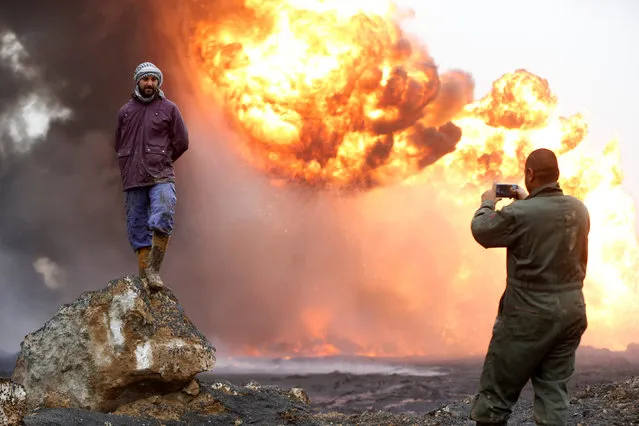
A man takes a photograph of his friend as thick smoke rises from a fire, which broke out at oil wells set ablaze by Islamic State militants before they fled the oil-producing region of Qayyara, Iraq, January 28, 2017. (Photo by Muhammad Hamed/Reuters)

A man takes a photograph of his friend as thick smoke rises from a fire, which broke out at oil wells set ablaze by Islamic State militants before they fled the oil-producing region of Qayyara, Iraq, January 28, 2017. (Photo by Muhammad Hamed/Reuters)
Details
30 Jan 2017 09:55:00
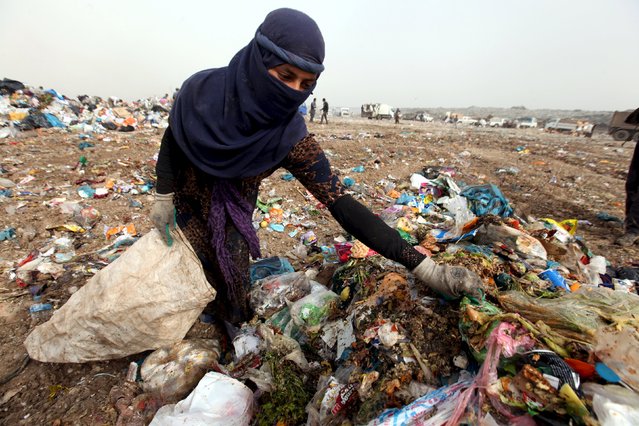
A garbage collector looks for recyclable waste at a dump in Erbil, in Iraq's northern autonomous Kurdistan region, February 21, 2016. (Photo by Azad Lashkari/Reuters)

A garbage collector looks for recyclable waste at a dump in Erbil, in Iraq's northern autonomous Kurdistan region, February 21, 2016. (Photo by Azad Lashkari/Reuters)
Details
22 Feb 2016 10:18:00
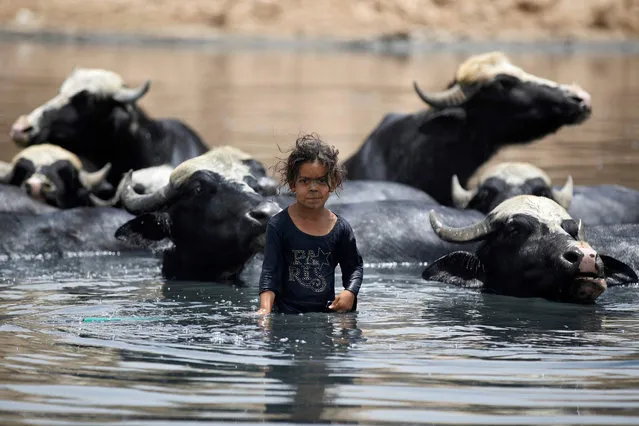
A young Iraqi shepherdess cools down buffaloes in wastewater filling the dried-up Diyala river which was a tributary of the Tigris, in the Al-Fadiliyah district east of Baghdad, on June 26, 2022. Iraq's drought reflects a decline in the level of waterways due to the lack of rain and lower flows from upstream neighboring countries Iran and Turkey. (Photo by Ahmad Al-Rubaye/AFP Photo)

A young Iraqi shepherdess cools down buffaloes in wastewater filling the dried-up Diyala river which was a tributary of the Tigris, in the Al-Fadiliyah district east of Baghdad, on June 26, 2022. Iraq's drought reflects a decline in the level of waterways due to the lack of rain and lower flows from upstream neighboring countries Iran and Turkey. (Photo by Ahmad Al-Rubaye/AFP Photo)
Details
07 Jul 2022 04:21:00
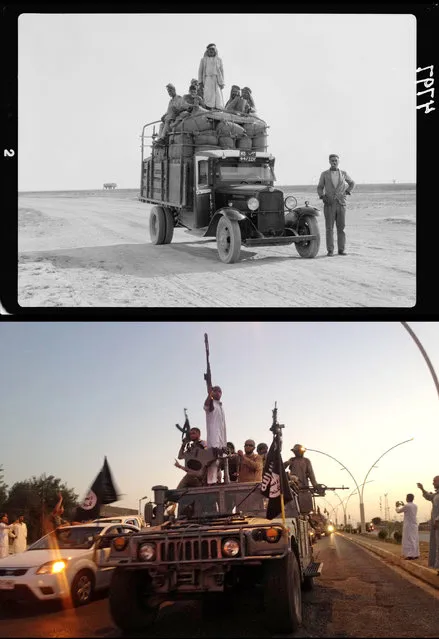
This combination of two photographs shows a 1932 image of men on a lorry on the road to Mosul, northern Iraq, from the Library of Congress, top, and fighters from the Islamic State group parading in a commandeered Iraqi security forces armored vehicle down a main road in Mosul on Monday, June 23, 2014. (Photo by AP Photo)


Iraq's second largest city, Mosul, is locked under the rule of extremists from the Islamic State group trying to purge it of everything they see as contradicting their stark vision of Islam. A trove of photographs now housed at the Library of Congress offers a glimpse of a different Mosul – before wars, insurgency, sectarian strife and now radicals' rule. The scenes were taken in the autumn of 1932 by staff from the American Colony Photo Department during a visit to Iraq at the end of the British mandate. (Photo by AP Photo)
Details
21 Sep 2014 11:13:00
A man prays to mourn victims of the March 11, 2011, earthquake and tsunami in front of a ship brought ashore by the disaster in Kesennuma, Miyagi Prefecture, Japan.  (Photo by Kyodo via Reuters)

A man prays to mourn victims of the March 11, 2011, earthquake and tsunami in front of a ship brought ashore by the disaster in Kesennuma, Miyagi Prefecture, Japan. (Photo by Kyodo via Reuters)
Details
13 Mar 2013 12:30:00
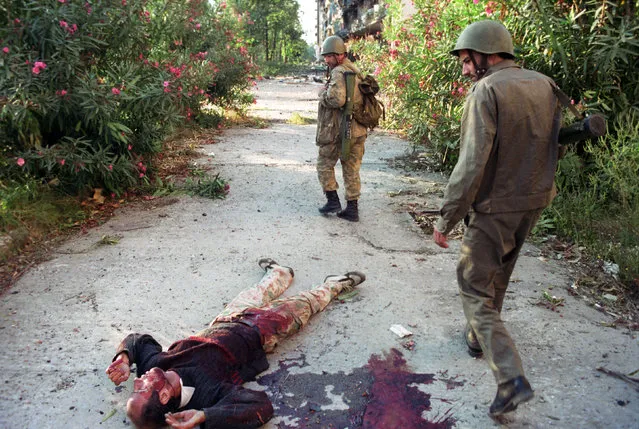
Abkhazia. Sukhumi, 1993. A house-to-house combat. (Photo by Andrei Solovyov/ITAR-TASS)

The War in Abkhazia from 1992 to 1993 was fought between Georgian government forces for the most part, and Abkhaz separatist forces, Russian armed forces and North Caucasian militants. Ethnic Georgians who lived in Abkhazia fought largely on the side of Georgian government forces. Ethnic Armenians and Russians within Abkhazia's population largely supported the Abkhazians, and many fought on their side. The separatists received support from thousands of North Caucasus and Cossack militants and from the Russian Federation forces stationed in and near Abkhazia. Here: Abkhazia. Sukhumi, 1993. A house-to-house combat. (Photo by Andrei Solovyov/ITAR-TASS)
Details
29 Sep 2017 07:31:00