Loading...
Done
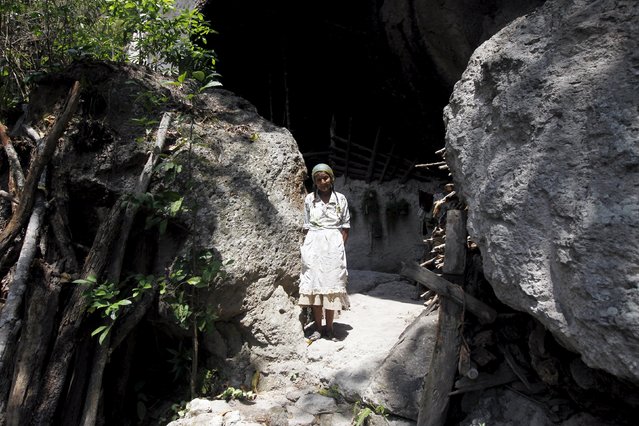
Francisca Gomez stands at an entrance to her home, a cave where she has been living for the past 50 years, in the mountains on the outskirts of Chusmuy April 21, 2015. (Photo by Jorge Cabrera/Reuters)

Francisca Gomez stands at an entrance to her home, a cave where she has been living for the past 50 years, in the mountains on the outskirts of Chusmuy, Honduras April 21, 2015. The 75-year old widow receives help from neighbors and friends and she makes a little money by selling wood she collects, according to a local newspaper. (Photo by Jorge Cabrera/Reuters)
Details
24 Apr 2015 10:38:00
Kawakanih Yawalapiti, 9, Upper Xingu region of Mato Grosso, Brazil, 2018: Kawakanih lives with her tribe, the Yawalapiti, in Xingu national park, a preserve in the Amazon basin of Brazil. The Yawalapiti collect seeds to preserve species unique to their ecosystem, which lies between the rain forest and savannah. Kawakanih’s diet is simple, consisting mainly of fish, cassava, porridge, fruit and nuts. “It takes five minutes to catch dinner”, says Kawakanih. “When you’re hungry, you just go to the river with your net”. (Photo by Gregg Segal/The Guardian)

Photographer Gregg Segal travelled the world to document children and the food they eat in a week. Partly inspired by the increasing problems of childhood obesity, he tracked traditional regional diets as yet unaffected by globalisation, and ironically, found that the healthiest diets were often eaten by the least well off. (Photo by Gregg Segal/The Guardian)
Details
03 Jul 2019 00:03:00
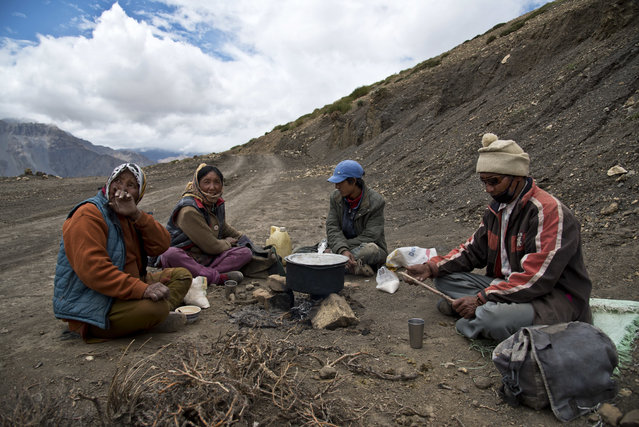
In this August 17, 2016, photo, from left to right, Chhering Chodom, 60, Tashi Yangzom, 50, Lobsang Chhering, 27, and Dorje Tandup, 58, drink milk tea on the side of the road. For centuries, the sleepy valley nestled in the Indian Himalayas remained a hidden Buddhist enclave forbidden to outsiders. Enduring the harsh year-round conditions of the high mountain desert, the people of Spiti Valley lived by a simple communal code – share the Earth's bounty, be hospitable to neighbors, and eschew greed and temptation at all turns. That's all starting to change, for better or worse. Since India began allowing its own citizens as well as outsiders to visit the valley in the early 1990s, tourism and trade have boomed. And the marks of modernization, such as solar panels, asphalt roads and concrete buildings, have begun to appear around some of the villages that dot the remote landscape at altitudes above 4,000 meters (13,000 feet). (Photo by Thomas Cytrynowicz/AP Photo)

In this August 17, 2016, photo, from left to right, Chhering Chodom, 60, Tashi Yangzom, 50, Lobsang Chhering, 27, and Dorje Tandup, 58, drink milk tea on the side of the road. For centuries, the sleepy valley nestled in the Indian Himalayas remained a hidden Buddhist enclave forbidden to outsiders. Enduring the harsh year-round conditions of the high mountain desert, the people of Spiti Valley lived by a simple communal code – share the Earth's bounty, be hospitable to neighbors, and eschew greed and temptation at all turns. That's all starting to change, for better or worse. (Photo by Thomas Cytrynowicz/AP Photo)
Details
15 Sep 2016 09:22:00
Somali couple Mohamed Noor (L) and Huda Omar pose for a photograph at their makeshift home during their wedding ceremony in Mogadishu's Rajo camp, Somalia August 17, 2016. Having met two years ago, the pair have just married at Rajo camp, where some 400 families live. Most, like Noor's parents, came here in the early 1990s to flee famine. They stayed on as years of conflict ravaged the Horn of Africa nation. As at any wedding, there is plenty of dancing and sweet treats for the young couple as they start married life in Noor's simple home, made of iron and plastic sheets. Noor works as a mason with his father. Others here are builders or sell sweets, nuts and stick toothbrushes to make money. Some beg around the seaside city, which like the rest of Somalia has been gripped by violence since the toppling of dictator Mohamed Siad Barre in 1991. (Photo by Feisal Omar/Reuters)

Somali couple Mohamed Noor (L) and Huda Omar pose for a photograph at their makeshift home during their wedding ceremony in Mogadishu's Rajo camp, Somalia August 17, 2016. Having met two years ago, the pair have just married at Rajo camp, where some 400 families live. Most, like Noor's parents, came here in the early 1990s to flee famine. (Photo by Feisal Omar/Reuters)
Details
14 Sep 2016 10:35:00
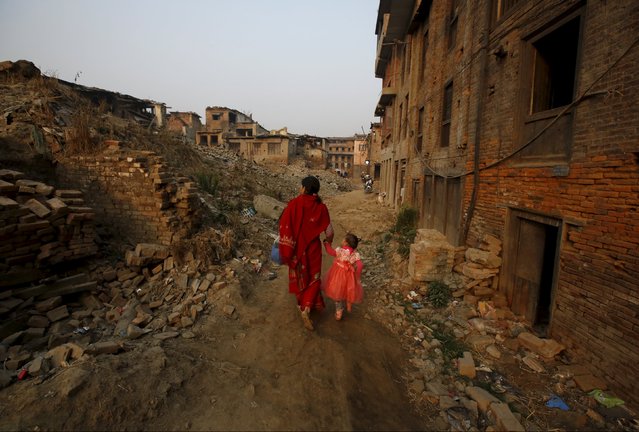
A woman and a child walk past the remains of collapsed houses damaged during the April 2015 earthquake, in Bhaktapur, Nepal March 18, 2016. The two devastating earthquakes that struck Nepal last year killed almost 9,000 people across the country. Inside the Kathmandu Valley almost 2,000 died, and some of the area's most important cultural and heritage sites were completely destroyed. As Kathmandu inhabitants prepare to mark the one-year anniversary of the event, thousands are still displaced and millions are living in temporary shelters. (Photo by Navesh Chitrakar/Reuters)

A woman and a child walk past the remains of collapsed houses damaged during the April 2015 earthquake, in Bhaktapur, Nepal March 18, 2016. The two devastating earthquakes that struck Nepal last year killed almost 9,000 people across the country. Inside the Kathmandu Valley almost 2,000 died, and some of the area's most important cultural and heritage sites were completely destroyed. As Kathmandu inhabitants prepare to mark the one-year anniversary of the event, thousands are still displaced and millions are living in temporary shelters. (Photo by Navesh Chitrakar/Reuters)
Details
25 Apr 2016 09:19:00
What Ali Wore By Zoe Spawton

Every morning at 9:05 AM sharp, a strikingly dapper octogenarian saunters by Zoe Spawton's coffee shop on his way to work in the Berlin borough of Neukölln. That man's name is Ali. He is an 83-year-old Turkish tailor who has been living in Germany for the past 44 years. He has 18 kids, and an impeccable sense of style.
Details
05 Apr 2013 10:44:00
Andrea Rossato, Italy. Professional; Candid. Children enjoy the simple pleasures of a seaside holiday. (Photo by Andrea Rossato/Sony World Photography Awards)

Andrea Rossato, Italy. Professional; Candid. Children enjoy the simple pleasures of a seaside holiday. (Photo by Andrea Rossato/Sony World Photography Awards)
Details
24 Feb 2016 13:14:00
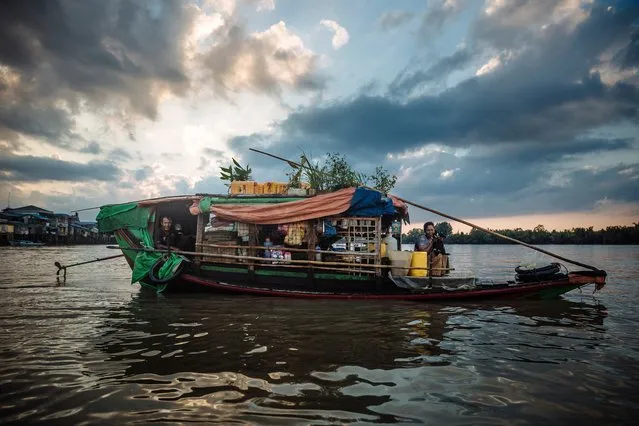
Tin and Naing win live on a small boat which they sail throughout the Delta region in Myanmar. The former gardeners once had a home on land but it was destroyed when a powerful cyclone ravaged the area in 2008. Since then, the couple have not been able to afford to rebuild their home, so they live on the boat from which they sell fish paste to make a living. (Photo by Muse Mohammed/IOM)

The ferocity of crises worldwide is forcing a record number of people to flee their homes, seeking some form of safety within their own country or across international borders. There are 65.3 million displaced people worldwide, including 21.3 million refugees. Most have lost their homes to armed conflict or natural disasters but other factors, such as extreme poverty and climate change, also drive displacement. The International Organisation for Migration commissioned photojournalist Muse Mohammed to document the plight of the displaced. (Photo by Muse Mohammed/IOM)
Details
02 Jan 2017 12:04:00