Loading...
Done
Tim Laman - Wildlife Photojournalist

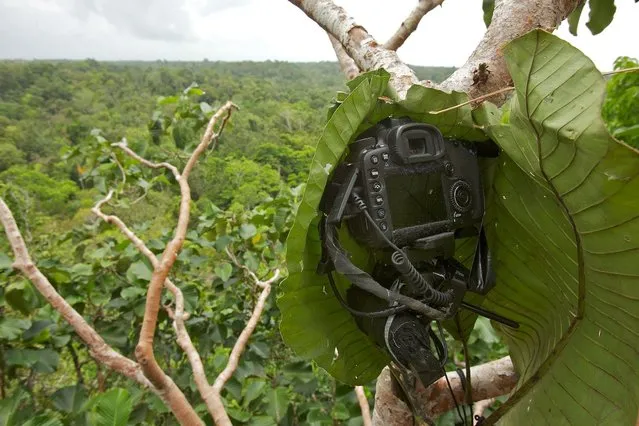
Tim Laman is a field biologist and wildlife photojournalist. His pioneering research in the rain forest canopy in Borneo led to a PhD from Harvard and his first National Geographic article in 1997. Since then, he has pursued his passion for exploring wild places and documenting little-known and endangered wildlife by becoming a regular contributor to National Geographic. He has eighteen articles to his credit to date, all of which have had a conservation message. Some have focused on endangered species such as Orangutans or Hornbills, while others, such as a series of articles on Conservation International’s Biodiversity Hotspots, have highlighted regions under intense pressure.
Details
14 Sep 2013 10:13:00
Icelandic horses feed on hay during a snow storm at a stud farm in Wehrheim near Frankfurt, Germany, Wednesday, December 14, 2022. (Photo by Michael Probst/AP Photo)

Icelandic horses feed on hay during a snow storm at a stud farm in Wehrheim near Frankfurt, Germany, Wednesday, December 14, 2022. (Photo by Michael Probst/AP Photo)
Details
18 Jan 2023 00:22:00
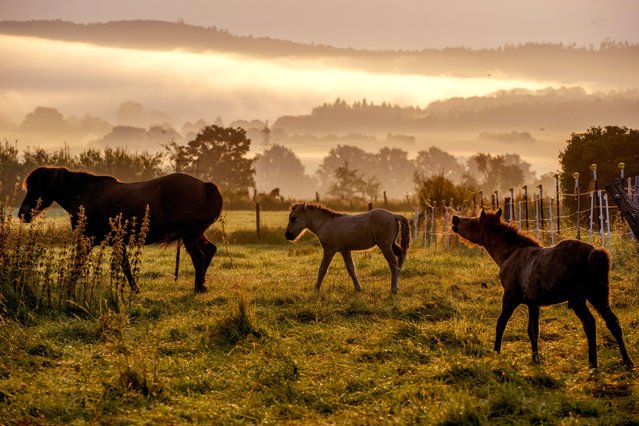
Icelandic horses play in their paddock at a stud farm in Wehrheim near Frankfurt, Germany, as  a mist rolls in on Thursday, August 5, 2021. (Photo by Michael Probst/AP Photo)

Icelandic horses play in their paddock at a stud farm in Wehrheim near Frankfurt, Germany, as a mist rolls in on Thursday, August 5, 2021. (Photo by Michael Probst/AP Photo)
Details
07 Oct 2021 08:10:00
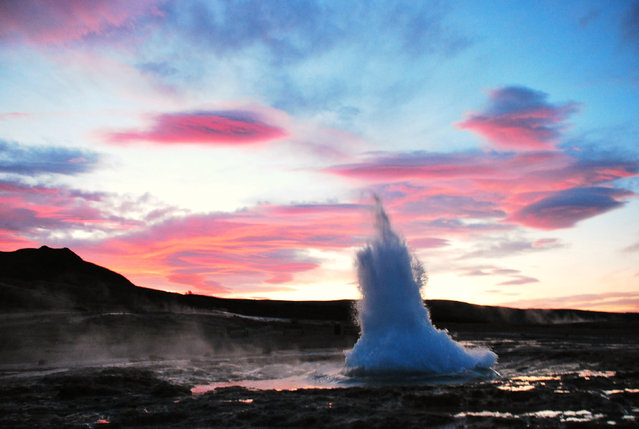
Strokkur geyser against cloudy sky at sunset. Strokkur is a fountain geyser located in a geothermal area beside the Hvítá River in Iceland in the southwest part of the country, east of Reykjavík. It is one of Iceland's most famous geysers, erupting once every 6–10 minutes. Its usual height is 15–20 m, although it can sometimes erupt up to 40 m high. (Photo by Teatsche Dijkhuis/Getty Images/EyeEm)

Strokkur geyser against cloudy sky at sunset. Strokkur is a fountain geyser located in a geothermal area beside the Hvítá River in Iceland in the southwest part of the country, east of Reykjavík. It is one of Iceland's most famous geysers, erupting once every 6–10 minutes. Its usual height is 15–20 m, although it can sometimes erupt up to 40 m high. (Photo by Teatsche Dijkhuis/Getty Images/EyeEm)
Details
18 Oct 2016 12:43:00
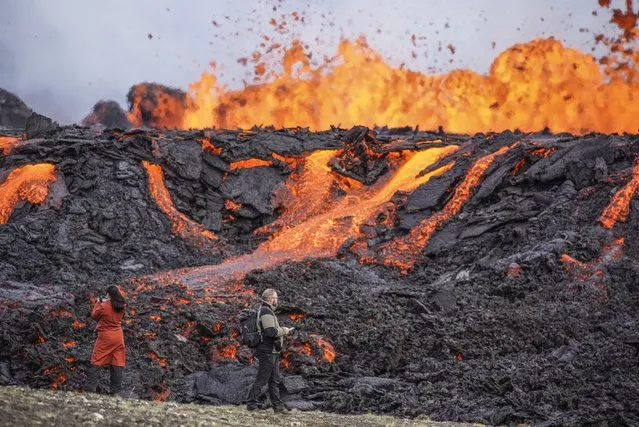
People look at the lava flowing on Fagradalsfjall volcano in Iceland on Wednesday August 3, 2022, which is located 32 kilometers (20 miles) southwest of the capital of Reykjavik and close to the international Keflavik Airport. Authorities in Iceland say the volcano in the southwest of the country is erupting just eight months after its last eruption officially ended. (Photo by Marco Di Marco/AP Photo)

People look at the lava flowing on Fagradalsfjall volcano in Iceland on Wednesday August 3, 2022, which is located 32 kilometers (20 miles) southwest of the capital of Reykjavik and close to the international Keflavik Airport. Authorities in Iceland say the volcano in the southwest of the country is erupting just eight months after its last eruption officially ended. (Photo by Marco Di Marco/AP Photo)
Details
24 Nov 2023 02:50:00
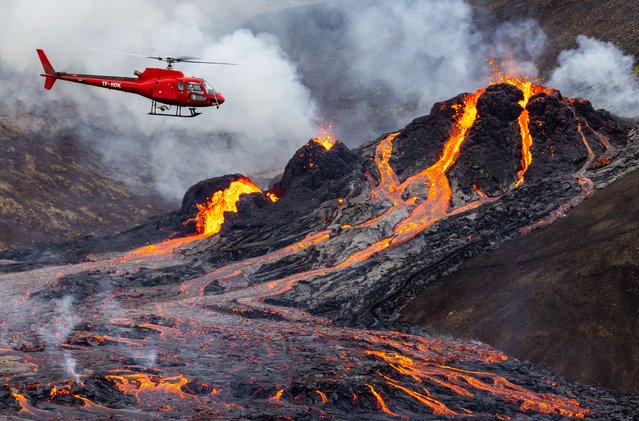
A helicopter flies close to a volcanic eruption which has begun in Fagradalsfjall near the capital Reykjavik on March 20, 2021 in Fagradalsfjall, Iceland. On Friday the Icelandic meteorological office announced a volcano, referring to a mountain located south-west of the Capital Reykjavik has erupted after thousands of small earthquakes in the area over the recent weeks. A no-fly zone has been established in the area. (Photo by Vilhelm Gunnarsson/Getty Images)

A helicopter flies close to a volcanic eruption which has begun in Fagradalsfjall near the capital Reykjavik on March 20, 2021 in Fagradalsfjall, Iceland. On Friday the Icelandic meteorological office announced a volcano, referring to a mountain located south-west of the Capital Reykjavik has erupted after thousands of small earthquakes in the area over the recent weeks. A no-fly zone has been established in the area. (Photo by Vilhelm Gunnarsson/Getty Images)
Details
21 Mar 2021 08:54:00
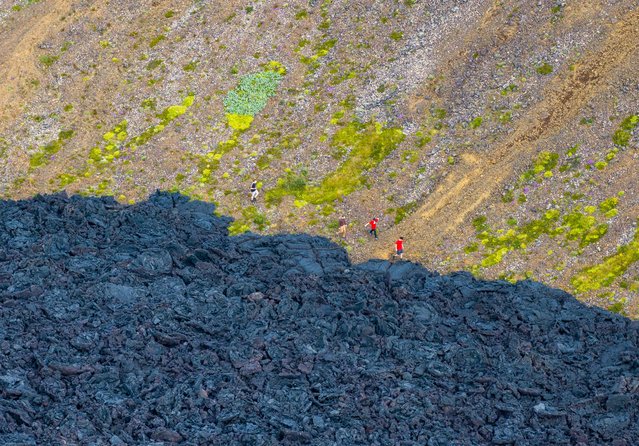
An aerial view taken with a drone shows people walking past dried lava (L) from a previous volcanic eruption as they make their way to a location closer to watch the fresh volcano eruption near Grindavik, Reykjanes, Iceland, 17 July 2025. According to the Icelandic Meteorological Office, a magma flow has begun at the Sundhnuk crater range on 16 July. (Photo by Jakob Vegerfors/EPA)

An aerial view taken with a drone shows people walking past dried lava (L) from a previous volcanic eruption as they make their way to a location closer to watch the fresh volcano eruption near Grindavik, Reykjanes, Iceland, 17 July 2025. According to the Icelandic Meteorological Office, a magma flow has begun at the Sundhnuk crater range on 16 July. (Photo by Jakob Vegerfors/EPA)
Details
14 Nov 2025 03:30:00
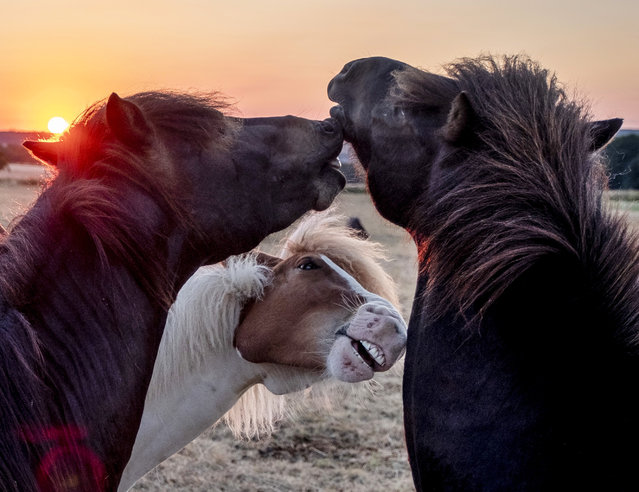
Iceland horses play on a meadow of a stud farm in Obernhain near Frankfurt, Germany, as the sun rises Thursday, July 23, 2020. (Photo by Michael Probst/AP Photo)

Iceland horses play on a meadow of a stud farm in Obernhain near Frankfurt, Germany, as the sun rises Thursday, July 23, 2020. (Photo by Michael Probst/AP Photo)
Details
18 Aug 2020 00:03:00