Loading...
Done
People look at buildings displaying a light show on the eve of the 100th anniversary of the Chinese Communist Party in Beijing on June 30, 2021. (Photo by Noel Celis/AFP Photo)

People look at buildings displaying a light show on the eve of the 100th anniversary of the Chinese Communist Party in Beijing on June 30, 2021. (Photo by Noel Celis/AFP Photo)
Details
01 Jul 2021 09:43:00
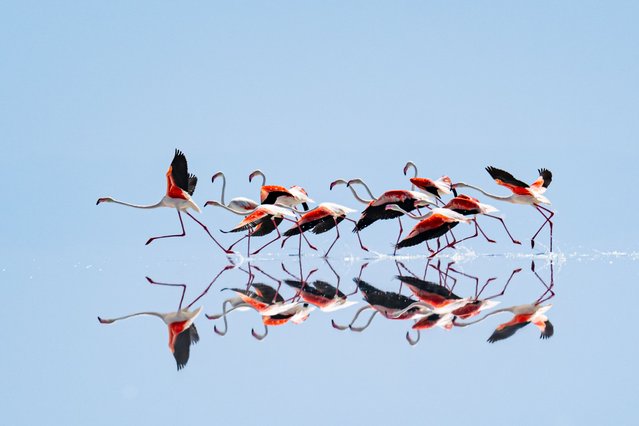
Flamingos preparing to take flight are reflected on Lake Tuz, which hosts thousands of flamingos every year, in Ankara, Turkiye, on June 24, 2025. This year, the lake has seen a decline in flamingo numbers due to drought, prompting the birds to shift their migration route to other wetlands across Turkiye. (Photo by Harun Ozalp/Anadolu via Getty Images)

Flamingos preparing to take flight are reflected on Lake Tuz, which hosts thousands of flamingos every year, in Ankara, Turkiye, on June 24, 2025. This year, the lake has seen a decline in flamingo numbers due to drought, prompting the birds to shift their migration route to other wetlands across Turkiye. (Photo by Harun Ozalp/Anadolu via Getty Images)
Details
31 Jul 2025 02:48:00
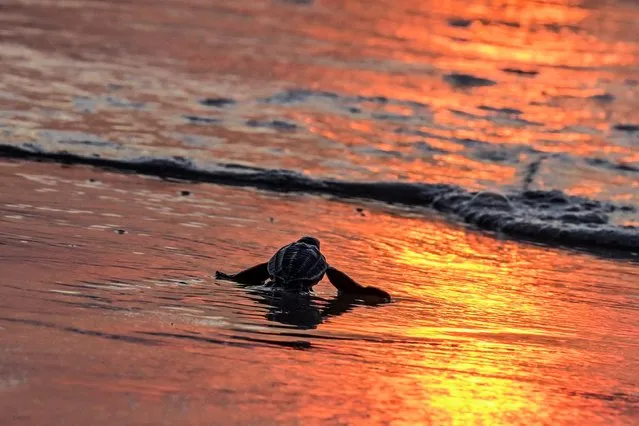
An Olive Ridley sea turtle hatchling releases into the sea at Lhoknga beach, Indonesia's Aceh province on January 16, 2024. (Photo by Chaideer Mahyuddin/AFP Photo)

An Olive Ridley sea turtle hatchling releases into the sea at Lhoknga beach, Indonesia's Aceh province on January 16, 2024. (Photo by Chaideer Mahyuddin/AFP Photo)
Details
03 Feb 2024 08:12:00
A young girl plays on the glass bottom platform of the Oriental Pear TV Tower as she travels with her family on the second day of the Chinese Lunar New Year holiday, also known as Spring Festival, in Shanghai, China on February 18, 2018. Some 287 million tourists travelled in China during the first four days of the week-long Chinese Lunar New Year holiday, up 11.1 percent from the same period last year, new data showed Sunday (18 February 2018). Tourism revenue rose 11.6 percent to 352.7 billion yuan (55.61 billion U.S. dollars) in the four days, the China National Tourism Administration (CNTA) said. On Sunday alone, some 73 million tourist trips were made across the country, up 15.3 percent, while tourism revenue rose 16.6 percent to 94.4 billion yuan. (Photo by Imaginechina/Rex Features/Shutterstock)

A young girl plays on the glass bottom platform of the Oriental Pear TV Tower as she travels with her family on the second day of the Chinese Lunar New Year holiday, also known as Spring Festival, in Shanghai, China on February 18, 2018. Some 287 million tourists travelled in China during the first four days of the week-long Chinese Lunar New Year holiday, up 11.1 percent from the same period last year, new data showed Sunday. (Photo by Imaginechina/Rex Features/Shutterstock)
Details
21 Feb 2018 00:03:00
Mars Panorama (Photo by NASA/JPL-Caltech/MSSS/Andrew Bodrov)

360Cities PRO member Andrew Bodrov has just published another stunning panorama stitched from images taken by the Curiosity Rover on Mars. Photo: “Mars Panorama – Curiosity Rover: Martian Solar Day 177” (Photo by NASA/JPL-Caltech/MSSS/Andrew Bodrov)
Details
16 Feb 2013 09:58:00


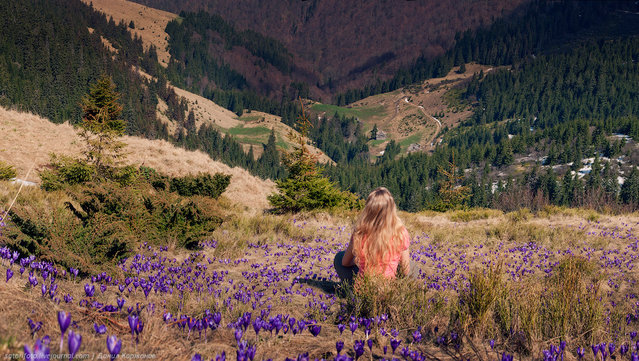
Photos by Daniel Korjonov
Details
30 May 2012 03:43:00
Brazilians Flock To Ocean For New Year's Eve Ritual

Brazilians celebrate at the annual New Year's Eve beach party on December 31, 2011 for the Copacabana Reveillon in Rio De Janeiro, Brazil. (Photo by Konrad Fiedler/Getty Images)
Details
01 Jan 2012 11:12:00
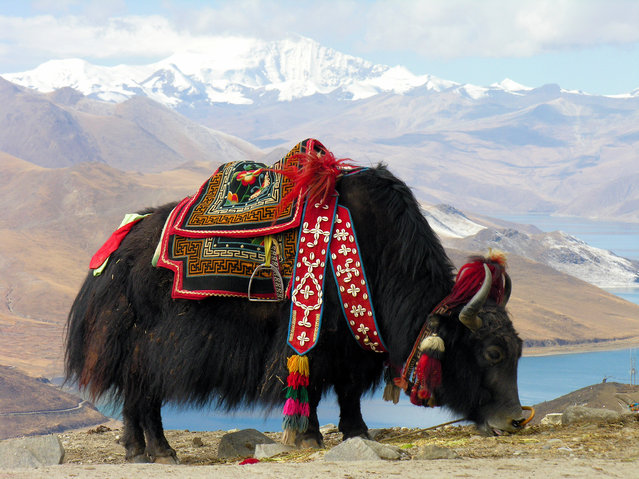
Yak near Yamdrok lake, Tibet. It is a long-haired bovinae found throughout the Himalayan region of south Central Asia, the Tibetan Plateau and as far north as Mongolia and Russia. The Tibetan economy is dominated by subsistence agriculture. Due to limited arable land, the primary occupation of the Tibetan Plateau is raising livestock, such as sheep, cattle, goats, camels, yaks, dzo, and horses. The Tibetan yak is an integral part of Tibetan life. (Photo by Dennis Jarvis)


Yak near Yamdrok lake, Tibet. It is a long-haired bovinae found throughout the Himalayan region of south Central Asia, the Tibetan Plateau and as far north as Mongolia and Russia. The Tibetan economy is dominated by subsistence agriculture. Due to limited arable land, the primary occupation of the Tibetan Plateau is raising livestock, such as sheep, cattle, goats, camels, yaks, dzo, and horses. The Tibetan yak is an integral part of Tibetan life. (Photo by Dennis Jarvis)
Details
10 Jun 2015 10:48:00