Loading...
Done
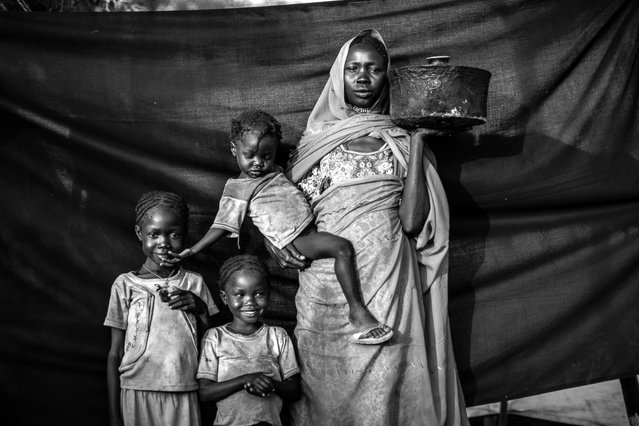
Magbola Alhadi, 20, and her three children pose for a portrait in Jamam refugee camp in Maban County, South Sudan on August 11th, 2012. Magboola and her family weathered aerial bombing raids for several months, but decided it was time to leave their village of Bofe the night that soldiers arrived and opened fire. (Photo by Brian Sokol/Panos Pictures)

Magbola Alhadi, 20, and her three children pose for a portrait in Jamam refugee camp in Maban County, South Sudan on August 11th, 2012. Magboola and her family weathered aerial bombing raids for several months, but decided it was time to leave their village of Bofe the night that soldiers arrived and opened fire. With her three children, she travelled for 12 days from Bofe to the town of El Fudj, on the South Sudanese border. The most important thing that Magboola was able to bring with her is the saucepan she holds in this photograph. It wasn't the largest pot that she had in Bofe, but it was small enough she could travel with it, yet big enough to cook sorghum for herself and her three daughters (from left: Aduna Omar, 6, Halima Omar, 4, and Arfa Omar, 2) during their journey. (Photo by Brian Sokol/Panos Pictures)
Details
18 Sep 2015 15:04:00
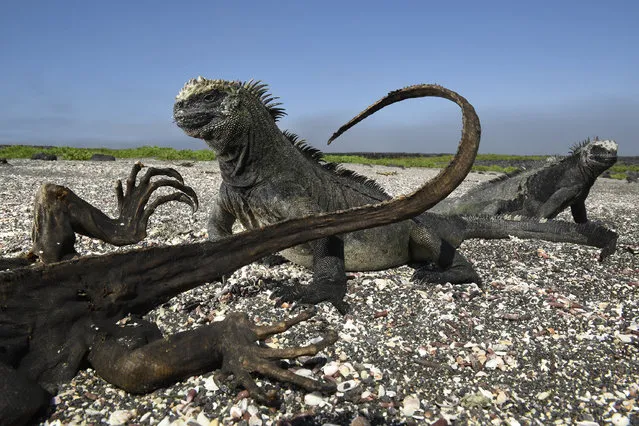
Galapagos – Rocking the Cradle: Four major ocean currents converge along the Galapagos archipelago, creating the conditions for an extraordinary diversity of animal life, April 25, 2016. The islands are home to at least 7,000 flora and fauna species, of which 97 percent of the reptiles, 80 percent of the land birds, 50 percent of the insects and 30 percent of the plants are endemic. The local ecosystem is highly sensitive to the changes in temperature, rainfall and ocean currents that characterize the climatic events known as El Niño and La Niña. These changes cause marked fluctuations in weather and food availability. Many scientists expect the frequency of El Niño and La Niña to increase as a result of climate change, making the Galapagos a possible early-warning location for its effects. (Photo by Thomas P. Peschak for National Geographic/World Press Photo)

Galapagos – Rocking the Cradle: Four major ocean currents converge along the Galapagos archipelago, creating the conditions for an extraordinary diversity of animal life, April 25, 2016. The islands are home to at least 7,000 flora and fauna species, of which 97 percent of the reptiles, 80 percent of the land birds, 50 percent of the insects and 30 percent of the plants are endemic. (Photo by Thomas P. Peschak for National Geographic/World Press Photo)
Details
16 Apr 2018 00:01:00
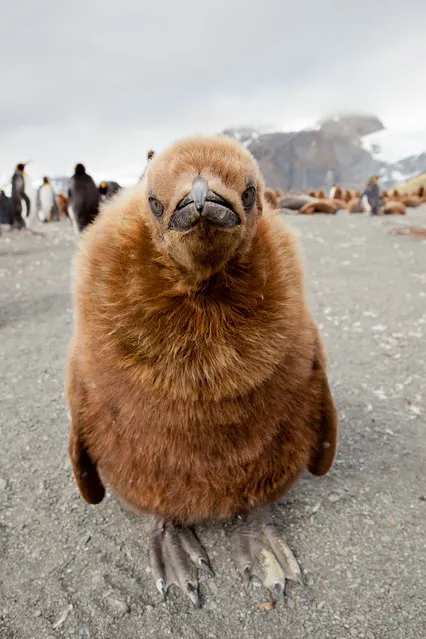
“Cub”. In the colony of penguins in South Georgia. (Photo and caption by Ondrej Zaruba/National Geographic Traveler Photo Contest)

“Cub”. In the colony of penguins in South Georgia. (Photo and caption by Ondrej Zaruba/National Geographic Traveler Photo Contest)

ATTENTION! All pictures are presented in high resolution. To see Hi-Res images – just TWICE click on any picture. In other words, click small picture – opens the BIG picture. Click BIG picture – opens VERY BIG picture.
Details
28 Jun 2013 12:32:00
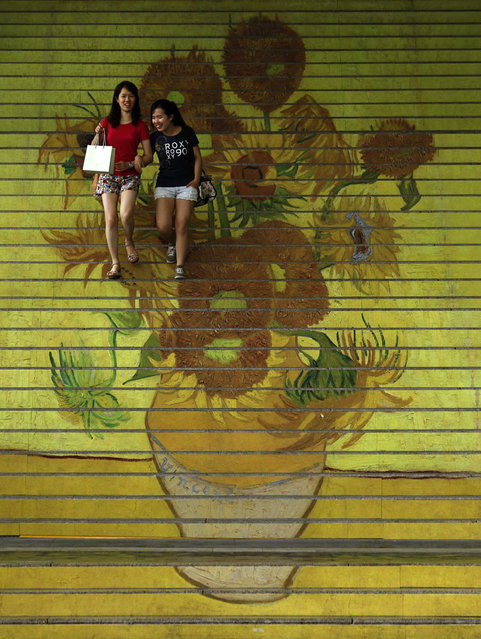
Shoppers walk down stairs featuring a five-metre-high reproduction of Vincent van Gogh's signature painting “Sunflowers”, at the entrance to Ocean Terminal in Hong Kong July 15, 2013. A premium three-dimensional reproduction of works of Van Gogh, the RELIEVO collection, approved by the curators of the Van Gogh Museum in Amsterdam, is on display at a gallery inside Harbour City shopping mall attached to the terminal. (Photo by Bobby Yip/Reuters)

Shoppers walk down stairs featuring a five-metre-high reproduction of Vincent van Gogh's signature painting “Sunflowers”, at the entrance to Ocean Terminal in Hong Kong July 15, 2013. A premium three-dimensional reproduction of works of Van Gogh, the RELIEVO collection, approved by the curators of the Van Gogh Museum in Amsterdam, is on display at a gallery inside Harbour City shopping mall attached to the terminal. (Photo by Bobby Yip/Reuters)
Details
20 Jul 2013 11:59:00
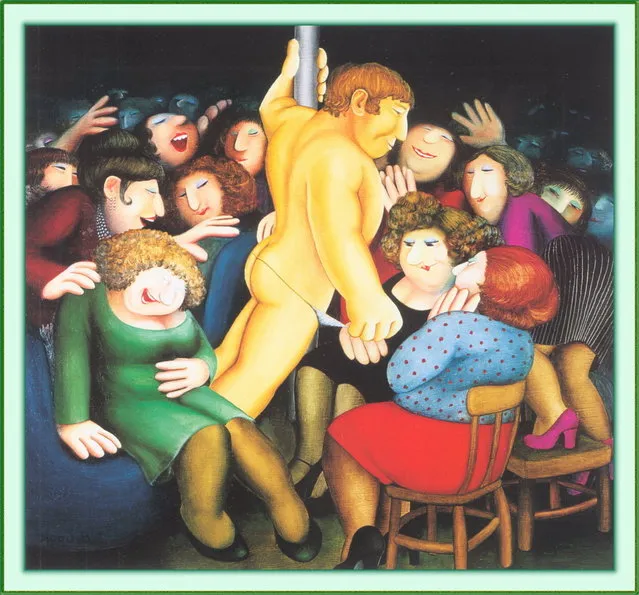
Ladies Night. Artwork by Beryl Cook

“Beryl Cook, (10 September 1926 – 28 May 2008) was an English artist best known for her original and instantly recognisable paintings of people enjoying themselves in pubs,girls shopping or out on a hen night. Drag shows or a family picnicing by the seaside or abroad – tangoing in Buenos Aires or gambling in Las Vegas. She had no formal training and did not take up painting until middle age”. – Wikipedia. Photo: “Ladies Night”, 1991. Artwork by Beryl Cook.
Details
10 Sep 2012 10:45:00
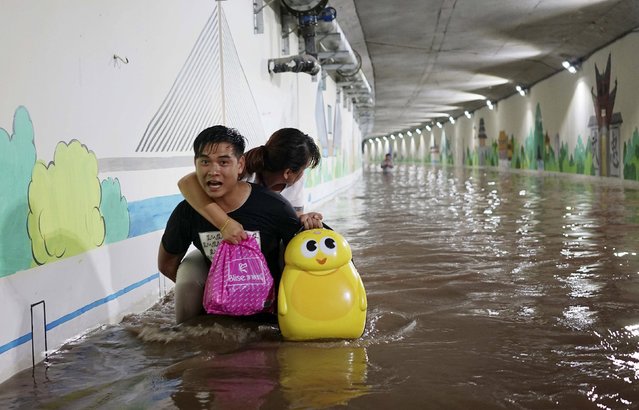
A man carries his wife on his back as they make their way with their luggage along a flooded tunnel to catch their train, after heavy rainfall hit Jinhua, Zhejiang province, China, July 21, 2015. (Photo by Reuters/China Daily)

A man carries his wife on his back as they make their way with their luggage along a flooded tunnel to catch their train, after heavy rainfall hit Jinhua, Zhejiang province, China, July 21, 2015. (Photo by Reuters/China Daily)
Details
23 Jul 2015 11:10:00
Chechen Interior Minister Ruslan Alkhanov greets participants of the military parade to mark the Victory Day in Grozny, Russia, May 9, 2015. Russia marks the 70th anniversary of the end of World War Two in Europe on Saturday with a military parade, showcasing new military hardware at a time when relations with the West have hit lows not seen since the Cold War. (Photo by Reuters/Host Photo Agency/RIA Novosti)

Chechen Interior Minister Ruslan Alkhanov greets participants of the military parade to mark the Victory Day in Grozny, Russia, May 9, 2015. Russia marks the 70th anniversary of the end of World War Two in Europe on Saturday with a military parade, showcasing new military hardware at a time when relations with the West have hit lows not seen since the Cold War. (Photo by Reuters/Host Photo Agency/RIA Novosti)
Details
10 May 2015 11:35:00
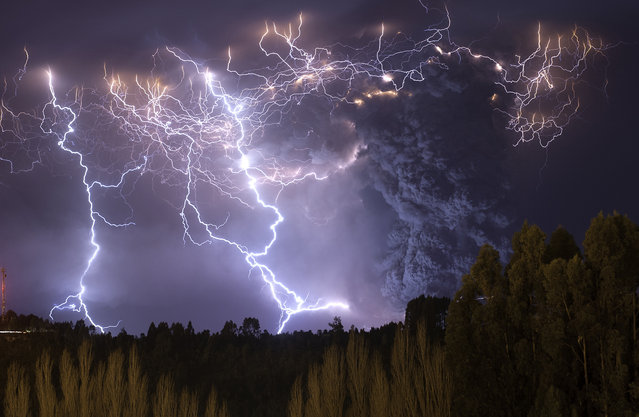
The eruption of Cordon Caulle began on June 4, 2011, located in the Region of Los Rios in Chile. For about 12 months, people and animals became accustomed to living with the daily fall of ash, which also caused problems in the air traffic in South America. The explosions and lightning during first days of the eruption could be seen from hundreds of miles around. This photograph was taken on the second night of eruption from the town of Lago Ranco. (Photo and caption by Francisco Negroni/National Geographic Traveler Photo Contest)

The eruption of Cordon Caulle began on June 4, 2011, located in the Region of Los Rios in Chile. For about 12 months, people and animals became accustomed to living with the daily fall of ash, which also caused problems in the air traffic in South America. The explosions and lightning during first days of the eruption could be seen from hundreds of miles around. This photograph was taken on the second night of eruption from the town of Lago Ranco. (Photo and caption by Francisco Negroni/National Geographic Traveler Photo Contest)

ATTENTION! All pictures are presented in high resolution. To see Hi-Res images – just TWICE click on any picture. In other words, click small picture – opens the BIG picture. Click BIG picture – opens VERY BIG picture.
Details
23 Jun 2013 11:24:00