Loading...
Done
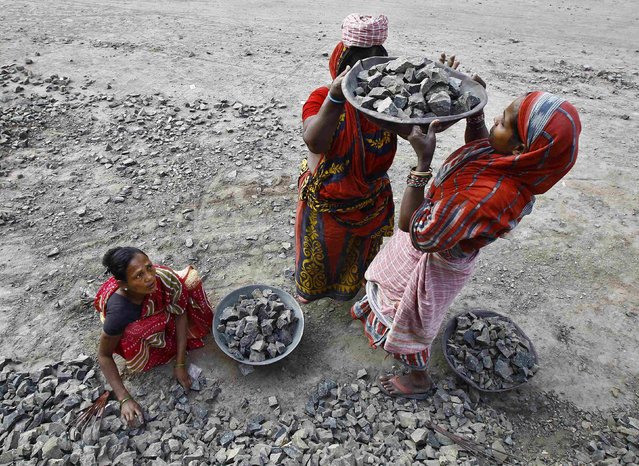
Women labourers work at the construction site of a road in Kolkata January 8, 2015. Across towns and cities in India, it is not uncommon to see women cleaning building sites, carrying bricks and or shoveling gravel - helping construct the infrastructure necessary for the country's economic and social development. (Photo by Rupak De Chowdhuri/Reuters)

Women labourers work at the construction site of a road in Kolkata January 8, 2015. Across towns and cities in India, it is not uncommon to see women cleaning building sites, carrying bricks and or shoveling gravel – helping construct the infrastructure necessary for the country's economic and social development. They help build roads, railway tracks, airports, and offices. They lay pipes for clean water supplies, cables for telecommunications, and dig the drains for sewage systems. But although women make up at least 20 percent of India's 40 million construction workers, they are less recognized than male workers with lower pay and often prone to safety hazards and sexual harassment. They are often unaware of their rights or scared to complain, say activists now trying to campaign for better treatment of women in the construction industry. (Photo by Rupak De Chowdhuri/Reuters)
Details
15 Jan 2015 13:47:00
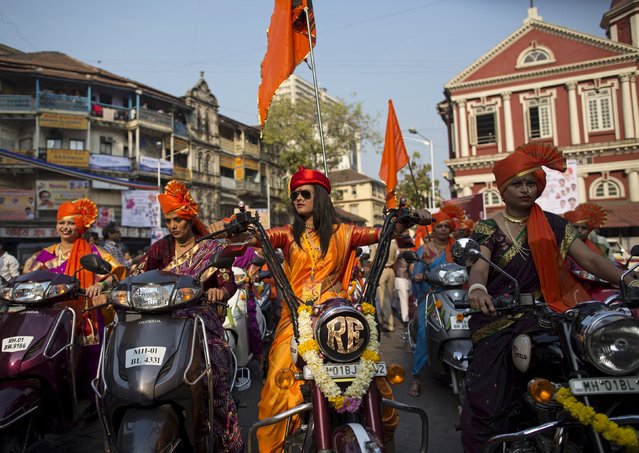
Maharashtrian women dressed in traditional costumes attend celebrations to mark the Gudi Padwa festival in Mumbai March 21, 2015. The festival marks the beginning of the new year for Maharashtrians and is celebrated widely in Maharashtra and in the Konkan region. (Photo by Danish Siddiqui/Reuters)

Maharashtrian women dressed in traditional costumes attend celebrations to mark the Gudi Padwa festival in Mumbai March 21, 2015. The festival marks the beginning of the new year for Maharashtrians and is celebrated widely in Maharashtra and in the Konkan region. (Photo by Danish Siddiqui/Reuters)
Details
02 Apr 2015 12:36:00
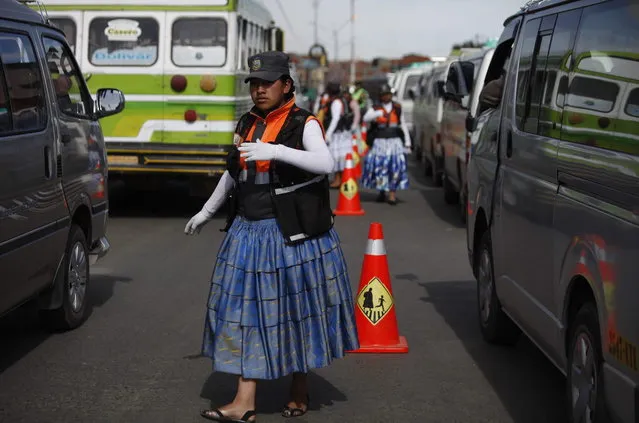
In this December 3, 2013 photo, an Aymara woman cops directs traffic on the streets of El Alto, Bolivia. The women wear the bright petticoats and shawls of indigenous women in the Andes, called cholitas in Bolivian slang, the main difference being that instead of bowler hats they wear khaki green police-style caps. Some don fluorescent traffic vests. (Photo by Juan Karita/AP Photo)

“This city in Bolivia's highlands has hired Aymara women dressed in traditional multilayered Andean skirts and brightly embroidered vests to work as traffic cops and bring order to its road chaos. About 20 of the “traffic cholitas” have been trained to direct cars and buses in El Alto, a teeming, impoverished sister city of La Paz in Bolivia's Andes mountains”. – El Alto via Associated Press. Photo: In this December 3, 2013 photo, an Aymara woman cops directs traffic on the streets of El Alto, Bolivia. The women wear the bright petticoats and shawls of indigenous women in the Andes, called cholitas in Bolivian slang, the main difference being that instead of bowler hats they wear khaki green police-style caps. Some don fluorescent traffic vests. (Photo by Juan Karita/AP Photo)
Details
25 Dec 2013 10:48:00
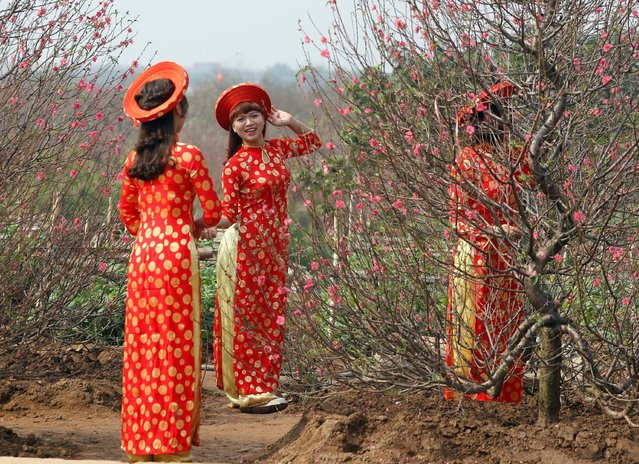
Women, wearing traditional “ao dai” dress, pose for a photo next to peach blossom flowers ahead of Vietnamese “Tet” (the lunar new year festival) in a field in Hanoi January 22, 2017. (Photo by Reuters/Kham)

Women, wearing traditional “ao dai” dress, pose for a photo next to peach blossom flowers ahead of Vietnamese “Tet” (the lunar new year festival) in a field in Hanoi January 22, 2017. (Photo by Reuters/Kham)
Details
23 Jan 2017 10:00:00
Noriaki Iwashima gestures as he lies in a coffin to try it out during an end-of-life seminar held by Japan's largest retailer Aeon Co in Tokyo October 24, 2014. (Photo by Toru Hanai/Reuters)

Noriaki Iwashima gestures as he lies in a coffin to try it out during an end-of-life seminar held by Japan's largest retailer Aeon Co in Tokyo October 24, 2014. Funeral arrangements are normally left to those who have been left behind but the latest trend in Japan, which literally translates to “End of life” preparations, is for the ageing to prepare their own funerals and graves before they set off on their journey to the great beyond. With a population that is expected to shrink by nearly 30 million people over the next 50 years, the market for funerals, graves and anything related to the afterlife is still very much alive. (Photo by Toru Hanai/Reuters)
Details
10 Nov 2014 13:48:00
British visitors wearing Bavarian costumes walk ahead the opening of the traditional Bavarian Oktoberfest festival at the Theresienwiese in Munich, southern Germany, on September 20, 2014. (Photo by Karl-Josef Hildenbrand/AFP Photo/DPA)

British visitors wearing Bavarian costumes walk ahead the opening of the traditional Bavarian Oktoberfest festival at the Theresienwiese in Munich, southern Germany, on September 20, 2014. Germany's world-famous Oktoberfest kicks off with millions of revellers set to soak up the frothy atmosphere in a 16-day extravaganza of lederhosen, oompah music and, of course, beer. (Photo by Karl-Josef Hildenbrand/AFP Photo/DPA)
Details
22 Sep 2014 11:27:00
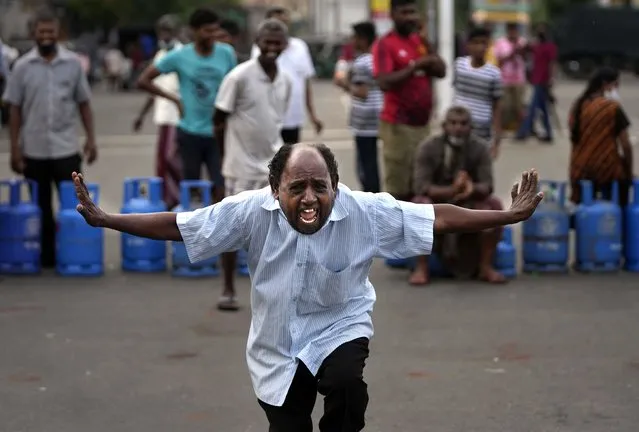
A man shouts slogans demanding cooking gas cylinders as a group of people block an intersection protesting against shortages of essentials in Colombo, Sri Lanka, Saturday, May 7, 2022. (Photo by Eranga Jayawardena/AP Photo)

A man shouts slogans demanding cooking gas cylinders as a group of people block an intersection protesting against shortages of essentials in Colombo, Sri Lanka, Saturday, May 7, 2022. (Photo by Eranga Jayawardena/AP Photo)
Details
13 May 2022 05:41:00
Alluvial Fan, China. A vast alluvial fan blossoms across the desolate landscape between the Kunlun and Altun mountain ranges that form the southern border of the Taklimakan Desert in China’s XinJiang Province. Image taken by the ASTER instrument on NASA’s Terra satellite on May 2nd, 2002. (Photo by NASA/GSFC/USGS EROS Data Center)

Alluvial Fan, China. A vast alluvial fan blossoms across the desolate landscape between the Kunlun and Altun mountain ranges that form the southern border of the Taklimakan Desert in China’s XinJiang Province. Image taken by the ASTER instrument on NASA’s Terra satellite on May 2nd, 2002. (Photo by NASA/GSFC/USGS EROS Data Center)
Details
07 Jan 2013 09:27:00