Loading...
Done
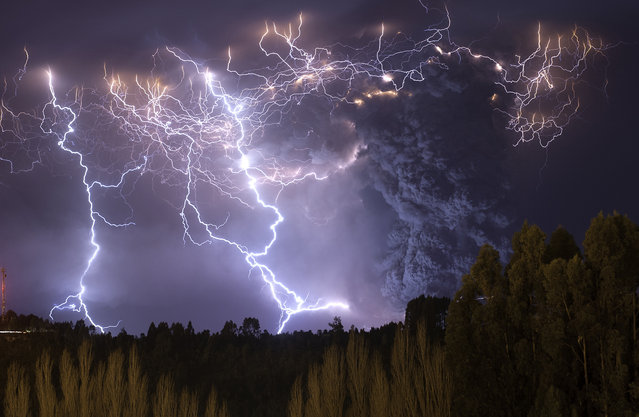
The eruption of Cordon Caulle began on June 4, 2011, located in the Region of Los Rios in Chile. For about 12 months, people and animals became accustomed to living with the daily fall of ash, which also caused problems in the air traffic in South America. The explosions and lightning during first days of the eruption could be seen from hundreds of miles around. This photograph was taken on the second night of eruption from the town of Lago Ranco. (Photo and caption by Francisco Negroni/National Geographic Traveler Photo Contest)

The eruption of Cordon Caulle began on June 4, 2011, located in the Region of Los Rios in Chile. For about 12 months, people and animals became accustomed to living with the daily fall of ash, which also caused problems in the air traffic in South America. The explosions and lightning during first days of the eruption could be seen from hundreds of miles around. This photograph was taken on the second night of eruption from the town of Lago Ranco. (Photo and caption by Francisco Negroni/National Geographic Traveler Photo Contest)

ATTENTION! All pictures are presented in high resolution. To see Hi-Res images – just TWICE click on any picture. In other words, click small picture – opens the BIG picture. Click BIG picture – opens VERY BIG picture.
Details
23 Jun 2013 11:24:00
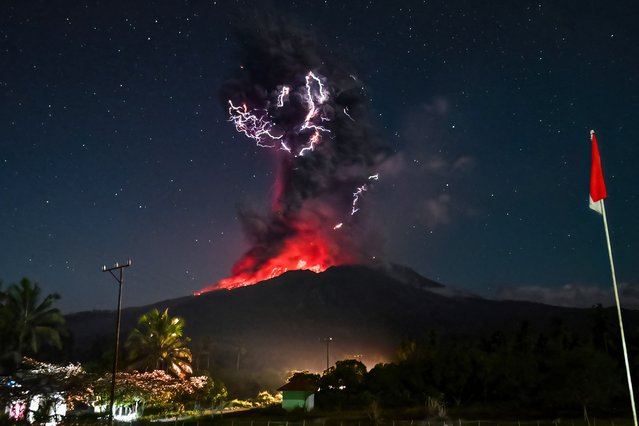
This handout photo taken and released on August 1, 2025 by Indonesia's Geological Agency shows Mount Lewotobi Laki-Laki spewing lava and volcanic ash up to approximately 10 kilometres high during its eruption as observed from the monitoring post in East Flores, in East Nusa Tenggara province. A volcano in eastern Indonesia erupted on August 1, belching an ash tower 10 kilometres (6.2 miles) into the sky, the country's volcanology agency said, weeks after another huge eruption triggered dozens of flight cancellations to and from Bali. (Photo by Indonesia's Geological Agency/AFP Photo)

This handout photo taken and released on August 1, 2025 by Indonesia's Geological Agency shows Mount Lewotobi Laki-Laki spewing lava and volcanic ash up to approximately 10 kilometres high during its eruption as observed from the monitoring post in East Flores, in East Nusa Tenggara province. A volcano in eastern Indonesia erupted on August 1, belching an ash tower 10 kilometres (6.2 miles) into the sky, the country's volcanology agency said, weeks after another huge eruption triggered dozens of flight cancellations to and from Bali. (Photo by Indonesia's Geological Agency/AFP Photo)

Details
24 Nov 2025 04:52:00
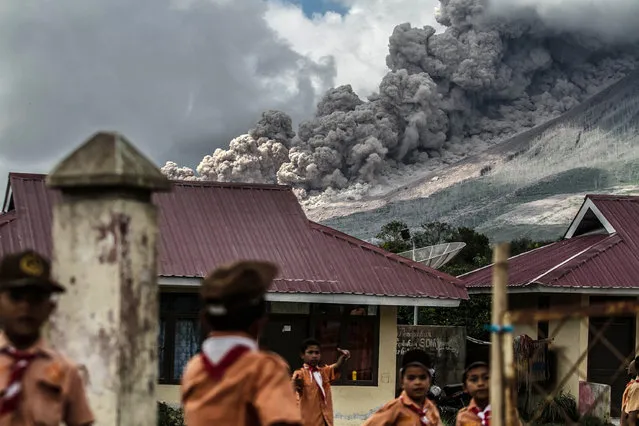
Elementary school children play outside their classrooms as mount Sinabung volcano spews thick volcanic ash in the background on February 10, 2017 in Karo, Indonesia. Mount Sinabung is one of the most active volcanoes in Indonesia and last erupted in May 2016, killing seven people. (Photo by Albert Damanik/Barcroft Images)

Elementary school children play outside their classrooms as mount Sinabung volcano spews thick volcanic ash in the background on February 10, 2017 in Karo, Indonesia. Mount Sinabung is one of the most active volcanoes in Indonesia and last erupted in May 2016, killing seven people. (Photo by Albert Damanik/Barcroft Images)
Details
11 Feb 2017 11:35:00
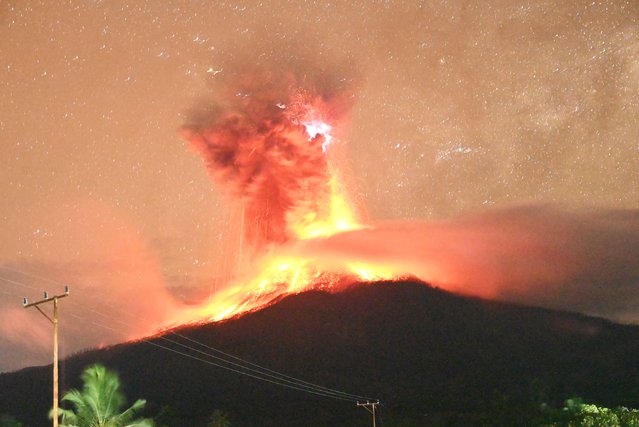
Mount Lewotobi Laki-laki volcano spews vulcanic materials during an eruption as seen from Pululera village in East Flores Regency, East Nusa Tenggara province, Indonesia, on April 27, 2025. (Photo by The Centre for Volcanology and Geological Hazard Mitigation (PVMBG)/Handout via Reuters)

Mount Lewotobi Laki-laki volcano spews vulcanic materials during an eruption as seen from Pululera village in East Flores Regency, East Nusa Tenggara province, Indonesia, on April 27, 2025. (Photo by The Centre for Volcanology and Geological Hazard Mitigation (PVMBG)/Handout via Reuters)
Details
17 May 2025 02:43:00
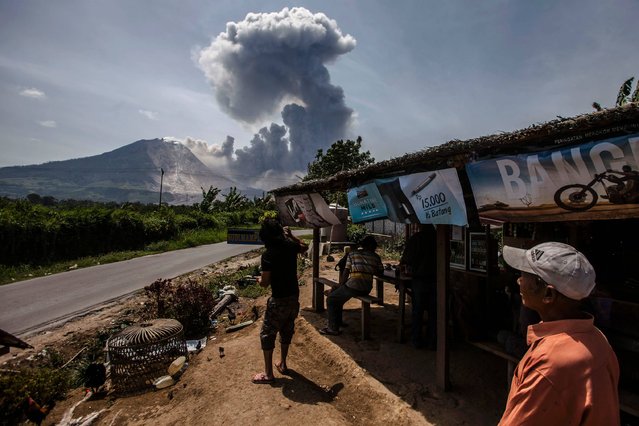
Indonesian residents look at the Mount Sinabung volcano as it spews volcanic ash near the Tiga Pancur village in Karo, North Sumatra on August 3, 2016. Volcanic eruptions in Indonesia in recent days have forced the closure of two airports and disrupted some flights to the holiday island of Bali, officials said August 3. Mount Sinabung, a volcano on the western island of Sumatra which has been rumbling for some time, also erupted violently on August 2, although its ash clouds did not disrupt any flights. (Photo by Y.T. Haryono/AFP Photo)

Indonesian residents look at the Mount Sinabung volcano as it spews volcanic ash near the Tiga Pancur village in Karo, North Sumatra on August 3, 2016. Volcanic eruptions in Indonesia in recent days have forced the closure of two airports and disrupted some flights to the holiday island of Bali, officials said August 3. Mount Sinabung, a volcano on the western island of Sumatra which has been rumbling for some time, also erupted violently on August 2, although its ash clouds did not disrupt any flights. (Photo by Y.T. Haryono/AFP Photo)
Details
04 Aug 2016 12:48:00
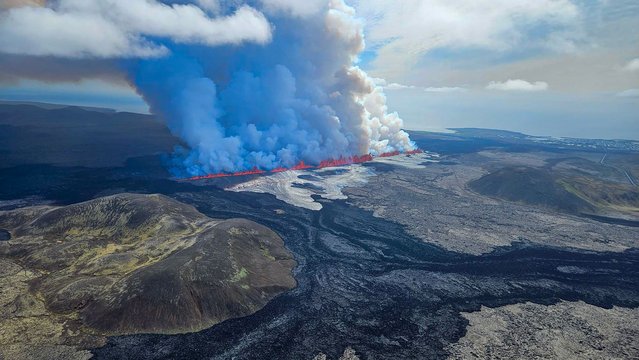
This handout picture released by the Icelandic Coast Guard on May 29, 2024 shows billowing smoke and flowing lava pouring out of a new fissure, during a surveilance flight above a new volcanic eruption on the outskirts of the evacuated town of Grindavik, western Iceland. A new volcanic eruption has begun on the Reykjanes peninsula in southwestern Iceland, the country's meteorological office said Wednesday, shortly after authorities evacuated the nearby town of Grindavik. (Photo by Icelandic Coast Guard/Handout via AFP Photo)

This handout picture released by the Icelandic Coast Guard on May 29, 2024 shows billowing smoke and flowing lava pouring out of a new fissure, during a surveilance flight above a new volcanic eruption on the outskirts of the evacuated town of Grindavik, western Iceland. (Photo by Icelandic Coast Guard/Handout via AFP Photo)
Details
03 Jun 2024 03:47:00
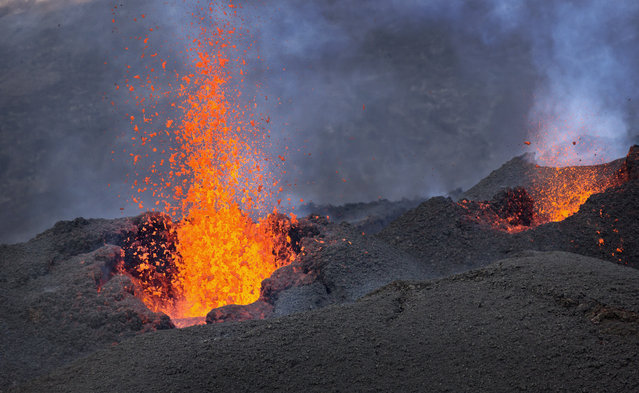
Lava erupts from the Piton de la Fournaise “Peak of the Furnace” volcano, on the southeastern corner of the Indian Ocean island of Reunion Saturday, August 1, 2015. Spewing red-hot lava, one of the most active volcanoes in the world is currently erupting on this Indian Ocean island, where the world's attention has been focused since a wing fragment believed to be from the missing Malaysian jet was discovered washed up on a beach. (Photo by Ben Curtis/AP Photo)

Lava erupts from the Piton de la Fournaise “Peak of the Furnace” volcano, on the southeastern corner of the Indian Ocean island of Reunion Saturday, August 1, 2015. Spewing red-hot lava, one of the most active volcanoes in the world is currently erupting on this Indian Ocean island, where the world's attention has been focused since a wing fragment believed to be from the missing Malaysian jet was discovered washed up on a beach. The lava fountains are shooting as high as 40 meters (44 yards) and are creating cones that are about 20 meters high after only one day of eruption, said Peltier. The volcano is in the Reunion National Park – a world heritage site. The volcano is not seen as dangerous because the lava flows down the east side of the mountain through an uninhabited area called the Grand Brule, or the Big Burned, toward the sea. The last times the volcano threatened the population was in 1977 and 1986. (Photo by Ben Curtis/AP Photo)
Details
03 Aug 2015 12:23:00
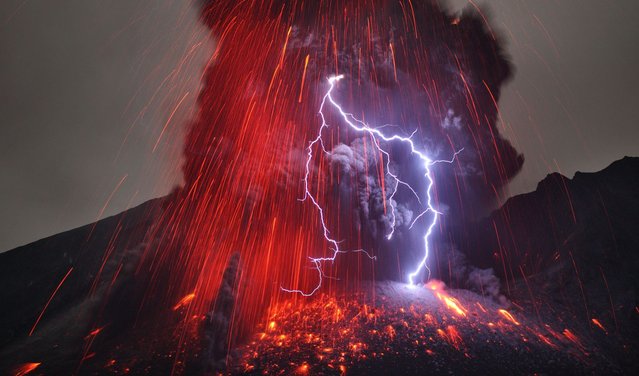
Lightning only ever strikes a volcanic eruption during heavy “vulcanian” or “plinian” explosions when the amount of red lava is very low. (Photo by Martin Rietze/Guzelian)

Martin Rietze is a “volcano-chaser”, a particular breed of photographer who takes big risks for big shots. He was able to capture destructive and beautiful forces of nature at work on a trip to Japan in February 2013. His photos show the Sakurajima Volcano, an active volcanic who's record-breaking 1914 eruption sent lava flows across the island. (Photo by Martin Rietze/Guzelian)
Details
08 Apr 2013 10:49:00