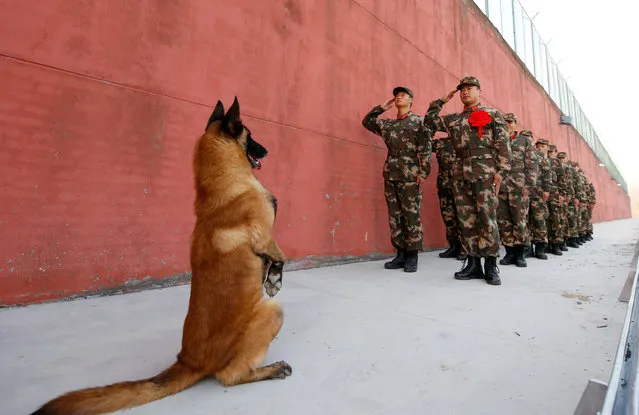
An army dog stands up as retiring soldiers salute their guard post before retirement in Suqian, Jiangsu province, China on November 29, 2017. (Photo by Reuters/China Stringer Network)
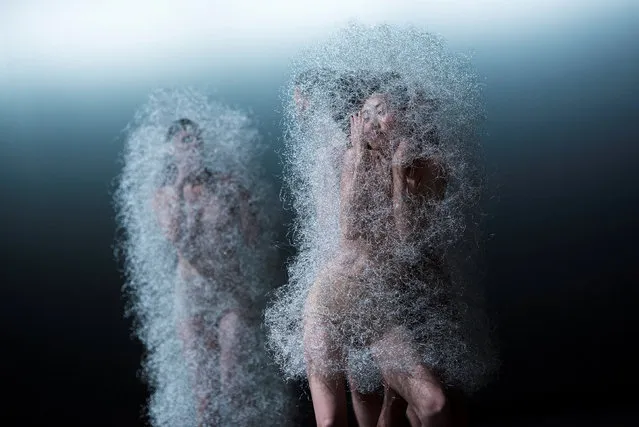
Dancers perform during a general rehearsal of “Kreatur” (Creature) by German choreographer Sasha Waltz in collaboration with artist and fashion designer Iris van Herpen and light designer Urs Schoenebaum in Berlin, Germany on June 8, 2017. (Photo by Stefanie Loos/Reuters)
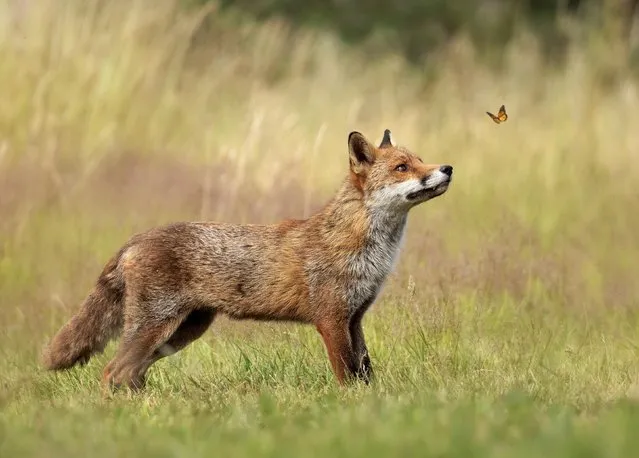
As if pulled from a Disney film, a fox is mesmerised by a butterfly hovering in front of its nose in a field in Taplow, Berkshire, South East England in the second decade of July 2023. (Photo by Ann Aveyard/Animal News Agency)
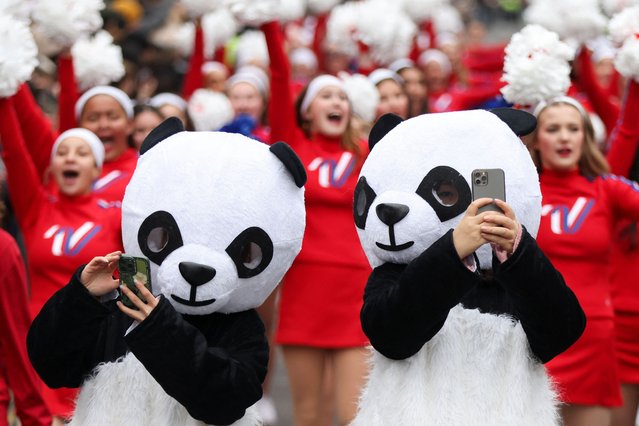
People dressed as pandas walk in front of cheerleaders during the London's New Year's Day Parade event in London, Britain on January 1, 2024. (Photo by Hollie Adams/Reuters)
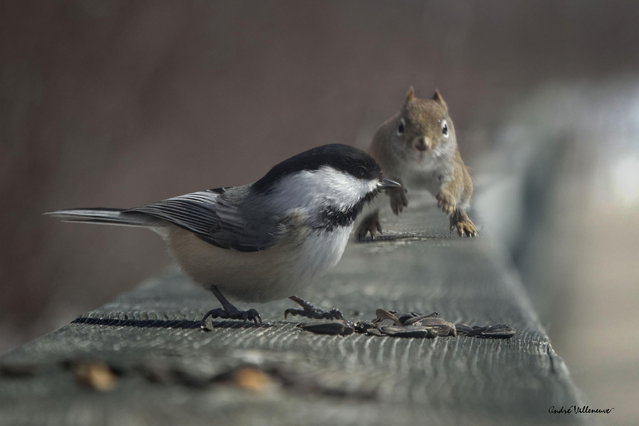
“Self-educated photographer, Quebec. I always impassioned myself for the animal world and natural spaces, in particular for the red squirrels and the titmouses. Having reached sixty and more, I am nothing any more has to prove but all has to show”. – Andre Villeneuve. Photo: “Eat and run”. (Photo by Andre Villeneuve)
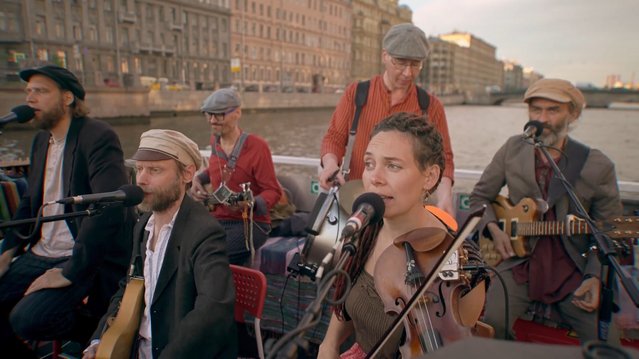
Отава Ё – Яблочко (Otava Yo – Yablochko; Russian: Яблочко, “Little Apple”). Yablochko is a Russian folk song of chastushka style and dance, traditionally presented as sailors' dance. The choreographed version of the dance first appeared in the 1926 Reinhold Glière ballet The Red Poppy and from there is known in the West as the Russian Sailors Dance.
“In anatomy, heterochromia refers to a difference in coloration, usually of the iris (but also of hair or skin). Although infrequently seen in humans, complete heterochromia is more frequently observed in other species, where it almost always involves one blue eye”. – Wikipedia (Photo by StooMathiesen)