Loading...
Done
(L-R) Russian actor Semyon Serzin, Russian actor Yuriy Borisov, Russian actress Yuliya Peresild, Russian actor Yuri Kolokolnikov, Russian actor Ivan Dorn and Russian actress Chulpan Khamatova jump as they arrive for the screening of the film “Petrov's Flu” at the 74th edition of the Cannes Film Festival in Cannes, southern France, on July 12, 2021. (Photo by Johanna Geron/Reuters)

(L-R) Russian actor Semyon Serzin, Russian actor Yuriy Borisov, Russian actress Yuliya Peresild, Russian actor Yuri Kolokolnikov, Russian actor Ivan Dorn and Russian actress Chulpan Khamatova jump as they arrive for the screening of the film “Petrov's Flu” at the 74th edition of the Cannes Film Festival in Cannes, southern France, on July 12, 2021. (Photo by Johanna Geron/Reuters)
Details
14 Jul 2021 09:52:00
A resident of the Goodwin House senior living community, looks on as the DC area motown band “The Tribe” plays a social distance concert in their parking lot in Arlington, Virginia, during the coronavirus pandemic on April 14, 2020. (Photo by Andrew Caballero-Reynolds/AFP Photo)

A resident of the Goodwin House senior living community, looks on as the DC area motown band “The Tribe” plays a social distance concert in their parking lot in Arlington, Virginia, during the coronavirus pandemic on April 14, 2020. (Photo by Andrew Caballero-Reynolds/AFP Photo)
Details
20 Apr 2020 00:05:00


Nazis won't run away - I'll finish them in their lair! - Viktor Koretsky (1945)
Details
17 Aug 2013 10:23:00
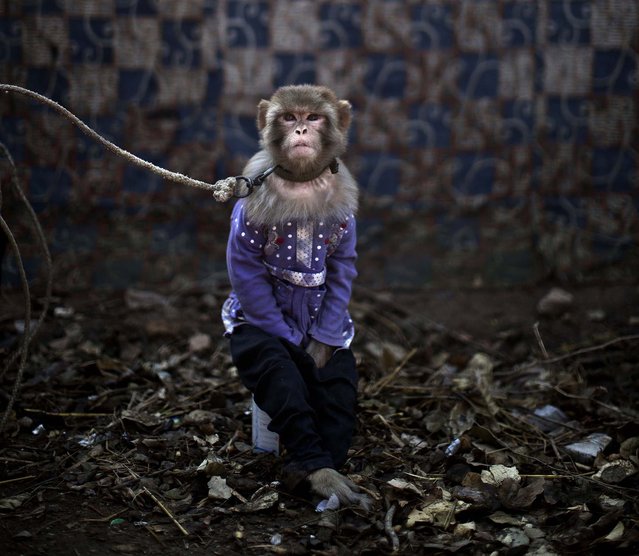
In this Tuesday, February 11, 2014, photo, a trained monkey, that makes a living for her Pakistani owner by performing to a crowd in public and private places, sits held by a leash, in Rawalpindi, Pakistan. For Pakistanis who raise and train the monkeys they are an important source of income in an impoverished country, and they form a strong bond with the animals. The monkeys are usually captured in the wild when they are babies and then trained. A trained monkey can fetch 20,000 to 30,000 rupees ($190 to $285). (Photo by Muhammed Muheisen/Associated Press)

In this Tuesday, February 11, 2014, photo, a trained monkey, that makes a living for her Pakistani owner by performing to a crowd in public and private places, sits held by a leash, in Rawalpindi, Pakistan. For Pakistanis who raise and train the monkeys they are an important source of income in an impoverished country, and they form a strong bond with the animals. The monkeys are usually captured in the wild when they are babies and then trained. A trained monkey can fetch 20,000 to 30,000 rupees ($190 to $285). (Photo by Muhammed Muheisen/Associated Press)
Details
23 Feb 2014 09:50:00


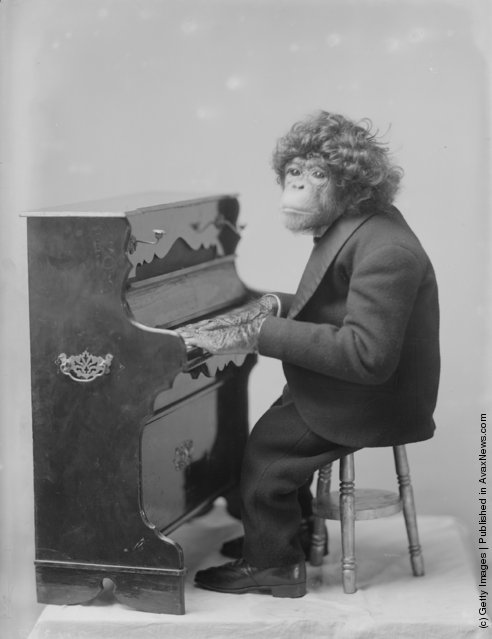
Esau the ape at the piano. (Photo by Reinhold Thiele/Topical Press Agency/Getty Images). Circa 1900
Details
27 Mar 2011 12:07:00
A super flexible schoolboy has become a limbo legend - by roller-skating under 39 cars in a row. It took six-year-old Gagan Satish just 29 seconds to cover a distance of nearly 70 metres with his face just five inches from the ground. (Photo by Arkaprava Ghosh/Barcroft Media India)

A super flexible schoolboy has become a limbo legend - by roller-skating under 39 cars in a row. It took six-year-old Gagan Satish just 29 seconds to cover a distance of nearly 70 metres with his face just five inches from the ground. (Photo by Arkaprava Ghosh/Barcroft Media India)
Details
24 Jul 2014 12:59:00
Farmer holding a freshly cut cocoa bean pod, revealing the pulp and seed inside on a rainforest farm. (Photo by Doug McKinlay/Getty Images)

Chocolate is the greatest gift the Earth has given us. The dessert table would be a sad sight without it. It’s so beloved, so appreciated, that the Swedish scientist who named the cocoa plant that gives us chocolate called it Theobroma cacao, which means “food of the gods”. Here: Farmer holding a freshly cut cocoa bean pod, revealing the pulp and seed inside on a rainforest farm. (Photo by Doug McKinlay/Getty Images)
Details
10 Aug 2016 10:20:00
Is it a leaf? Is it tree bark? No, it’s the Satanic leaf-tailed gecko. Cleverly disguised as a rotting leaf, Madagascar’s camouflage king has red eyes, pointy horns and a taste for night hunting: it’s nature’s most devilish deceiver. (Photo by Thomas Marent/ARDEA)

Is it a leaf? Is it tree bark? No, it’s the Satanic leaf-tailed gecko. Cleverly disguised as a rotting leaf, Madagascar’s camouflage king has red eyes, pointy horns and a taste for night hunting: it’s nature’s most devilish deceiver. The twisted body and veiny skin echo the detail of a dry leaf, which ensures the gecko blends in with its forest home. The mottled tail appears to have sections missing, as though it has withered over time. This mini-monster epitomises survival of the fittest, having adapted gradually to become today’s extraordinary leaf impersonator. (Photo by Thomas Marent/ARDEA)
Details
20 Nov 2015 08:03:00