Loading...
Done
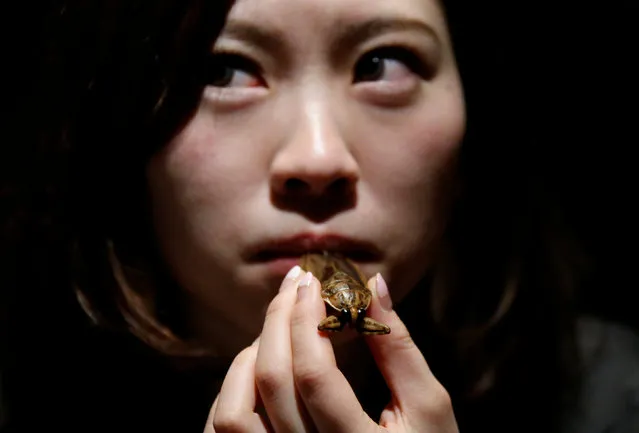
A woman tries to eat a water bug at a bar in downtown Tokyo, Japan, February 12, 2017. (Photo by Toru Hanai/Reuters)

A woman tries to eat a water bug at a bar in downtown Tokyo, Japan, February 12, 2017. A Tokyo bar on Sunday offered courageous couples and curious gourmets a special menu of desserts and drinks made with insects ahead of Tuesday's holiday. (Photo by Toru Hanai/Reuters)
Details
15 Feb 2017 00:02:00
At the 50th anniversary of the Hartford Automobile Club a 1914 Mercer with an economical wind screen, looking like a large magnifying glass, designed to offer minimum wind resistance. Brass is used instead of chrome for the “shiny” parts, circa 1955. (Photo by Three Lions)

At the 50th anniversary of the Hartford Automobile Club a 1914 Mercer with an economical wind screen, looking like a large magnifying glass, designed to offer minimum wind resistance. Brass is used instead of chrome for the “shiny” parts, circa 1955. (Photo by Three Lions)
Details
28 Sep 2012 10:56:00
In this Tuesday, June 19, 2018 filer, clouds are illuminated by the sun setting sun over a church during the 2018 soccer World Cup in Podolsk near Moscow, Russia. (Photo by Michael Probst/AP Photo)

In this Tuesday, June 19, 2018 filer, clouds are illuminated by the sun setting sun over a church during the 2018 soccer World Cup in Podolsk near Moscow, Russia. (Photo by Michael Probst/AP Photo)
Details
09 Dec 2021 08:55:00
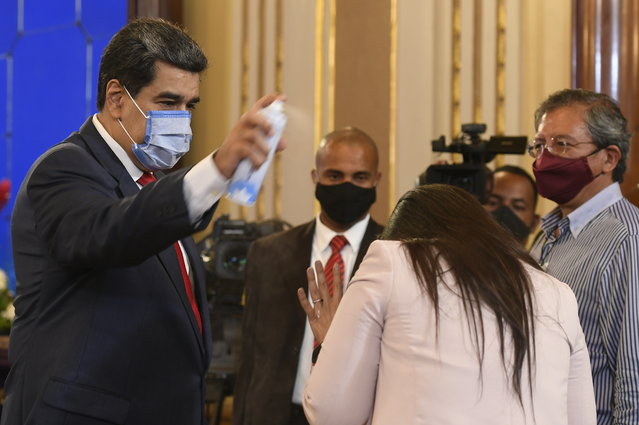
In this December 8, 2020 file photo, Venezuela's President Nicolas Maduro playfully sprays a journalist with disinfectant as he exits a press conference at Miraflores Presidential Palace in Caracas, Venezuela, amid the new coronavirus pandemic. Attorneys for the cash-strapped government blame the impact of U.S. sanctions for its inability to make an initial $18 million down payment to the United Nations for doses of the U.N.-supplied vaccines, whose deadline has already passed. (Photo by Matias Delacroix/AP Photo/File)

In this December 8, 2020 file photo, Venezuela's President Nicolas Maduro playfully sprays a journalist with disinfectant as he exits a press conference at Miraflores Presidential Palace in Caracas, Venezuela, amid the new coronavirus pandemic. Attorneys for the cash-strapped government blame the impact of U.S. sanctions for its inability to make an initial $18 million down payment to the United Nations for doses of the U.N.-supplied vaccines, whose deadline has already passed. (Photo by Matias Delacroix/AP Photo/File)
Details
27 Jan 2021 10:21:00
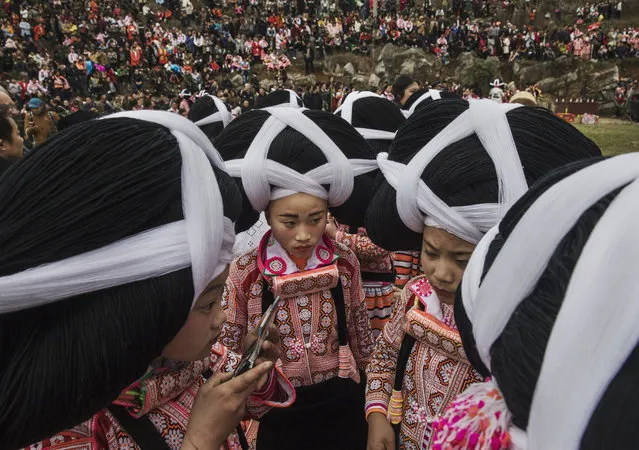
Girls of the Long Horn Miao ethnic minority group wear headdresses as they prepare gather for Tiaohua or Flower Festival as part of the Lunar New Year on February 6, 2017 in Longga village, Guizhou province, southern China. The Long Horn Miao are recognized for their declining practice of wrapping a blend of linen, wool, and the hair of their ancestors around animal horns or a wooden clip to make headdresses. Many young women say they now wear the headdresses only for special occasions and festivals, as the ornaments, which are attached by the horns to their real hair, have proved impractical for modern daily life in a fast changing world. China officially recognizes 56 different ethnic minorities, and statistics show over 7 million Chinese identifying themselves as Miao. But the small Long Horn Miao community counts only around 5000 people living in 12 villages, whose age-old traditions, language, and culture are fading. It is increasingly difficult in a modernizing China, as young people are drawn from remote rural villages to opportunities in bigger cities amongst wide-scale urbanization. Farming and labour remain the mainstays of life for the Long Horn Miao, leaving the area relatively poor in comparison with many parts of China. The government has invested significant amounts into local infrastructure and the tourism industry to try to bolster the local economy. (Photo by Kevin Frayer/Getty Images)

Girls of the Long Horn Miao ethnic minority group wear headdresses as they prepare gather for Tiaohua or Flower Festival as part of the Lunar New Year on February 6, 2017 in Longga village, Guizhou province, southern China. (Photo by Kevin Frayer/Getty Images)
Details
13 Feb 2017 00:01:00
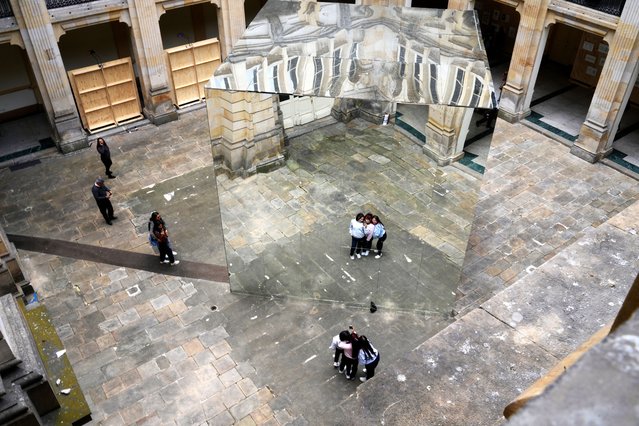
A trio poses for a photo in front of the art installation Surrender (Flag) by John Gerrard of Ireland displayed in a courtyard of the Palacio de San Francisco, as part of the first art biennial in Bogota, Colombia, Tuesday, September 23, 2025. (Photo by Fernando Vergara/AP Photo)

A trio poses for a photo in front of the art installation Surrender (Flag) by John Gerrard of Ireland displayed in a courtyard of the Palacio de San Francisco, as part of the first art biennial in Bogota, Colombia, Tuesday, September 23, 2025. (Photo by Fernando Vergara/AP Photo)
Details
18 Nov 2025 04:11:00
In this June 20, 2015 photo, Niberta Galvez uses the bottom half of his shirt to collect coca leaves in Samugari, Peru. Coca farmers were among the locals who, in 1984, formed citizen militias to help the military beat back Shining Path rebels, reducing them to a small group of fewer than 500 who now are deeply involved in drug trafficking. (Photo by Rodrigo Abd/AP Photo)

In this June 20, 2015 photo, Niberta Galvez uses the bottom half of his shirt to collect coca leaves in Samugari, Peru. Coca farmers were among the locals who, in 1984, formed citizen militias to help the military beat back Shining Path rebels, reducing them to a small group of fewer than 500 who now are deeply involved in drug trafficking. (Photo by Rodrigo Abd/AP Photo)
Details
01 Jul 2015 13:11:00
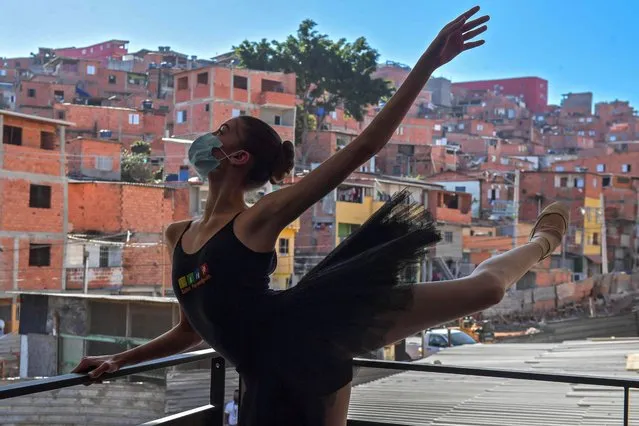
Mariana Sousa, student of the Ballet Paraisopolis, warms up during a rehearse in Paraisopolis favela, outskirts of Sao Paulo, Brazil on August 27, 2020, amid the new coronavirus COVID-19 pandemic. The 200 ballet students of Paraisopolis, the second largest favela in Sao Paulo, restarted rehearsals after five months with a coreography about a police operation that put their community in mourning last year. (Photo by Nelson Almeida/AFP Photo)

Mariana Sousa, student of the Ballet Paraisopolis, warms up during a rehearse in Paraisopolis favela, outskirts of Sao Paulo, Brazil on August 27, 2020, amid the new coronavirus COVID-19 pandemic. The 200 ballet students of Paraisopolis, the second largest favela in Sao Paulo, restarted rehearsals after five months with a coreography about a police operation that put their community in mourning last year. (Photo by Nelson Almeida/AFP Photo)
Details
11 Sep 2020 00:03:00