Loading...
Done
A member of the Fuerza Civil (Civil Force) police unit takes part in a simulated crime situation during a media presentation to show the police model that the federal government wants for the rest of the country, at the police academy in Monterrey December 17, 2014. Fuerza Civil, a tactical team of the police unit trained by the army, was created by the Nuevo Leon government in 2011 to curb down corruption and infiltration by drug gangs in the police corps, local media reported. (Photo by Daniel Becerril/Reuters)

A member of the Fuerza Civil (Civil Force) police unit takes part in a simulated crime situation during a media presentation to show the police model that the federal government wants for the rest of the country, at the police academy in Monterrey December 17, 2014. Fuerza Civil, a tactical team of the police unit trained by the army, was created by the Nuevo Leon government in 2011 to curb down corruption and infiltration by drug gangs in the police corps, local media reported. Promising a new law to stop the infiltration of local governments by organized crime, President Enrique Pena Nieto pledged to reform the penal system and send an proposal to Congress to unify multi-layered police forces in Mexico's 31 states. (Photo by Daniel Becerril/Reuters)
Details
19 Dec 2014 12:35:00
Faruk, 17, a Rohingya refugee trader holds betel leaves which are on sale at a stall in Palong Khali refugee camp near Cox's Bazar, Bangladesh, November 3, 2017. He left his village in Myanmar when the military opened fire towards the Rohingya. “I buy this betel leaf from Palong Khali market, in one bundle there are 160 pieces, I buy it for 80 taka and I sell it for 100 taka. Bangladeshi's and I sell for the same rate in the camp. Outside in the local market it is 80 taka per bundle. My problem is that I don't have money so I can't buy anything to eat, I can't buy fish to eat”, he said. (Photo by Hannah McKay/Reuters)

Faruk, 17, a Rohingya refugee trader holds betel leaves which are on sale at a stall in Palong Khali refugee camp near Cox's Bazar, Bangladesh, November 3, 2017. He left his village in Myanmar when the military opened fire towards the Rohingya. “I buy this betel leaf from Palong Khali market, in one bundle there are 160 pieces, I buy it for 80 taka and I sell it for 100 taka (1 Bangladeshi Taka = 0.012 US Dollar). Bangladeshi's and I sell for the same rate in the camp. Outside in the local market it is 80 taka per bundle. My problem is that I don't have money so I can't buy anything to eat, I can't buy fish to eat”, he said. (Photo by Hannah McKay/Reuters)
Details
27 Nov 2017 08:54:00
Somali couple Mohamed Noor (L) and Huda Omar pose for a photograph at their makeshift home during their wedding ceremony in Mogadishu's Rajo camp, Somalia August 17, 2016. Having met two years ago, the pair have just married at Rajo camp, where some 400 families live. Most, like Noor's parents, came here in the early 1990s to flee famine. They stayed on as years of conflict ravaged the Horn of Africa nation. As at any wedding, there is plenty of dancing and sweet treats for the young couple as they start married life in Noor's simple home, made of iron and plastic sheets. Noor works as a mason with his father. Others here are builders or sell sweets, nuts and stick toothbrushes to make money. Some beg around the seaside city, which like the rest of Somalia has been gripped by violence since the toppling of dictator Mohamed Siad Barre in 1991. (Photo by Feisal Omar/Reuters)

Somali couple Mohamed Noor (L) and Huda Omar pose for a photograph at their makeshift home during their wedding ceremony in Mogadishu's Rajo camp, Somalia August 17, 2016. Having met two years ago, the pair have just married at Rajo camp, where some 400 families live. Most, like Noor's parents, came here in the early 1990s to flee famine. (Photo by Feisal Omar/Reuters)
Details
14 Sep 2016 10:35:00
Nepalese women and young girls struggle to drink homemade alcohol poured through a pipe sticking out of the mouth of Swet Bhairab, a god of Power, during the Indra Jatra festival at Basantapur Durbar Square in Kathmandu, Nepal, 17 September 2016. Hundreds of women and young girls gathered to drink alcohol as a blessing from idol of Swet Bhairab which they believes will keep them free from all diseases. The Indra Jatra festival is celebrated to honor Indra, the king of gods and god of rains. The festival also marks the end of the monsoon. (Photo by Narendra Shrestha/EPA)

Nepalese women and young girls struggle to drink homemade alcohol poured through a pipe sticking out of the mouth of Swet Bhairab, a god of Power, during the Indra Jatra festival at Basantapur Durbar Square in Kathmandu, Nepal, 17 September 2016. Hundreds of women and young girls gathered to drink alcohol as a blessing from idol of Swet Bhairab which they believes will keep them free from all diseases. The Indra Jatra festival is celebrated to honor Indra, the king of gods and god of rains. The festival also marks the end of the monsoon. (Photo by Narendra Shrestha/EPA)
Details
18 Sep 2016 08:31:00
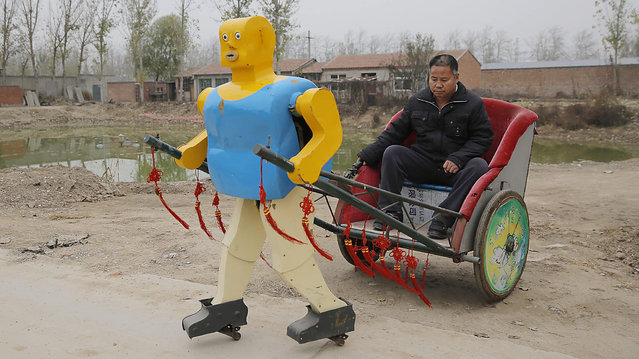
Robot inventor Wu Yulu sits on a rickshaw driven by a robot which he invented in his village in rural Beijing's Tongzhou district, China, 17 November 2016. The 54-year-old Chinese farmer living in rural Beijing's Tongzhou district invented 63 robots in the past 30 years. Wu, who only received primary school education, plans to give up the agricultural work for his robot products. He regularly participates in exhibitions, transfers patent rights and teaches at the university to earn money. (Photo by Wu Hong/EPA)

Robot inventor Wu Yulu sits on a rickshaw driven by a robot which he invented in his village in rural Beijing's Tongzhou district, China, 17 November 2016. The 54-year-old Chinese farmer living in rural Beijing's Tongzhou district invented 63 robots in the past 30 years. Wu, who only received primary school education, plans to give up the agricultural work for his robot products. He regularly participates in exhibitions, transfers patent rights and teaches at the university to earn money. (Photo by Wu Hong/EPA)
Details
21 Nov 2016 10:41:00
A government employee reacts as she is sprayed with disinfectant before entering a government office building to curb the spread of COVID-19 on March 19, 2020 in Pasig city, Metro Manila, Philippines. The Philippine government has sealed off Luzon, the country's largest and most populous island, to prevent the spread of COVID-19. Land, sea, and air travel has been suspended, while government work, schools, businesses, and public transportation have been ordered shut in a bid to keep some 55 million people at home. The Philippines' Department of Health has so far confirmed 217 cases of the new coronavirus in the country, with at least 17 recorded fatalities. (Photo by Ezra Acayan/Getty Images)

A government employee reacts as she is sprayed with disinfectant before entering a government office building to curb the spread of COVID-19 on March 19, 2020 in Pasig city, Metro Manila, Philippines. The Philippine government has sealed off Luzon, the country's largest and most populous island, to prevent the spread of COVID-19. Land, sea, and air travel has been suspended, while government work, schools, businesses, and public transportation have been ordered shut in a bid to keep some 55 million people at home. The Philippines' Department of Health has so far confirmed 217 cases of the new coronavirus in the country, with at least 17 recorded fatalities. (Photo by Ezra Acayan/Getty Images)
Details
07 Jan 2021 00:05:00
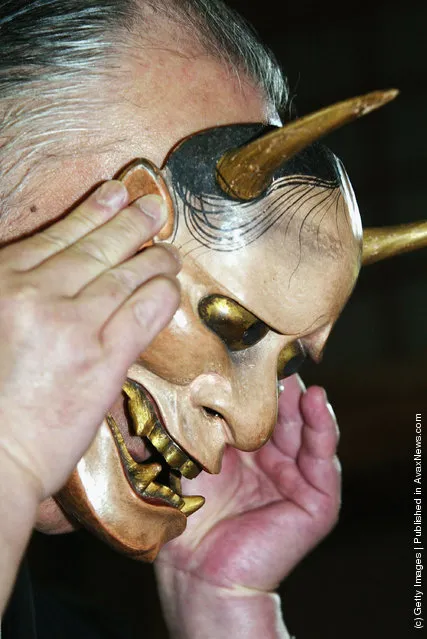
A renowned Noh actor, Otoshige Sakai, demostrates how to put on a Noh mask

“Noh, or Nogaku – derived from the Japanese word for “skill” or “talent” – is a major form of classical Japanese musical drama that has been performed since the 14th century. Many characters are masked, with men playing male and female roles. Traditionally, a Noh “performance day” lasts all day and consists of five Noh plays interspersed with shorter, humorous kyōgen pieces. However, present-day Noh performances often consist of two Noh plays with one Kyōgen play in between”. – Wikipedia

Photo: A renowned Noh actor, Otoshige Sakai, demostrates how to put on a Noh mask, on May 17, 2004 in Tokyo, Japan. (Photo by Koichi Kamoshida/Getty Images)
Details
02 Aug 2011 14:09:00
Dancing Cop Tony Lepore

“Tony Lepore (born October 17, 1947), aka the Dancing Cop, is a retired American police officer who has been entertaining on the streets of Providence, Rhode Island during the December holiday season by directing traffic using a dancing style since 1984”. – Wikipedia

Photo: Retired police officer Tony Lepore performs his dance routine while directing traffic December 14, 2004 in downtown Providence, Rhode Island. Lepore has been entertaining drivers and directing traffic at intersections around Providence for 20 years. He came upon the idea after seeing a “Candid Camera” clip of New York City police officers who flamboyantly directed traffic in the 1950's. (Photo by Darren McCollester/Getty Images)
Details
08 Aug 2011 11:06:00